


1.0 New Survey Reports Most Americans Reject Moral Realism
A recent survey purports to show that most people in the United States reject moral realism (Carneades, 2026). You can find the survey results here and a video discussing them here. I’m always excited to see this kind of research. My primary area of research is experimental metaethics, and specifically the question of whether nonphilosophers are moral realists. So a survey drawing on a nationally representative sample that specifically sought to evaluate whether people are moral realists or not is exactly the kind of study that interests me. I also appreciate that the designers of the survey included a range of metaethical positions, rather than presenting a false dichotomy between e.g., moral realism and moral relativism. As you can see from their findings, they report the following:
Realism 35.9%
Emotivism 43%
Cultural relativism 18.2%
Error theory 3.0%
Since I have dedicated much of my work to arguing against the presumption that most people are moral realists, it would be convenient to herald these findings as a clear and unambiguous indication that most people in the United States are moral antirealists. The report associated with these findings does appear to interpret in this way:
Nearly two-thirds (64%) of Americans reject moral realism, the claim that there is an objective truth about right and wrong. When given the choice between major metaethical theories, a plurality (43%) of Americans said that emotivism, (the view that statements about right and wrong merely express personal sentiments like “boo killing” or “yay charity”) best aligns with their beliefs. Nearly one in five Americans said that cultural relativism best describes their beliefs, with only 3% preferring error theory.
I believe these claims are too confident, and that the measures used in the survey do not support such confident conclusions about the proportion of Americans who endorse or reject moral realism. To explain why I think this, I will present the question posed to survey respondents, then describe the many methodological shortcomings associated with the survey method they used. I did comment on YouTube expressing a willingness to offer critical feedback, which you can see here. I didn’t hear back, but that may not have been the best way to contact them.
2.0 Survey methods
According to the report on the survey:
The best attempt was made to make the statements succinctly represent the four positions, while still being accessible to a general audience without too much philosophical lingo. Of the statements, 1 corresponds to moral realism, 2 corresponds to emotivism, 3 corresponds to cultural relativism, and 4 corresponds to error theory.
Here was the question respondents were given:
When someone makes a statement about right and wrong (like “it is wrong to kill”) your view of that statement is best described as...
Moral statements are objectively true or false (i.e. “killing is wrong” can be true or false in the same way statements like “snow is white” can).
Moral statements express a person’s feelings about an action (i.e. that they don’t like killing).
Moral statements express cultural norms (i.e. that killing is wrong in their culture, but might be ok in other cultures)
All moral statements are false, because they fail to refer to anything real (saying “killing is wrong” is like saying “killing is bgike” it does not mean anything).
3.0 Problems with the survey
This may appear to be a straightforward method for assessing which metaethical position nonphilosophers endorse. However, as we will see, there are many shortcomings with this seemingly simple question. Let’s get into them.
3.1 Forced choice
A forced choice paradigm requires participants to select a response from a restricted range of options. This can introduce a number of methodological problems.
First, if the participant doesn’t endorse any of the positions listed, they have no way to express this. If they respond, whatever choice they make will inevitably reflect a position other than one they actually endorse. For instance, suppose you were given this survey question:
Which of the following fruits is your favorite fruit of all?
▢ Apple
▢ Banana
If neither of these is your favorite fruit, too bad. Most people will choose one anyway. This would then give the impression that almost everyone’s favorite fruit is an apple or a banana, even if this isn’t true. A person may prefer other fruit, or have no preferred fruit at all. Any person whose genuine position doesn’t correspond to one of these options must either not answer, or answer in a way that categorizes them incorrectly. If enough people are categorized incorrectly, you no longer have a valid measure.
This is a serious problem because people will tend to choose from the response options you give even if none of those options reflect their actual position. Why? There are several reasons. The very act of presenting people with a limited range of options frames a question in a way that makes it easier to choose from among those options than to even consider alternatives. It effectively gives people “cognitive tunnel vision,” focusing their thoughts on the options in question and reducing the likelihood or willingness to consider alternatives.
Second, people typically desire to be cooperative when engaging in research. The completion rate for this survey was 43.7%, which is pretty good, but it is less than half of those who received the survey. Ask yourself: who is more likely to be cooperative and wish to appease the authors of a survey by responding in accord with the categories on offer: those who opted to complete the survey, or those who didn’t? Presumably it’s the former. As such, not only are people generally motivated to be cooperative, studies that consist of voluntary respondents invariably self-select for that subset of the population most likely to be especially cooperative. And it is generally uncooperative to refuse to respond to a particular question.
And, in any case, if the data consists only of those who did complete the survey, one’s data may be discounted if they found themselves unable to answer the question because none of the options reflected their views, so not answering may lead one to be excluded from the dataset to begin with. If this is what those running this survey did, then by design the study would exclude anyone who did opt to not respond. This creates a sort of dilemma. Consider the survey question about apples and bananas. Now suppose many people prefer pineapple. Some of those people, out of a desire to be cooperative, may choose apples or bananas, even though neither is their favorite fruit. They are included in the study, but their responses are inaccurate. Others refuse to answer the question. They are subsequently excluded from the analysis, and so their answers effectively don’t count: the final count only includes those who did respond. As a result, researchers would no longer have a true estimate of what people’s favorite fruit is, because their survey, by design, only looks at a limited range of response options.
Another related problem is that when response options are limited, people may interpret the task and the response options in a way that would enable them to give an answer, but it is effectively an answer to a different question. Once again, consider this question:
Which of the following fruits is your favorite fruit of all?
▢ Apple
▢ Banana
If pineapple is your favorite fruit, but you are given a question like this, you may think:
Well, perhaps this is simply asking me which is my favorite of the two. And that’s bananas, so I guess I’ll go with that.
The problem with this line of reasoning is that if we suppose this is not what researchers are asking, then the participant’s response is effectively a response to a different question, yet researchers have no way to know this and will still interpret it as a response to the question they intended to ask, which once again leads to miscategorization. The participant’s response means something like “I prefer bananas over apples,” but the researchers will interpret, and report the response to be “bananas are my favorite fruit out of all fruit.” To relate back to the present survey, note the way they framed the question:
When someone makes a statement about right and wrong (like “it is wrong to kill”) your view of that statement is best described as… (emphasis mine)
This phrasing could be interpreted in a conventionally absolute way, i.e., which one of these is the best overall description of your views. But it could also be interpreted as something like: “of these options, which is the closest to what you think?” If it is interpreted in this way, then many respondents may choose a response that is the best of a bad lot, i.e., the best of the options available, even if it is not what they’d choose if given a wider range of response options or the open-ended ability to express their own views. For comparison, I could easily answer the question: “Between apples and bananas, which is the best?” Whereas it would make no sense to ask me which of the two was my favorite fruit “overall” since the answer is neither. How many participants chose one of the four options as a result of interpreting the question this way? Who knows? That’s a problem.
Finally, note that in addition to forcing participants to choose from a limited set of options, these choices are also categorical: a participant must express unequivocal endorsement of one, and only one position. What if participants feel ambivalent? Or vary in how confident they are? Or are drawn to two or more positions and endorse both to some degree? There is no way to express any of this using a multiple choice question. A great deal of potential information is lost when participants are unable to express mixed, ambivalent, or uncertain stances towards a given response option. Consider, for instance, how one of the most prominent findings in experimental metaethics is that when participants are given the chance to endorse realism and antirealism, they often vary in what kind of response they give depending on the concrete moral issue in question or the specific question that has been posed to them. Studies that prohibit the ability for participants to express mixed, ambivalent, or pluralistic attitudes presume in advance that such possibilities are off the table. This is already a problem. But by structuring questions in ways that prohibit the expression of such attitudes, they can give the misleading impression that the data suggests such attitudes aren’t present in the sample to begin with, thereby reinforcing the very preconceptions behind forced categoricity in the first place. The possibility of mixed, pluralistic, confused, incoherent, ambivalent, or otherwise non-categorical notions is already hinted at by studies (see e.g., Wright, Grandjean, & McWhite, 2013) and have been theorized since early in such research (e.g., Colebrook, 2021; Gill, 2008; 2009; Loeb, 2008). Ruling out even the possibility of detecting such possibilities by design is a mistake.
3.2 Lack of alternative positions
Another problem with the response options is that they do not exhaust the range of possible positions participants could take. Here, the only responses are: moral realism, emotivism, cultural relativism, and error theory. This range is fairly restrictive and somewhat arbitrary. It may reflect some of the more prominent traditions throughout the 20th century, but there’s no particularly good reason to think these are the only positions most participants would favor. For instance, the study omits individual subjectivism, constructivism, prescriptivism, and contemporary expressivist accounts, as well as pluralist accounts.
When participants are not presented with a broader range of possible response options, many will default to those options that are available and choose whichever one is closest. Restricting the range of response options thus can lead to miscategorization of people who would’ve chosen otherwise if it were an option. Previous research in experimental metaethics has shown that this probably already was occurring in early studies. When Beebe (2015) introduced noncognitivism as a response option, it was frequently chosen. Previous studies required participants to respond in ways that presupposed cognitivism. Subsequent studies have likewise often found high rates of noncognitivism when these response options were provided (see Davis, 2021). Would participants choose from among the list of alternative metaethical positions I’ve mentioned here? I suspect so. When Pölzler and Wright (2020) distinguished cultural relativism from individual subjectivism, this is what they found:
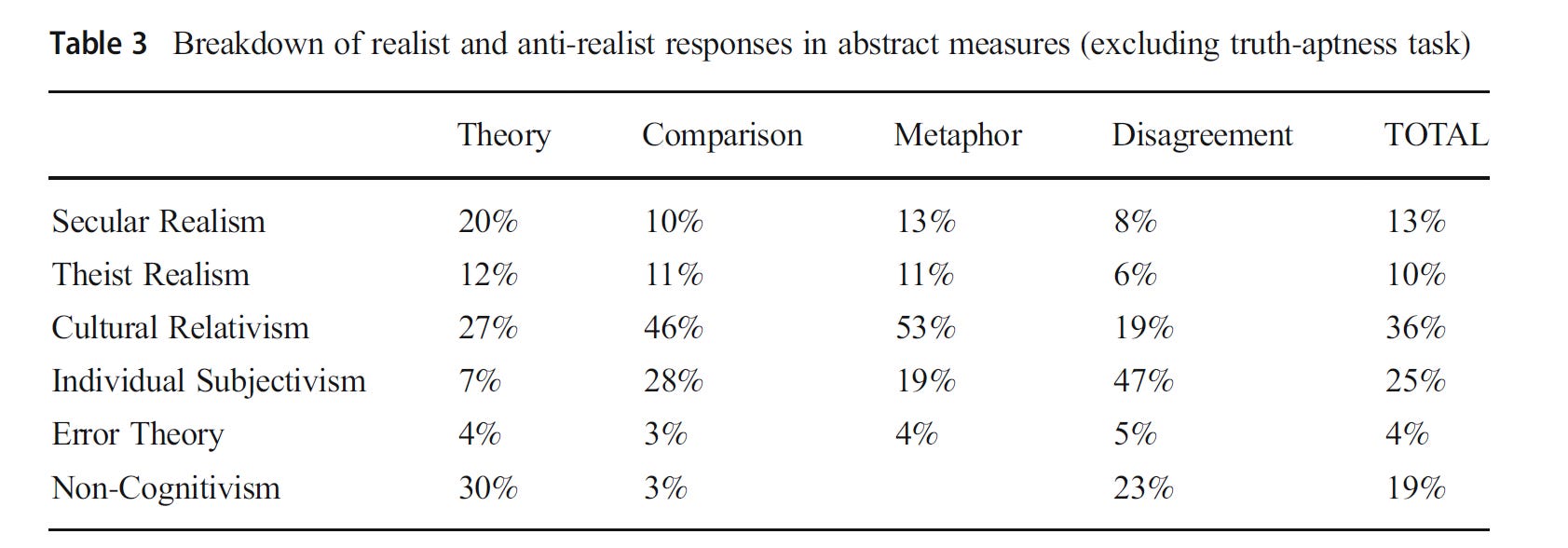
Individual subjectivism ranged from 7-47% across different measures. In three of the four paradigms it was a very prominent response: 19%, 28%, and 46% are by no means small proportions. It was the second most common response for the comparison and metaphor task and by far the most common for the disagreement task, and took up 25% of the total responses overall. Given this, I see little rationale for excluding it from the present survey. Take, for instance, this remark on the potential consequences of a restricted, closed range of options (i.e., the use of a forced choice paradigm) from Krosnick and Presser (2010). For context, a closed question is one that presents participants with a restricted range of response options, while an open question allows the participant to respond using their own words:
If the list of choices offered by a closed question omits objects that a significant number of respondents would have mentioned to an open form of the question, even the rank ordering of the objects can differ across versions of the question. Therefore, a closed categorical question can often be used only if its answer choices are comprehensive. In some cases, identifying these categories will require a large-scale pretest of an open version of the question. In such instances, it may be more practical simply to ask an open question than to do the necessary pretesting.
Researchers who want to get a handle on the metaethical positions of nonphilosophers should engage in considerable pretesting in advance to discover which positions emerge organically in the population.
3.3 Lack of subcategories/variants
The inclusion of emotivism as the only noncognitivist response option is also rather odd. Emotivism is the earliest, crudest form of noncognitivism out there. Does that make it the worst? By no means; I’m not antagonistic towards the view at all. But it is just one of several noncognitivist positions. Their response options not only fail to include whole categories of alternative positions, such as constructivism, but exclude subcategories and variants of existing positions that may have differential appeal were they more fleshed out. Subjectivism, mentioned in the previous section, arguably falls into this category, in that it reflects one form of relativism that indexes moral claims to individuals rather than cultures. Arguably, constructivism and both cultural relativism and individual relativism fall into the broader category of stance-dependent cognitivist accounts, which form a supercategory of antirealist accounts which maintain that moral claims are propositional and some are true in a way that depends on stance.
The survey in question only provides one example of noncognitivism/expressivism, emotivism, and only one form of stance-dependent cognitivism, cultural relativism. By excluding other forms of noncognitivism and stance-dependent cognitivism whole positions are left off the table for participants to consider. Realism, too, can be subdivided into naturalist and non-naturalist accounts. While one may simply wish to know whether people are realists or antirealists, the way realism is framed in the survey doesn’t distinguish between the two. If participants associate moral realism with religiosity or a more non-naturalist or supernatural conception of morality, they may be disinclined to select it merely due to a failure to consider the possibility of naturalist moral realism. Of course, it’s a separate question entirely whether and to what extent they interpret any of the stimuli as intended well enough to even consider this possibility, but in the absence of a fuller explanation of what possibilities are available, participants have little choice but to rely on assumptions about what the response options they’re given consist in or imply, and many people may spontaneously associate moral objectivism (or realism) with religious belief (this isn’t merely speculative; participants in my studies often do just this). Excluding naturalism as a response option could thus inflate the number of people who give antirealist responses.
Finally, the response options don’t distinguish agent and appraiser relativism. I discuss this distinction here. This is a serious problem because the two have quite different implications. The cultural relativism item’s wording (including the parenthetical) seems to refer to agent relativism, which would result in the omission of appraiser relativism as a potential stance participants could express.
The problem of excluding variants is an issue Pölzler and Wright (2020) sought to address in their research and, as their findings indicate, the overall picture of what metaethical position people favor is more distinct and robust when you include those options. More importantly, a broader range of options can mitigate the amount of miscategorization.
3.4 Crowding out of alternatives
Another problem with this study is that there is a substantial asymmetry in the response options: there is only one realist response option, and three antirealist response options. This asymmetry in response options could skew the overall pattern of responses towards a larger proportion of people who appear to favor antirealism rather than realism. There are simply more opportunities for subtle features of wording, random guess, confusion, or any other factors contributing to measure error to skew results towards antirealism. This is just one small way in which subtle features of design can skew results in a particular direction and, sure enough, this is consistent with antirealist responses comprising the majority of respondents.
3.5 Questionable use of examples & metaphors
Each response option also includes a parenthetical with examples/additional information. While this could enhance understanding of the respective response option, it may instead serve to mislead participants in ways that could lead them to choose or avoid choosing that response option for unintended reasons. Let’s have a look at each of the parentheticals:
When someone makes a statement about right and wrong (like “it is wrong to kill”) your view of that statement is best described as…
Objectivism
Moral statements are objectively true or false (i.e. “killing is wrong” can be true or false in the same way statements like “snow is white” can).
What, exactly, does it mean for killing to be wrong “in the same way” as a statement like “snow is white”? And how will participants interpret this comparison? As David Moss helpfully noted, the perception that snow is white is (at least to some extent) response-dependent, in that the appearance of snow depends on lighting conditions and other variables that could be perceived differently by different people and under different circumstances, unlike e.g., the chemical composition of water. It’s both unclear how they’d tend to interpret this and whether there’d be significant interpretative variation between participants. If they interpret this in unintended ways, this would invalidate their responses. And if there are significant variations in how participants interpret the question, then the results we get won’t be consistent from one participant to another. The net effect of the comparison might enhance intended interpretations, have little or no effect, or actively undermine them. It’s not clear why we should presume the parenthetical helped in this particular case. That is, itself, an empirical question.
Emotivism
Moral statements express a person’s feelings about an action (i.e. that they don’t like killing).
This may mislead participants. To express that you don’t like killing could be construed as a propositional claim rather than as an emotional expression, in which case this item may prompt at least some participants to conflate emotivism with individual subjectivism.
Another problem is to say that you “don’t like” killing may pragmatically imply a lack of stronger opposition. For comparison, imagine a man says:
I like my wife.
The social expectation is for this man to say he loves his wife. As such, for him to say he likes his wife will, in many contexts, pragmatically imply that he doesn’t love her. Likewise, some people may interpret the notion of merely saying you “don’t like” killing to fail to convey an appropriately robust attitude of repugnance and opposition.
Cultural relativism
Moral statements express cultural norms (i.e. that killing is wrong in their culture, but might be ok in other cultures)
This is ambiguous between a metaethical reading and a descriptive reading. Killing can be considered wrong in one culture but not another without the participant having to think it is in fact wrong relative to one set of standards but not wrong relative to another. Unintended descriptive interpretations were a common finding when I prompted participants to explain their answers to a variety of existing metaethics stimuli, or to offer their interpretations of what such stimuli meant. Descriptive readings remain an attractive unintended interpretation and may have influenced how some participants interpreted this particular response option.
Another common tendency among participants is to interpret categories of actions such as stealing or killing as right or wrong depending on the context, e.g., it may be okay to kill in self-defense but not to take someone’s wallet. The example provided here may facilitate or increase the rate at which participants interpreted this response option to indicate a potential sensitivity to context, which is orthogonal to the relativism/non-relativism distinction. This may have in turn inflated the tendency for participants to choose this response option, both because sensitivity to context is something many people may favor, and because it is comparatively more attractive than alternative response options that, by implication, would suggest comparative insensitivity to context (thanks to David Moss for emphasizing this possibility).
Another problem is that this item strongly implies agent relativism rather than appraiser relativism. Since agent relativism is often interpreted in such a way so as to indicate that one must regard societies with practices contrary to one’s moral standards as morally acceptable, it is often the far less appealing of the two forms of relativism. This could lead fewer participants to choose this option.
Finally, the specific use of killing may throw some people off, as participants may be disinclined to specifically choose a response option that would indicate that they are okay with killing, and if they think it’s not plausible some societies would be okay with killing, this may also discourage favoring this response option. More generally, if researchers provide examples of cultural variation in moral standards, choosing variation in whether killing is okay may not be the best option. Research shows that participants are more likely to favor antirealist or relativist responses for moral issues that are considered controversial or that plausibly vary within and across populations, e.g., abortion, whereas they are far less likely to favor such response options when the matter is one for which there is little controversy. And without context, it’s likely most people would be opposed to people or cultures that think “killing” without qualification is acceptable.
Error theory
All moral statements are false, because they fail to refer to anything real (saying “killing is wrong” is like saying “killing is bgike” it does not mean anything).
First, note the asymmetry between this item’s use of “all” and other items. This makes this item especially strong and definitive relative to the others. It also rules out any inclination participants may have towards some degree of pluralism or openness to alternative metaethical stances by default. This difference may have made this item especially unappealing, which could partially explain why it was chosen at an almost negligible rate (thanks to David Moss for making this point).
Error theory holds that moral claims contain an implicit commitment to the existence of stance-independent moral truth. But since there is no such truth, such claims fail to refer to a genuine phenomenon. For comparison, suppose a person believed that moral claims expressed God’s will, so statements of the form “X is wrong” meant something like “X is against God’s rules.” If so, then a statement like this:
Stealing is wrong.
…would mean something like:
Stealing is against God’s rules.
If God does not exist, then it’s not true that stealing is against God’s rules, and thus “Stealing is wrong” would be false. Just so, if moral claims like
Stealing is wrong.
…mean:
Stealing is stance-independently wrong.
…but nothing is stance-independently wrong because there are no stance-independent moral facts, then the statement “Stealing is wrong” would be false. It would not thereby be nonsensical. Yet the parenthetical included in this study implies that error theory holds that moral claims don’t mean anything, by comparing the notion of right and wrong to gibberish strings of nonsense letters. This is not an accurate characterization of error theory. Unfortunately, then, the parenthetical included with this item provides false and misleading information about what error theory would commit the respondent to. I don’t know if this influenced response rates, but it’s important when presenting a metaethical view to present that view accurately.
3.6 Use of technical terminology & ambiguous phrasing
Another problem with this survey is the use of technical terms or terms and language that may prompt unintended interpretations. The most serious of these is the use of the term “objective”. Objective is a polysemous term with a variety of distinct colloquial meanings. It can be understood to mean:
Impartial judgment (“The judge was objective”)
Focused on the facts, not relying on personal presumption (“The detective didn’t rely on hunches because they were objective in their work”)
Capable of being measured by publicly evaluable standards (“They used an objective, 5-point scale to measure performance”)
Absolute, or exceptionless (“It is objectively wrong to torture people, meaning that there is never any circumstance where it’d be acceptable”)
Universal, or a moral rule that applies to everyone (“It is objectively wrong to commit murder, regardless of who you are or what culture you are from”)
…and there are likely other interpretations. The only way for this item to serve as a valid reflection of moral realism is if most participants specifically and exclusively interpreted it to mean something like “stance-independent.” Yet data shows that most participants don’t interpret use of the term “objective” this way. Instead, they consistently interpret “objective” in a variety of unintended ways. In fact, when I asked participants explicitly what it meant for morality to be objective or for specific moral claims to be objective, many interpreted this as the opposite of what objective meant, offering responses that indicated that “objective” meant something like relative or non-objective. Still others interpreted it in the various ways described above. What most didn’t do is interpret “objective” to mean something like “made true in a way independent of the goals or standards of individuals or cultures.” As such, the item used to reflect moral realism may not have been interpreted as intended by a substantial proportion (and perhaps even a majority) of respondents.
To a lesser extent, terms that may have fairly distinct meanings to philosophers familiar with the use of those terms in a metaethical context may be less clear to untrained survey respondents. What, exactly, is a “statement”? What does it mean to “express” a feeling or norm? While philosophers may share a common understanding of these terms, it’s not clear nonphilosophers do, or that, to the extent that they do, their understanding of these terms aligns with philosophical usage.
Finally, the error theory item includes the notion of a statement failing to refer. This is a technical notion that nonphilosophers may be unfamiliar with, both with respect to the terminology used to characterize this notion and the notion itself. There are additional complications with the error theory item I address below.
3.7 Lack of face validity in noncognitivist response option
One of the most serious problems with this survey is that the “emotivism” response option is not a face valid measure of emotivism. Here is how the item reads:
Moral statements express a person’s feelings about an action (i.e. that they don’t like killing).
The problem is that emotivism is the view that the primary or exclusive function of moral claims is to express emotions, and that, as such, they don’t also express propositional content. In other words, moral claims may appear superficially to express propositions because they take the form of a declarative sentence, but in fact they function only to express nonpropositional content, and, in particular, the emotions of the person who makes the moral claim. So someone who says:
Murder is wrong.
…is expressing an emotional state of opposition to murder, but is not expressing any claim that could be evaluated as true or false.
Yet the response option used to reflect emotivism doesn’t make any of this clear. Instead, it simply holds that moral claims express a person’s feelings about an action. This is, in fact, consistent with every other realist and antirealist position. Literally all of them. Consider moral realism. Moral realism is a cognitivist position, according to which moral claims assert propositions that can be evaluated as true or false. But this is not inconsistent with, nor does it preclude by implication, that moral claims don’t also express a person’s feelings about an action. A moral realist could intend to assert and interpret others to be asserting true moral claims when they say things like:
Murder is wrong!
…while simultaneously also taking those claims to pragmatically convey the speaker’s emotions as well. In fact, most moral realists probably do interpret one of the most common secondary functions of moral claims to convey a speaker’s emotions. It’s just that those emotions are conveyed alongside the propositional content of the statement. The exact same holds for error theorists and relativists, both of whom likewise can and in most cases probably do regard moral claims as capable of expressing nonpropositional emotive content alongside their respective semantic analyses of the moral statements in question. What distinguishes emotivism isn’t simply that it treats moral claims as expressing emotions, but, roughly, that the only express emotions.
Since this isn’t clear to participants, a disproportionate number of participants may have favored this response option because they considered it quite obvious that moral claims do typically express one’s feelings towards the action in question. Of course they do!
At the same time, people don’t interpret response options in isolation from one another. Instead, they interpret response options in relation to other response options. It is only natural to interpret the other response options, which don’t mention the expression of one’s feelings, as pragmatically implying that moral statements don’t express one’s feelings. And since this is rather implausible, many participants may have been drawn to this response option because it conveyed something that is clearly true about moral statements (i.e., that they express feelings), while other response options implied they didn’t.
It is important to note that when pointing out biases, those biases should account for the pattern in the data specifically in a way that accords with whether the bias should lead to an inflated or reduced rate of participants selecting a specific response option. Since I think this is one of the most serious shortcomings of this survey, and because it would lead to the prediction, if it is a serious problem, of a higher rate of emotivist responses, what do we find? Sure enough: an extremely high rate of people choosing emotivism of 43%, nearly half the participants. I suspect this high rate of “emotivism” is due in large part to this particular problem.
3.8 Error theory item is unclear and too technical
The error theory item also exhibits another problem. Note the wording of the item:
All moral statements are false, because they fail to refer to anything real [...]
What exactly does it mean to say that they fail to refer to anything “real”? The most standard form of error theory is one which holds that ordinary moral claims are committed to some form of stance-independence, objective prescriptivity, or some other implicit commitment to a metaphysical thesis. Error theorists then maintain that because the metaphysical thesis is false, the claims in question are systematically committed to those false presuppositions and are thus uniformly false. None of this is adequately conveyed by telling participants that moral statements fail to refer to “anything real.” The notion of “anything real” is too vague and underdescribed to sustain the distinctive features of error theory that make clear why the error theorist would think all moral claims are false. In fact, “anything” is so open-ended it may appear to many participants to be obviously false.
What error theorists specifically hold is that first-order moral claims involve a commitment to stance-independence, such that insofar as moral claims are intended to refer to stance-independent moral facts, and there are no such facts, the claims in question fail to refer to something that exists. What this does not mean is that error theorists think that moral claims don’t refer to anything real. Why? Because moral claims often include nonmoral, descriptive content. For instance, take the claim that “it is wrong to harm innocent people.” The only thing the error theorist denies is that this statement is true insofar as, and only to the extent that, it purports to refer to a stance-independent moral fact. However, the error theorist is not also obliged to deny that harm or suffering are real. Likewise, take thick moral concepts like “cruelty” or “courage.” These concepts include both normative and non-normative content. Even if one denies that the normative content, when distilled from these statements, fails to refer due to a commitment to stance-independence as a feature of the semantics of normative moral discourse, this doesn’t mean the descriptive aspects of the moral claim fail to refer to anything real: they do refer to real, descriptive features of people.
More generally, moral claims often involve multiple implicit presuppositions, which include both whatever implicit metaethical theses are involved in the claim (e.g., stance-independence), and any presumptive descriptive content, including any respect in which certain ontological considerations are a legitimate precondition for the claim in question. The notion that suffering is morally bad, for instance, presupposes the existence of minds and their capacity for suffering, and antirealists will generally agree these are real.
Since the statement doesn’t specify what, exactly, isn’t “real,” whoever employs this survey leaves interpretation of this remark at the mercy of whatever assumptions respondents to the survey make, which may or may not correspond to researcher intent (which is, presumably, an exclusive reference to moral claims exhibiting a commitment to stance-independence).
Note, by the way, that error theory in this form was devised specifically as a rejection of non-naturalist moral realism. If one took the semantics of ordinary moral discourse to involve a commitment to naturalist moral realism, standard forms of error theory wouldn’t apply. So are participants expected to somehow interpret “fail to refer to anything real” to specifically involve a rejection of non-natural metaphysical properties?
This seems like a tall order. And yet this is compounded by further issues with this response option. Participants must implicitly (or explicitly) recognize that error theory involves a two-step process: a commitment to both a semantic thesis about what ordinary moral claims mean and a metaphysical thesis predicated on this. This, too, is a tall order.
Finally, participants must recognize on some level that “All moral statements” specifically refers to all first-order moral statements, specifically. Nonphilosophers may not appreciate this distinction, and take “all” to include metaethical statements, or descriptive moral statements, or both a moral claim and the negation of that claim, which would make error theory absurd and nonsensical. More likely few if any of these distinctions would be salient, but even so it’s not likely they’d appreciate the notion of the systematic falsehood of a distinctive subset of “all” claims implicitly delineated by the notion of “all moral statements.”
3.9 Variation based on paradigm
Even if we set aside all of these issues, it would be too quick to move straight from the results of this one survey to any confident conclusions about what most Americans think. Pölzler and Wright’s (2020) survey also found a majority favored moral antirealism, but their participants tended to favor cultural relativism and individual subjectivism over noncognitivism. Notably, the specific antirealist position participants favored varied considerably across the paradigms they employed. For instance, 30% of the participants chose the noncognitivism response in one task, 23% in another, but only 3% in a third. That’s quite a wide range. Individual subjectivism exhibited an even greater cross-paradigm variation, with 7% favoring it according to one measure, but 47% according to another. One can look across the paradigms other researchers have employed (e.g., Beebe, 2015; Davis, 2021; Sarkissian et al., 2011; Zijlstra, 2023) and readily observe that rates of realists and antirealists, and the specific antirealist positions participants favor, vary considerably across different measures. Such wide variation should lead us to question whether any one of these studies in particular should be trusted as an accurate estimate of the true proportion of realists and antirealists within a given population.
4.0 Conclusion
Given the volume of methodological shortcomings with the methods used in this survey, I do not believe we should conclude with any significant level of confidence that most Americans reject moral realism.
Acknowledgements
Thanks to David Moss for commentary and suggestions on an earlier draft of this article.
References
Beebe, J. (2015). The empirical study of folk metaethics. Etyka, 50, 11-28.
Carneades (2026). National Survey of Philosophical Viewpoints | March 2026. Experimental Philosophy. https://www.carneades.org/post/national-survey-of-philosophical-viewpoints-march-2026
Colebrook, R. (2021). The irrationality of folk metaethics. Philosophical Psychology, 34(5), 684-720.
Davis, T. (2021). Beyond objectivism: New methods for studying metaethical intuitions. Philosophical Psychology, 34(1), 125-153.
Gill, M. B. (2008). Metaethical variability, incoherence, and error. In W. Sinnott-Armstrong (Ed.), Moral psychology: The cognitive science of morality (Vol. 2, pp. 387-402). Cambridge, MA: MIT Press.
Gill, M. B. (2009). Indeterminacy and variability in meta-ethics. Philosophical Studies, 145(2), 215-234.
Krosnick, J. A., & Presser, S. (2010). Question and questionnaire design. In P. V. Marsden & J. D. Wright (Eds.), Handbook of survey research (2nd ed., pp. 263-314). Emerald Group Publishing Limited.
Loeb, D. (2008). Moral incoherentism: How to pull a metaphysical rabbit out of a semantic hat. In W. Sinnott-Armstrong (Ed.), Moral psychology: The cognitive science of morality (Vol. 2, pp. 355-386). Cambridge, MA: MIT Press.
Pölzler, T., & Wright, J. C. (2020). Anti-realist pluralism: A new approach to folk metaethics. Review of Philosophy and Psychology, 11(1), 53-82.
Sarkissian, H., Park, J., Tien, D., Wright, J. C., & Knobe, J. (2011). Folk moral relativism. Mind & Language, 26(4), 482-505.
Wright, J. C., Grandjean, P. T., & McWhite, C. B. (2013). The meta-ethical grounding of our moral beliefs: Evidence for meta-ethical pluralism. Philosophical Psychology, 26(3), 336-361.
Zijlstra, L. (2023). Are people implicitly moral objectivists?. Review of Philosophy and Psychology, 14(1), 229-247.
Is there a survey on this that you consider good methodologically at least? I was having a think about what questions I'd ask and that was quite fun.
Loved this