


1.0 Introduction
In their article “God and moral knowledge,” Crummett and Swenson (2019) claim that we have moral knowledge, and explore the implications of this claim for naturalism (which they describe as “the view that all that exists is the natural world” (p. 33). According to C&S, naturalism encounters problems when accounting for moral knowledge that theism can solve. Their goal here, it seems, is to leverage the alleged existence of moral knowledge to provide evidence of God.
I’m not a naturalist and I don’t think we have moral knowledge. This leaves me with little motivation to respond to much of what they have to say. Instead, I think the best response is to simply deny that we have moral knowledge. They make a case for moral knowledge in the first section of their response. After addressing this, I turn my attention to their discussion of moral skepticism.
2.0 Moral knowledge
C&S’s case for moral knowledge begins with the following remark:
Our argument requires that human beings have lots of moral knowledge. We certainly grant that humans are fallible about morality. But almost everyone thinks they know a fair amount about it. For example, you probably think you know facts like “hurting people just for fun is morally bad” and “slavery is morally wrong.” (p. 36)
According to C&S, “almost everyone” thinks they know a fair amount about morality.
Note that claims about what “almost everyone thinks” are empirical questions. They present absolutely no empirical evidence for this claim. They present no arguments at all. They simply assert that almost everyone thinks this.
Note that C&S don’t explicitly state that they are moral realists, or that the knowledge in question is knowledge of stance-independent moral facts until later on, where they say this:
Note that we are not currently assuming that morality is objective. We are just claiming that there is moral knowledge. If some form of moral relativism or subjectivism is true, people still know something about morality. It’s just that what they know about is a subjective domain. (p. 36)
I would say that I know “hurting people just for fun is morally bad” and “slavery is morally wrong.” However, the sense in which I know these things is consistent with non-relativist antirealism. I don’t claim to have the kind of moral knowledge C&S think people have. Non-relativist antirealists are not without the resources to claim to have “moral knowledge,” unless, and only unless, “moral knowledge” is defined in such a way so as to exclude them by definition; but antirealists are not obliged to accept such characterizations of moral knowledge, anymore than they’re obliged to accept realism.
Their remarks also carry a degree of normative entanglement. Who is going to disagree that hurting people for fun is immoral, or that slavery is wrong? Only sadists and psychopaths. You can say and think these things are wrong without thereby believing you have moral knowledge of the sort they think people have. They go on to say:
There are some holdouts. Moral skeptics deny that we have any moral knowledge. But this is a rare and extreme view, and the endorsement of moral knowledge is part of common sense. (p. 36)
Note the language here: “holdouts,” as though we’re a few scattered, disheveled rebels clinging to a failed revolution. This is a framing device to depict antirealism as an undesirable fringe view. Realists often employ these kinds of framings to make antirealist views look unappealing independent of the merits of the view. Antirealists can and should resist these framings where warranted.
Their characterization of skepticism presumably excludes relativists, since it seems only to involve the denial of both relativistic and non-relativistic moral facts. It’s hard to get good data on how many people reject both, but about 5.3% of respondents to the 2020 PhilPapers Survey endorse error theory, and another 10.6% endorse expressivism. That leaves us with at least ~16% moral skeptics. That’s not a lot, but it’s not that low, either. This low proportion also presents a misleading picture of the philosophical landscape: constructivists, relativists, and people who endorse “other” views may either (a) not believe we have moral knowledge or (b) believe we have moral knowledge of such a kind so different from the kind C&S believe we have it’s a bit strange to lump them all together.
Next, they explicitly claim the endorsement of moral knowledge is “part of common sense.” Again, this is an empirical claim, and again, they provide no arguments or evidence for this claim at all. They then add:
If something seems obvious to you and nearly every other reasonable person, then that’s a powerful reason to believe it. (p. 36)
This only compounds the problems with their remarks. Not only do they claim (without any arguments or evidence) that “almost everyone” thinks they have moral knowledge, but that it is “obvious” to these people. This involves further empirical claims about the epistemic status and/or phenomenology of “almost everyone” that they also present absolutely no arguments and evidence for.
They then add the qualifier that restricts this to every other “reasonable person.” Wait, what? When did they establish that what almost everyone thinks is reasonable? Here, they help themselves to the further assumption that a belief in moral knowledge is “reasonable.” So am I unreasonable for not thinking it obvious we have moral knowledge? If so, why?
What they present here are a series of unsupported assertions. They might be true. They might have good arguments for them. But if they do have good arguments for these claims, they simply don’t present them.
Unfortunately, things only get worse from here. It’s like they are slowly dialing up the rhetoric:
Our argument will make the case that naturalists may be forced to abandon either their naturalism or their belief that we have moral knowledge. The idea now is just that, given how clear the existence of a substantial amount of moral knowledge is to most sane people, abandoning belief in it should be done only as a last resort. (p. 36)
I reject realism and relativism. Their remarks imply I’m probably not sane, and that anyone who thinks like me is not sane, either. Well, almost anyone. They mysteriously include a qualification of “most.” Maybe it’s not clear to some of us, but we’re still sane? I can only hope I make the list! Even if I do, it’s a shame that the rest of my associates are off frothing and gibbering and speaking to clouds.
Note that, once again, they present no arguments, evidence, or reasons to think that sane people believe we have moral knowledge, but people who don’t are probably insane. It’s simply asserted. They also don’t clarify what they mean by “sane.” If they mean this literally, then the claim would be more than a little absurd. Most moral skeptics neither froth nor gibber (most of the time, anyway). If they mean this in some non-literal respect, e.g., “hold an extremely implausible position,” or something along those lines, why the hyperbolic language? If they mean it literally, it’s false. If they mean it non-literally, this kind of hyperbolic and derogatory way of describing their opposition is disrespectful and unprofessional, and has no place in a serious publication. This is especially given that they don't put any effort into supporting the claim.
I find remarks like this to be revealing of how moral realists often regard moral skeptics. I’m glad I found a published instance of such a remark. I often point out how moral realists run roughshod over antirealists (or in this case, moral skeptics, which is a bit more narrow), denigrating us and depicting us as evil or insane. Here, I have a genuine, published instance of them explicitly doing so.
C&S also claim that prominent atheists believe we have or can acquire moral knowledge. They mention Sam Harris as an example, and, fair enough, Harris is a good example. But they also mention Dawkins, who they say “criticizes the God of the Old Testament as unjust. Clearly, one can’t justifiably condemn teachings or practices as immoral if one doesn’t have a good idea of what sorts of things are immoral.” (pp. 36-37) This is a stretch. Moral skeptics can and do make moral claims and condemn moral actions. Dawkins’s remarks do not require that Dawkins believes we can have moral knowledge. Moral skeptics don’t take themselves to be making knowledge claims when they say things like Dawkins (at least, not the sort that would make them non-skeptics), but they do say these sorts of things.
3.0 Moral intuitions
Next, C&S say that:
Our moral beliefs ultimately depend, in some way, on what philosophers call “moral intuitions.”(p. 37)
Mine don’t, and I doubt most people’s do, either. If their claim is that moral beliefs (a psychological term) depend on moral intuitions (another psychological term), I’d be interested in seeing the empirical research that supports this claim. I don’t think there is much in the way of a well-developed account of moral psychology that would support the notion that moral beliefs depend on moral intuitions. If this isn’t an empirical claim, I’d be interested in knowing what kind of claim it is. Talk of “beliefs” and “intuitions” sounds like empirical talk to me. But when I say these sorts of things, philosophers often object.
It’s a have-your-cake-and-eat it situation; they often seem to want to help themselves to armchair claims about how people think but don’t want to treat such claims as empirical. Whatever the case, it’s a dilemma: if such claims are at least partially empirical claims, I question whether there’s good evidence to support these claims. If they’re not, then I question what they’re talking about and whether they’re making defensible non-empirical claims. Personally, I regard this intuition talk as, at best, underdeveloped pseudopsychology. At worst, it at least partially consists of mysterious, a prioristic armchair assumptions that I would be even more skeptical of than if such claims were primarily empirical. Either way, I don’t grant that C&S are entitled to claim that moral beliefs depend on intuitions. What they go on to say gives me even more cause for worry:
When we consider certain moral claims, we can just “see” whether they’re true: we can see that (at least absent extenuat- ing circumstances) hatred is bad, virtue is good, killing innocent people is wrong, etc. (p. 37)
The use of “see” in scare quotes should be a red flag. We see whether they’re true? Why should I believe C&S, or anyone else, can “see” whether a moral claim is true? What does that even mean? What we’re given here is a bald assertion that people possess a mysterious power for detecting moral truth that is described almost entirely in terms of an undeveloped metaphor for visual perception. You can’t actually see moral truth. So what are people doing when they claim to “see” moral truths? What’s going on, psychologically? How did C&S determine that people have this ability? Does it rely on specific regions of the brain? Do you have to train to use it properly? How do you know if it’s working or not? Once again, notice that they present almost nothing by way of an explanation, argument, or evidence for such a claim. They simply assert that we can “see” moral truth.
C&S go on to claim that it is difficult to reconcile our purported capacity for moral knowledge with naturalism. I’m not interested in that dispute. What I am interested are the handful of responses they suggest that a naturalist could take: the naturalist could appeal to (1) subjectivism, (2) nihilism, or (3) defend a moral realist account that is consistent with naturalism.
4.0 Moral relativism
One solution to the problem they discuss is to endorse some form of what they call moral subjectivism. They go on to describe a specific form of what they call moral relativism. They then narrow this further to a form of cultural relativism. They state that cultural relativism:
[...] in its simplest form, claims that actions are right just in case the standards of the society in which they’re performed says that they’re right, wrong if those standards say they’re wrong, etc. (p. 38)
In describing this view, they add:
They [cultural relativists] aren’t just making the obvious claim that which actions people think are right or wrong can vary from culture to culture. What they claim is that which actions really are right or wrong vary depending on cultural standards, even when the actions are performed in otherwise equivalent situations. (p. 39, emphasis original)
“Really are” in what sense? It’s not clear from this article.
4.1 Relativism as a la carte realism
“Really are” could be interpreted to mean in a sense at least somewhat akin to moral realism: that the standards of different cultures determine what individuals within those cultures “have reason” to do, and somehow “give” them reasons, obligations, and so on. Critics of relativism sometimes describe forms of relativism like this, as though relativism were a kind of a la carte realism, where cultures or individuals, in virtue of their standards or values, “fix” the moral facts that bind them something like relativism, such that the moral facts have something like the authority over people’s actions that realists think stance-independent moral facts do. They might mean something like this, but I wouldn’t bet much on it. If they do, then such a realism may be unappealing. But relativists aren’t obligated to hold a view like this. They could instead take a far more deflationary approach, and regard relativism as an accurate descriptive account of ordinary moral semantics that has few, if any, substantive practical implications about how people ought to act (more on this below).
4.2 Agent and appraiser relativism
They also don’t disambiguate agent and appraiser relativism. I don’t know if they have one or the other or both in mind, or whether their characterization is indeterminate. It looks to me more like agent relativism, but it’s not clear.
This distinction is important because these forms of relativism carry different implications, and the sense in which at least some forms of appraiser relativism cash out what it means for something to “really” be good or bad, right or wrong, is so reductive that it’d be a bit weird to describe these views as holding that things “really are” right or wrong without being clear about what this commits the relativist to.
If you’re an agent cultural relativist, then whether an action is right or wrong is determined by the cultural standards of the members of a culture performing a particular action. So if members of a culture practice child sacrifice, then it is morally permissible for them to do so in such a way that everyone (you included) must regard their practice of child sacrifice as morally permissible. Cultures “fix” which actions are right or wrong for them in such a way that this rightness or wrongness is binding on everyone. As Quintelier et al. (2014) put it, “According to agent moral relativism, each moral statement about a specific act performed by a specific agent is either true or false, irrespective of who is appraising the act.” On such a view, if someone performing an action considers it permissible (agent individual subjectivism) or their culture considers it permissible (agent cultural relativism), then it is permissible, full stop. You (the appraiser) would be obliged, under this conception of relativism, to regard their actions as permissible. This is the form of relativism according to which, if someone thinks it’s okay to torture babies, then you must agree that it’s okay for them to torture babies. This is a form of relativism realist critics often target, because it carries just this unpalatable implication.
If, on the other hand, you’re an appraiser cultural relativist, then you believe we should judge the practices of members of different cultures according to our own cultural standards. This is because the appraiser relativist evaluates moral standards according to the standards of the culture of whoever is evaluating the act in question, not the culture of the person performing the act. Thus, the only sense in which it would be true it “really is” permissible to practice child sacrifice in a particular culture would be relative to that culture's standards, but this doesn’t obligate you or other members of your culture to consider the action permissible. It would be permissible relative to their standards but (if your culture is against child sacrifice) impermissible relative to your own.
Without disambiguating these senses of relativism, critics of relativism can give the misleading impression that if you’re a “cultural relativist” and some society approves of slavery or child sacrifice, that you must find it acceptable for them to do so. Since this is true for agent relativism but false for appraiser relativism, whether this implication follows depends on which type of relativism you’re talking about.
4.3 It seems a bit like agent relativism
I’m not sure Crummett and Swenson specifically have agent cultural relativism in mind, but it does look a bit like they do to me. They say that:
But relativism of this sort is extremely implausible, and almost everyone rejects it once they understand its implications. It entails that if a society says that slavery is okay and fighting to end slavery is wrong, then slavery there really is okay, and people who fight to abolish slavery are acting wrongly. Clearly, this contradicts how things seem. Someone who fights to end slavery in a society that views it as a good thing is a moral visionary, not a wrongdoer. Because cultural relativism has false implications, it must be false. (p. 39, emphasis mine)
This passage doesn’t fit appraiser cultural relativism, since, according to appraiser cultural relativism, whether a culture’s practices are morally right or wrong turns on the cultural standards of the agent evaluating the culture’s practices, not on the standards of the members of that culture engaging in the practice. If you’re a cultural appraiser relativist, and another culture “says that slavery is okay,” this does not mean that slavery “really is” okay for that society; it means that slavery permissible relative to that culture’s standards, but it does not entail that you, in appraising it, must judge that culture by its standards; instead, you judge it by your culture’s standards.
Given this, I think the most plausible interpretation is that C&S are describing cultural agent relativism. For whatever reason, critics of relativism often depict “relativism” as though only agent relativism is on offer. This is strange. Consider how the distinction is characterized in the Stanford Encyclopedia of Philosophy:
[...] that to which truth or justification is relative may be the persons making the moral judgments or the persons about whom the judgments are made. These are sometimes called appraiser and agent relativism respectively. Appraiser relativism suggests that we do or should make moral judgments on the basis of our own standards, while agent relativism implies that the relevant standards are those of the persons we are judging (of course, in some cases these may coincide). Appraiser relativism is the more common position, and it will usually be assumed in the discussion that follows. (Gowans, 2021, emphasis mine)
If the SEP, one of the premiere resources for academic philosophers, comfortably asserts that appraiser relativism is the more common of the two, so much so that the article simply presumes appraiser rather than agent relativism, why do critics of moral relativism routinely depict relativism in agent relativistic terms, and don’t make this explicit? One reason may be that agent moral relativism carries an extremely unpalatable implication: that if some other individual or culture thinks an action is permissible, then it is permissible, and you must regard it as permissible for them to engage in that action. But this is not an implication of appraiser relativism.
4.4 Intuitions and plausibility claims
Setting aside the absence of a clear distinction between agent and appraiser cultural relativism, they also say this sort of relativism “contradicts how things seem” and is “extremely implausible.” How things seem to who? Implausible according to who? Are they talking about how things seem to them, or are they making an empirical claim about how they seem to people in general, or their readers, or people who reflect adequately on the topic, or what? Philosophers have a bad habit of making underspecified claims about how things “seem” and what’s “plausible,” without disambiguating the many meanings such remarks could have, all of which carry very different implications.
Suppose I went around explicitly arguing solely on the basis of how things seem to me. If so there’d be very little to say on the matter of realism: realism seems like obvious nonsense to me. Case closed? I doubt anyone else would think it is, because most people don’t care about my intuitions. If claims about seemings are so proprietary and private that their exponents don’t think they carry any weight, then why make such claims? I don’t think this is what people intend to do, much of the time; rather, I think they’re assuming their readers probably share their sense of how things seem and what is or isn’t plausible, or are at least making an appeal to those readers who do think the way the authors do. Often, though, it seems like philosophers think there’s a specific way this or that philosophical claim “seems” to people in some general sense. It’s as though they suppose all “reasonable” or “sane” people would have the same intuitions on any given issue.
Whether this is true is, as I keep having to point out, an empirical question. Philosophers are not entitled to simply make declarations about how human beings generally think about this or that philosophical issue. It is very challenging to get a clear picture of how people think, across cultures, languages, historical periods, religious beliefs, and so on even when using the best available empirical tools, and even when gathering data on thousands of people in a systematic fashion. Yet philosophers imagine they can figure out how everyone thinks by consulting their personal experiences about what they think people are like, or by imagining what they think people mean when they utter sentences in English. I call this generalizing from the armchair, and it is more or less just speculative, and, consequently, very bad psychology (and very bad linguistics, for that matter).
Philosophers wave around plausibility claims like magic wands, as though propositions were intrinsically plausible or implausible. They’re not. The degree to which something is plausible or not is a function of one’s own priors and background beliefs. Blanket statements about the plausibility of a given claim are often quite justified, e.g., “it’s not plausible there’s life on Neptune.” But such claims draw on a host of background assumptions that your interlocutors may not share. I don’t share Crummett’s confidence in moral realism. And I don’t feel Crummett’s judgments about what’s plausible or not are any better than my own (otherwise, I probably wouldn’t hold so many views to the contrary!). So how things seem to the authors of this article just doesn’t count for much to me, and it’s not clear it should count for much for any particular reader.
4.5 Do most people reject relativism?
Note, for instance, that they claim that “almost everyone rejects it once they understand its implications.” This is an empirical claim. Yet they provide no empirical evidence to support this claim. There is some empirical evidence that suggests otherwise. Consider the paper I routinely cite here from Pölzler and Wright (2020). Pölzler and Wright do something that most studies on the psychology of metaethics don’t: they provide training exercises and rich descriptions of metaethical positions to participants, and use a variety of other measures to enhance and confirm that participants have familiarized themselves with the relevant metaethical distinctions. There are methodological problems with this, which I’ve discussed in my own work, but what’s notable about these practices is that this is one of the rare cases where researchers went out of their way to explain relativism to participants. Their characterization of “cultural relativism” is a bit ambiguous, but is consistent with an agent relativist reading. Here are some of the descriptions they give:
When a person says that something is morally right or wrong, good or bad, etc. she intends to state a fact. Such facts exist – and they depend on what the majority of the members of her culture think about them. For example, an action is only morally wrong if the majority of the members of your culture believe that it is wrong. If the majority of the members of her culture did not believe the action to be wrong, it would not be wrong. (p. 60)
Moral facts are “cultural inventions”. They are introduced and determined by
cultures. (p. 61)
Morality is akin to social conventions. In each culture different things can be morally right or wrong. Cultures determine the moral facts. Individuals within cultures cannot, by themselves, change those facts. (p. 62)
This isn’t a perfect fit for agent relativism, but it’s at least a bit suggestive. What did they find?
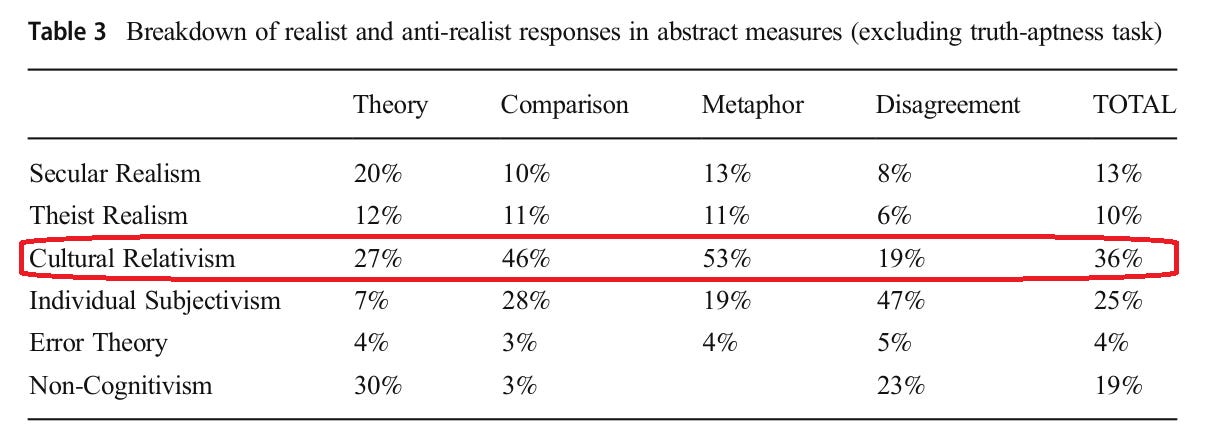
Cultural relativism was the most popular position overall. Maybe these participants weren’t presented with the implications of cultural relativism. But what, exactly, are those implications? It’s going to depend on whether it’s agent or appraiser relativism. Maybe they would reject agent relativism if presented with its implications. That seems reasonable to me. But it’s an empirical question, and not one philosophers are entitled to simply declare to be true without adequate evidence.
There’s also one study that directly addresses how nonphilosophers think about agent and appraiser relativism. In the article, Agent versus appraiser moral relativism: An exploratory study Quintelier, De Smet, and Fessler (2014) draw attention to the distinction and look at how nonphilosophers think about both kinds of relativism. As they note from the outset:
Agent moral relativism states that the appropriate frame of reference is the moral framework of the person who performs the act, or of the cultural group to which this person belongs. Appraiser moral relativists state that the appropriate frame of reference is the moral framework of the person who makes the moral judgment, or of the cultural group to which this person belongs. Contemporary empirical work on moral relativism has largely failed to investigate both (a) this critical distinction between agent and appraiser moral relativism, and (b) the corresponding comparative intuitive appeal of each type of moral relativism. (p. 210)
Quintelier et al. evaluated whether participants endorsed agent and appraiser relativism. I have concerns about the methods they used, but we can set those aside for now: perhaps the methods they used aren’t valid. That would not vindicate the use of armchair judgments from philosophers. Insofar as their results provide evidence of how nonphilosophers think, they found that both the moral standards of appraisers and agents influenced judgments of moral permissibility. This suggests that both forms of relativism may figure into how nonphilosophers are inclined to think about moral issues. As they themselve acknowledge “Our results are not definitive” (p. 227). One study like this is very far from establishing any substantive claims about whether many nonphilosophers would have a favorable view of either agent or appraiser relativism. But it’s a step in the right direction. C&S don’t appear to bother with any of this. They simply make assertions about how people think. Tenuous preliminary empirical data may not be sufficient to override reasonable confidence in one’s personal experiences; I certainly don’t think quantitative data always wins out over anecdote and personal experience. But I also have spoken to many people about their metaethical views. Far more than most people do. After all, I wrote my dissertation on the psychology of metaethics, with a focus on whether nonphilosophers are moral realists or antirealists. I talk about this a lot. I’ve also taught courses in both moral philosophy and psychology. My interactions with students do not give me the impression that students uniformly reject relativism, nor do they appear to me to consistently be intuitive realists. When asked, the vast majority consistently espouse support for some form of moral relativism.
While I grant that they may reject relativism were they aware of its implications, I don’t trust realists who present the topic in a classroom setting to do so in a fair and unbiased way. I suspect students who endorse relativism tend to face considerable pressure from instructors who have an animus towards the view to abandon the position. It would not surprise me the metaethical landscape were presented in a distorted and biased way that depicted antirealist views in an extremely unfavorable light in many classes. Likely, I’d present it in a far more favorable light, so I’d exhibit a bias in the opposite direction. This is one of the main reasons anecdotal experiences aren’t good evidence: when we are ourselves part of a social interaction, our own attitudes and biases can influence how other people react to us. Students who know I’m an antirealist may be more hesitant to endorse realism or criticize antirealism, while the reserve may be true for realists. I assume instructors are well aware of this fact, so I’m puzzled as to why they are so confident in making claims about realism being a “common sense” view without empirical data. Anecdotes and personal experience are not a reliable source of data on the matter, but without empirical data, that’s about all they’ve got.
Another issue with suggesting that people would reject relativism if made aware of its implications is that, even if this is true, it may not be a good indication of the merits of the position. A fair test of whether people would favor such a view conditional on its implications, may require substantive engagement with philosophy. Simply saying view X has negative implication Y only presents people with a single highly salient reason for rejecting the view. For comparison, I bet engineers could convince a lot of people to reject building a certain kind of bridge by pointing to one downside, e.g., “it’s expensive,” or “it would take a long time to build it.” But this only renders salient a single undesirable trait. It doesn’t weigh up the pros and cons of that type of bridge relative to other kinds of bridges. Just the same, that someone would reject relativism because you point to a flaw in it would be potentially premature. If one described cultural relativism and then specifically highlighted its allegedly unsavory implications, this might prompt people to reject it. But adequate consideration of a particular position, like a scientific hypothesis, is best judged relative to alternatives. The most defensible position may turn out to have some objectionable implications, but one may nevertheless settle on such a view because other positions have even worse implications. Without a relative comparison of alternative positions, that most people would reject some forms of relativism conditional on being told of their implications is not good evidence against those views.
Thus, whether people would reject the view all things considered seems like a more important line of consideration, but it would be absurd to make confident claims about so inaccessible a hypothetical: a hypothetical in which all nonphilosophers were somehow able to weigh up all the considerations for and against every metaethical position, then judge which one was, overall, most plausible. This makes no sense in part because a person who did this wouldn’t be a nonphilosopher.
It may not be viable, then, to empirically evaluate how nonphilosophers think about these issues, since they’d have to do philosophy to adequately entertain the relevant considerations. Even if such a process could be done, how on earth would we know what the outcome of that process would be? This wouldn’t simply involve speculative psychology about what nonphilosophers currently think, it would involve an extraordinary power of prognostication: to know what people would think at the end of an idealized line of inquiry. Nobody is in a position to make confident claims about the result of such a process.
Another reason to doubt the viability of such a process is that there may not be any clear, uncontested, universal set of practices such that we should expect everyone to converge on the same philosophical views under a variety of different counterfactual conditions. Instead, the popularity of philosophical views may be highly historically contingent, and depend on e.g., the distinctive history of a particular society. Would moral realism be as popular if we’d had thousands of years of secularism instead of monotheism? I doubt it. But there’s no great way to test claims like this. Nevertheless, I worry that the popularity of philosophical views is highly dependent on trends in the field at a given time. Decades ago, noncognitivism was all the rage. Now non-naturalist realism has enjoyed new popularity. Is this due to progress in the field? Maybe. But it could be the result of a kind of academic drift, and not a mark of genuine convergence.
In short: judgments about what people would think under some hypothetical circumstances would be exceptionally difficult to determine in practice. The claim that people would reject relativism if made aware of its implications is a speculative empirical hypothesis. There’s a little empirical evidence that suggests it may not be true, and not much evidence that it is true.
It’s also not clear to me why we should put much stock in philosophers making such claims. I could just as readily maintain that if people really thought about things in the right way, they’d realize moral realism is a very silly position and they wouldn’t endorse it. I doubt moral realists are going to take that very seriously, and I don’t think they should. Maybe people could be persuaded of agent relativism. I’d bet against it, but even I’d be cautious to baldly assert what metaethical views nonphilosophers would endorse under some hypothetical scenario without any data, and I specifically specialize in the study of how nonphilosophers think about these issues. If I don’t think I’m justified in being confident, I see little reason to think people who don’t study this topic should be confident.
Next, consider this remark:
Someone who fights to end slavery in a society that views it as a good thing is a moral visionary, not a wrongdoer.
One problem with this remark is that it hints at agent relativism: if the abolitionist in a pro-slavery society’s actions are “wrong,” why are they wrong for the relativist? Are they wrong because they conflict with their own society’s standards? If so, then this would only make sense under agent relativism. Under agent relativism, moral standards are determined by that particular culture. So anti-slavery members of that culture would be “wrongdoers” if they opposed slavery. But if you’re a cultural appraiser relativist, you would evaluate the abolitionist relative to the standards of your culture, and if your culture is anti-slavery, then there’d be no issue at all with saying that if there is a pro-slavery society, that the practice of slavery is wrong (relative to your culture’s standards) and that the abolitionists fighting against slavery doing something morally good (relative to your culture’s standards).
Also, I agree with this statement, and I’m a moral skeptic. Skepticism is consistent with making remarks like this.
Finally, consider how they end their remark:
Because cultural relativism has false implications, it must be false. (p. 39)
Even if one has the intuition that cultural relativism is false, and judges it to be false in the absence of defeaters, this doesn’t mean that it must be false. I’m not sure why they used this language. They may mean that, conditional on the implications of (agent?) cultural relativism being false, that it must be false. That would be true, but if so, they could have worded this a little better.
5.0 Individual moral relativism
Next, they consider individual moral relativism. They characterize it as follows:
Other forms of relativism say that morality is relative to something besides cultural standards, but they run into similar problems. For instance, individual moral relativism, in its simplest form, says that which actions are right or wrong is relative to individuals: the morality of my actions is determined by my own moral standards, and the morality of yours by yours. (p. 39)
This is agent individual relativism in particular, not appraiser relativism. And agent relativism does typically carry the undesirable implications they pin on it. Once again, though, why critique agent relativism but not appraiser relativism?
They continue:
But this is clearly false, too. It implies that the actions of a racist are right, as long as the racist is living up to their own standards.
If you’re an appraiser relativist, whether a moral statement is true or false is indexed to the standards of whoever is appraising the statement. If a person says something like “it’s morally okay for me to kick puppies,” this means something like “it is consistent with my moral standards to kick puppies.” If this is what this person means, and it is consistent with their moral standards, then this statement is true. All the statement amounts to is a statement about the consistency between that person’s moral standards and their actions. It has no implications whatsoever for what anyone else has to think about their actions. Anyone else could regard that person as a monster, and respond accordingly. Yet appraiser relativism isn’t even considered. It’s not even mentioned.
Instead, they talk about other “more sophisticated” forms of subjectivism. For instance, some subjectivists may hold that whether an action is right or wrong turns on what people would think if they “informed about all the other facts of the situation and if their beliefs were perfectly consistent” (p. 39). Proponents of such views can then argue that people wouldn’t endorse unpalatable views if they were better informed about the relevant facts. Rather than offer a critique of this view, C&S opt not to continue, saying:
This represents an improvement. But although we cannot discuss every view like this in all its detail, we suspect that these more sophisticated views will ultimately fail for reasons similar to those that undermined the cruder forms of subjectivism we discussed earlier. In principle, if someone’s conscience was messed up enough, it seems that they might approve of racism even if they met the conditions mentioned earlier. But clearly racism would still be wrong, even if everyone thought this way. (p. 40)
They can’t discuss every view in all its detail, but why focus only on those views subject to the same objection: that if someone thinks or would think [insert bad thing] is morally permissible, then you have to think it’s morally permissible. There are forms of relativism that aren’t subject to this concern, but they don’t mention or engage with them at all. As an aside, C&S state earlier in their article:
Sharon Street suggests that we must give up on the “realist’s independent evaluative truths” and endorses a sophisticated form of subjectivism. We explain why we reject this in Section 4.1. (p. 38)
…except they kind of don’t. Instead, they spend almost all of their space critiquing an unsophisticated form of agent cultural relativism, then make some perfunctory and hand waving remarks about how the same could be said of more sophisticated forms of subjectivism.
6.0 Therefore, realism!
They then make a really weird pivot:
In light of problems like this, we accept moral realism. (p. 40)
Wait…what? The only thing they did here was reject an extremely crude form of agent cultural relativism, and give an extremely brief and dismissive treatment of some kind of constructivist view. Therefore realism? They didn’t engage with almost any other form of relativism, nor did they offer any critiques of other antirealist positions.
7.0 Conclusion
The rest of their article is of little direct relevance to my interests, so I won’t address it. This article is similar in some ways to another article coauthored by Crummett on psychophysical harmony. That article likewise dismisses my own views from the outset, relegating their rejection of views like mine (with respect to consciousness) to a footnote. In both cases, the strategy seems to be to say:
“Our opposition endorses A or B. A is stupid and ridiculous and we’re not going to consider it. We endorse C. We’re going to argue that C > B.”
This is fine, as far as it goes. Nobody is obligated to contend with every rival position. But it is frustrating and disappointing to run into articles that simply dismiss your own views, and suggest, in doing so, that such views are “insane” or (as they say a bit later in the article) “crazy.” even if C > B, that does not mean C > A.
I’m used to this kind of dismissive attitude at this point, but that doesn’t mean I like it. I don’t think moral realists have much in the way of good arguments against skeptical views, and I think that’s why they often rely, to a significant extent, on posturing and dismissal. If you can convince your audience that a view is “insane” or that it has repugnant implications, you can put people off of the view without really showing what’s wrong with it.
References
Crummett, D., & Swenson, P. (2019). God and moral knowledge. In J. Rasmussen & K. Vallier (Eds.), A new theist response to the new atheist (pp. 33-46). Routledge.
Gowans, C. (2021). Moral relativism. In E. N. Zalta (Ed.), The Stanford encyclopedia of philosophy (Spring 2021 Edition). https://plato.stanford.edu/archives/spr2021/entries/moral-relativism
Pölzler, T., & Wright, J. C. (2020). Anti-realist pluralism: A new approach to folk metaethics. Review of Philosophy and Psychology, 11, 53-82.
Quintelier, K., De Smet, D., & Fessler, D. (2014). Agent versus appraiser moral relativism: an exploratory study. In H. Sarkissian & J. C. Wright (Eds.), Advances in experimental moral psychology (pp. 209-230). London, UK: Bloomsbury Academic.