


This is a critical response to J. P. Andrew’s “The Myth of Moral Relativism.”
1.0 JPA on relativism
According to JPA,
Moral relativism is often presented as a kind of middle position between robust moral realism, on the one hand, and outright moral anti-realism, on the other. The relativist supposedly avoids the perceived dogmatism of realism while also avoiding the more radical implications of denying moral truth altogether. But this appearance is illusory. Once we examine the view carefully, moral relativism collapses into a form of anti-realism, according to which, ultimately, anything goes.
I don’t know anyone who claims that relativism occupies a middle ground. I wouldn’t be surprised if some people did, I’m just not so sure this is that common of a claim. What I find odd about this claim is that realism and antirealism are typically construed as mutually exhaustive: either your position is a realist one, or it isn’t. Things can get a bit murky with constructivist positions, but I rarely see anyone struggle to place relativism on one or the other side. As long as you’re clear about what you mean by “moral realism” and “moral relativism” it’s usually fairly easy to determine whether relativism is a form of antirealism. It’s more a matter of what labels we choose to use rather than a substantive philosophical issue. But, as we’ll see, JPA’s phrasing is a bit misleading and the real issue isn’t how to categorize relativism, but whether relativism carries the same allegedly “radical” implications of nonrelativistic antirealist accounts. He’s not clear, for instance, on what “outright” antirealism is, and in what respect relativism is supposed to occupy a middle ground. Middle position with respect to what?
2.0 How I construe relativism
The two most common characterizations of moral realism that I’ve seen are the claim that there are moral truths (without qualification) and the claim that there are stance-independent moral truths. Relativism would categorically be a form of moral realism according to the former, while if stance-independence is a requirement for realism whether a given form of relativism is a form of realism would turn on whether it relativized moral truths to stances or not. If it did, it’d be a form of antirealism, while if it didn’t, it would be a form of realism. There’s no mystery here. Relativism simply isn’t hard to place as either a form of realism or antirealism (including using JPA’s definitions, which don’t meaningfully differ from the one I’m using here).
Along with Richard Joyce, I treat moral relativism as the position that moral truths contain an indexical element, such that their truth can only be judged when indexed to one or another of different moral standards. In other words, statements like:
“Slavery is wrong.”
…contain an implicit indexical element that fixes their truth value:
"Slavery is wrong [according to my moral standards].”
“Slavery is wrong [according to my culture].”
In principle, this construal of relativism is consistent with moral realism because relativists could index moral standards to something other than stances. Someone could believe that whether a moral claim is true or false is indexed to certain fixed, stance-independent biological facts, such as one’s species, or that it’s determined by one’s astrological sign, e.g., the statement “Slavery is wrong” may be true if uttered by a Scorpio but false if uttered by a Gemini.
Is this ridiculous? Yes. Is it also technically possible? Yes, also. What this illustrates is that stance-independence and indexicality are conceptually distinct. Philosophers like their conceptual distinctions, so this is one they should happily acknowledge, even if it’s a bit weird.
In practice, most relativists are going to index moral standards to the stances of individuals or groups, making relativism a form of antirealism. On this view, relativism isn’t a middle ground between realism and antirealism. If realism requires stance-independence, these forms of relativism are antirealist by definition. If it doesn’t, they’re realist by definition. It’s the stance-dependence that disqualifies it as a form of realism, not relativism. But it’s also not a middle ground in any practically meaningful sense, because neither standard forms of relativism nor other forms of antirealism carry any substantively different implications in the first place. They’re all similarly mundane and non-radical.
3.0 JPA’s misleadingly non-trivial claims
Since JPA characterizes relativism as requiring stance-dependence by definition, and realism as requiring stance-independence by definition, then it follows, trivially, that relativism is a form of antirealism. It makes very little sense for JPA to claim that it “collapses” into antirealism. Given how JPA uses the terms, relativism just is a form of antirealism. What JPA is doing is a bit like claiming that bachelorhood “collapses” into being an unmarried man, where one stipulates that a “bachelor” is a “man who is not married.”
This is a common theme with JPA, who enjoys presenting deductive syllogisms on Twitter as compelling proofs of various philosophical theses. These posts almost invariably consist of trivial arguments whose premises repackage the conclusion in a fairly transparent way. Here are some examples:

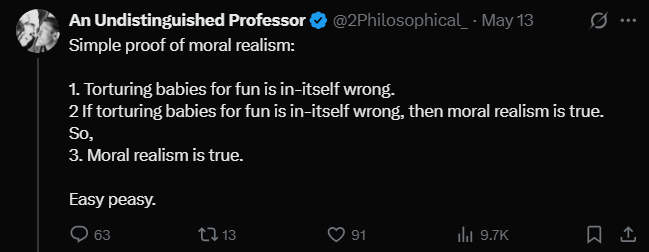
Both of these arguments include premises that, if disambiguated, would either be false or effectively repackage the conclusion. The only way the first argument would work is if “It’s like something to be me” were construed as the claim that we have phenomenal states. And since illusionism just is the view that we mistakenly think we have phenomenal states, appealing to the existence of phenomenal states in the premise of an argument against illusionism makes about as much sense as appealing to the premise “God exists” in an argument against atheism.
Likewise, either the sense in which torturing babies for fun is “in-itself” wrong constitutes or entails that there are stance-independent facts, or the conditional in the second premise would be false. If it does carry such an entailment, then the first premise effectively states that there are stance-independent moral facts. And since moral realism is simply the view that there are stance-independent moral facts, the argument ends up amounting to an argument that is not meaningfully different from:
P1: God exists.
P2: If God exists, theism is true.
C: Theism is true.
Since theism just is the view that God exists, such an argument is completely vacuous. And yet JPA presents arguments of similar caliber as if they are anything other than an utterly vacuous set of statements. As a result of these kinds of posts, I’ve encountered at least a few people who assumed or remain convinced that JPA is engaged in some form of elaborate satire. I think the reality is that JPA is utterly serious, and thinks arguments like the ones he presents are substantive.
The same kind of vacuousness at least appears to apply to this post, as well. However, I think it only appears this way because JPA doesn’t express himself very clearly. As I said, JPA construes relativism as requiring stance-dependence:
Relativists reject this stance-independence. According to relativistic theories, moral truth is always indexed to some standpoint: an individual perspective, a cultural framework, or a historically contingent set of social norms.
I prefer my definition. Rather than carving up the conceptual landscape on the basis of arbitrary conjunctions of positions (indexicality + stance-dependence), I favor separating views in terms of the presence or absence of distinct, orthogonal features: some views are indexical and some aren’t, some are stance-independent and some aren’t, and so on. There’s no particularly good reason to specifically highlight relativism as a view that conjoins indexicality and stance-dependence when the former is adequate on its own. This renders categorization cleaner and less dependent on contingent historical convention. But that’s a bit of conceptual engineering on my part; I acknowledge there’s no fact of the matter about which labels, categories, or distinctions are “correct” or not.
So while I don’t like JPA’s definition, I don’t think it’s mistaken. Relativism, on this view, is a position according to which moral truths are indexed to stances. Furthermore, JPA defines realism as follows:
Moral realists hold, at minimum, that there exist at least some moral truths that are stance-independent: truths whose validity does not depend upon what any particular individual, culture, or society happens to believe about them (Shafer-Landau 2003).
This is puzzling. If realism holds that moral truths are stance-independent, and relativism doesn’t by definition, then what is JPA doing when he says this?
Once we examine the view carefully, moral relativism collapses into a form of anti-realism, according to which, ultimately, anything goes.
How does it “collapse” into a form of antirealism if it is a form of antirealism by definition? One might think he is claiming that it is the conjunction of antirealism and the notion that anything goes. But another remark indicates this isn’t so:
But once that move is made, the position collapses into anti-realism.
Also, the subtitle of the essay is
Why Moral Relativism Collapses Into Anti-Realism
JPA seems to take relativism’s place in metaethics as a substantive matter of philosophical dispute to be settled by argument, rather than a more mundane matter of its classification following automatically from the definitions and labels we choose to employ. Consider this remark:
The relativist supposedly avoids the perceived dogmatism of realism while also avoiding the more radical implications of denying moral truth altogether. But this appearance is illusory.
I think what JPA is trying to get at is something like this:
Realism holds that there are stance-independent moral truths. Antirealism denies this. Relativism is technically a form of antirealism, but it purports to possess features that allow it to avoid the “radical implications” of denying moral truth altogether, since it technically holds that there is a form of moral truth. Yet the kinds of moral truths it yields don’t matter, since it still has the same radical implications as forms of moral antirealism that deny all forms of moral truth.
I take it, then, that JPA isn’t actually asserting something trivial, but instead simply failed to express himself clearly. If so, fair enough. I do that myself at times. Having set aside the unclear and seemingly trivial way JPA construes his position, we’ll see if JPA can sustain the claim that relativism fails to avoid the allegedly radical implications of denying moral truth outright.
4.0 Does relativism have radical implications?
4.1 Global relativism
First, JPA discusses global relativism. Nothing about this section appears to demonstrate that metaethical relativism has any radical implications.
4.2 Comparison to preferences
Second, JPA compares moral claims to taste claims. He states:
When I say that murder is wrong, I do not mean merely that I personally dislike murder in the way that I dislike the texture of overcooked steamed vegetables. Rather, I mean that people genuinely ought not murder — that everyone has decisive reason not to engage in such behavior. Moral language purports to possess a kind of universality that ordinary taste judgments lack.
This is often true (though as I’ve argued previously, it’s not always true. See here). However, universality is consistent with preference claims, and is irrelevant to the question of whether moral claims are stance-independent or not. As such, it does not assist in establishing that the language in question commits one to realism.
JPA continues:
Indeed, our moral practices seem saturated with assumptions inconsistent with relativism. We speak of moral discovery, moral education, moral error, moral confusion, and moral progress. All of this strongly suggests that we ordinarily take morality to involve truths that transcend mere preference.
JPA provides no evidence our moral practice is saturated with such language, no evidence that such language entails or is best explained by assumptions that are inconsistent with relativism, and does not engage with how a relativist might account for such discourse. He certainly doesn’t provide any cross-cultural or cross-linguistic evidence that such practices are widespread or universal across languages or cultures.
I’ve noticed a tendency for philosophers to do this sort of thing. They make numerous assertions, including ones that a reasonable person might find contentious, but just breeze along without appreciating that there are many steps along the way to establishing one’s views that would benefit from a degree of support. While the philosopher works their way towards a syllogism whose premises are worthy of their attention, these contentious assumptions pile up like a roaring river of enthymemes. Something about analytic philosophy fosters a tendency to build dams of assertions to block them off, and woe unto those who have the audacity to ask what holds the river in abeyance. No, they want to direct your attention to the premises of their choosing.
This is why so often you’ll see a philosopher present some argument or other and demand that their interlocutors specify which premise they reject. Such efforts are often premature. There is a time and place for such demands, which is typically after one has resolved background issues (if nothing else for the sake of argument) and resolved any underspecificity. But philosophers are at times impatient, and skip over these steps, and simply want to make their point, a point that only has any merit conditional on a whole panoply of background assumptions that others are free to reject.
This is just a general observation, though, and it may or may not apply in this particular case. Either way, I don’t grant that any of what JPA describes is “inconsistent with relativism.” Every one of these forms of discourse (moral discovery, moral progress, etc.) is consistent with relativism, and it isn’t even an awkward fit.
I’ve made this point before, but it’s worth making again. Dr. Seuss’s "Green Eggs and Ham” is a popular children’s book in which the protagonist is confronted by Sam-I-Am, an annoying figure who repeatedly offers them green eggs and ham. The protagonist refuses many times over. Yet Sam-I-Am chases them and harasses them until they relent, and try it. It turns out they like it. This person discovers that they like green eggs and ham. This illustrates that an iconic part of American culture consists in teaching children that taste is often a matter of discovery. And it is. People often have to figure out what they’re into. They discover that they like horror movies. They learn that they don’t like cilantro, and so on. Nothing about stance-dependence in any way entails that one has full, immediate, or infallible introspective access to their desires, values, or whatever other factors are relevant to establishing one’s stance on a given matter. If we can teach this to children, it is remarkable that philosophers could so blithely presume that the notion of discovery is somehow inconsistent with a stance-dependent conception of a normative domain.
The same holds for other notions. One can become educated on different genres of music or the culinary arts. Does this mean music and gastronomy are saturated with assumptions inconsistent with relativism? No, it does not.
Can relativists make errors? Yes they can. One can be mistaken about the nonmoral facts. One can recognize that some of their values are inconsistent with more fundamental values, and abandon them. One can have false beliefs about the standards of their culture. And so on. The gastronomic comparisons again come quite easily. Even on the assumption that taste is subjective, one can make errors. I can think berries would work well in a sauce, but discover I was mistaken. An artist can mistakenly believe a new technique will yield more beautiful art, but turn out to be wrong. And so on.
Confusion and progress can likewise be accommodated by a relativistic view, and easily, at that. Has anyone ever been ambivalent about whether they liked a movie, unsure if they liked it? Felt conflicted or confused? They sure have. Has anyone ever been perplexed by a work of art, and spent some time wondering if they liked it or not? Has anyone ever tried a new food, and initially found it peculiar, confusing, and strange, and had to take a few more bites or sips to determine if they liked it? Indeed, they have. These are all common occurrences, and they all illustrate how matters of taste can prompt confusion.
Finally, progress. This one is one of the easiest to account for on a relativist view. People can set their own goals, and make progress on them. They can make progress relative to certain preferences or desires, as well. I can make progress on making pies more to my family’s liking, or make progress in a fitness program, or make progress on improving my art in a way I find aesthetically appealing. Nothing about progress entails, presupposes, or requires stance-independent normative or evaluative standards.
Every single one of the features JPA mentions as “inconsistent with relativism” can be easily accommodated by relativism. JPA is simply mistaken about this. And yet JPA ends by saying:
As Thomas Nagel observes, morality characteristically presents itself as aspiring to a kind of objectivity that reaches beyond individual desire or social convention (Nagel 1986).
Recall my earlier remark about philosophers just making assertions without supporting them. This is worse. Here, JPA invokes a philosopher who allegedly “observes” that something is the case. Such phrasing helps itself to the presumption that what one has “observed” is true. For comparison, if I say that Mike “observed” that there was a tree, this implies that it’s true that there was a tree. This is quite different from someone claiming that there was a tree. The latter phrasing suggests this may not be true. JPA is not arguing for anything here. Instead, he appeals to a famous philosopher who allegedly “observed“ that something was the case. We’re not obliged to grant that Nagel “observed” this.
Having said all this, don’t forget that our initial goal was to identify the allegedly radical implications of relativism. I still haven’t seen any radical implications. Where are they?
4.3 Individual and cultural relativism
JPA also points to the distinction between individual and cultural relativism. The former relativizes claims to individuals, the latter to cultures. JPA characterizes the distinction as follows:
Some relativists hold that morality is relative to individual belief. On this view, if I believe lying is wrong, then lying is wrong for me; if someone else believes lying is permissible, then lying is permissible for them.
Alert readers will notice a problem. JPA is characterizing both in terms of agent relativism. It’s becoming tedious to make these points, but let’s do it again.
Agent relativism holds that moral claims are true or false relative to the standards of the agent or the culture of the agent performing the action.
Appraiser relativism holds that moral claims are true or false relative to the standards of the agent or the culture of the agent evaluating an action.
Agent relativism carries the unpleasant implication that if another person thinks it’s good to torture babies (or this is considered good in their culture), then it is in fact good for that person to torture babies. Since this would require you to think it’s good for them to torture babies, this is supposed to shock and horrify you (as it rightly should). Agent relativism bad.
The problem is that this is just one form of relativism. Many of you will already be familiar with the SEP quote I’ve presented several times before:
Appraiser relativism suggests that we do or should make moral judgments on the basis of our own standards, while agent relativism implies that the relevant standards are those of the persons we are judging (of course, in some cases these may coincide). Appraiser relativism is the more common position, and it will usually be assumed in the discussion that follows. (Gowans, 2021)
I don’t know if the latter claim is true. I don’t think there’s any survey data on whether agent or appraiser relativism is more common. But it’s awfully conspicuous that so many critics of relativism focus only on agent relativism and don’t bring up the distinction. Instead, they treat “relativism” as if it is, by default, agent relativism. This is convenient for the critic, since it is easy to score a victory against agent relativism in the eyes of audiences by noting that agent relativism would commit you to thinking it’s good for some people to torture babies or commit genocide.
Appraiser relativism doesn’t carry this implication. And yet, for some reason, this is omitted from discussion by most critics of relativism. I’ll leave it as an exercise for the reader to consider why this might be the case.
In any case, JPA continues with what’s allegedly so unacceptable about these forms of relativism:
But this position is extraordinarily difficult to reconcile with ordinary moral discourse. If morality simply reduces to whatever each person happens to believe, then genuine moral disagreement becomes impossible. Two people who appear to disagree morally would merely be reporting different psychological states.
This is either false or trivially true in a way that doesn’t help JPA. Note the use of the phrase genuine moral disagreement. I’ve noticed before how philosophers frequently lean on misleading modifiers that serve to conceal (with or without intent) that one is making a vacuous or highly dubious claim.
Just what is “genuine” moral disagreement? If it is disagreement about what the stance-independent moral facts are, then of course relativism can’t accommodate such disagreement. But this is just to say that if one presumes that everyday moral disagreements are disputes about what the stance-independent moral facts are, then any theory according to which it’s not the case that everyday moral disagreements are disputes about the stance-independent moral facts are is going to be false. This would amount to saying something like “According to relativism, not-P. But P is the case, so relativism cannot account for the fact that P.”
If, on the contrary, it’s not the case that “genuine” moral disagreement concerns disputes over stance-independent moral facts, then it’s no longer obvious relativism can’t account for it. After all, the whole reason it supposedly can’t account for it must have to do with the differences between relativism and realism. And in this case, the difference is that one rejects the existence of stance-independent moral facts and the other doesn’t.
In short: once one gets clear on what “genuine” moral disagreement is, it will either involve the question-begging presumption that ordinary moral discourse is non-relativist, or it won’t be inconsistent with relativism, so relativism could account for it. JPA loses either way.
I’ve also argued at length that philosophers typically rely on an impoverished and narrow conception of what “disagreement” consists in, which you can see here. This serves as a far more extensive rebuttal to JPA’s claim that relativism can’t account for disagreement. It can.
In that article, I emphasize that “disagreement” need not concern disputes about what the stance-independent facts are, but can instead include disputes resulting from conflicting goals or desires. Furthermore, it is the latter that will almost always predominate in ordinary discourse and interactions, because all intentional action is goal-directed. Conflicts about what’s stance-independently true would only occur in practice if people cared enough to dispute what was true. In practice, disputes about what’s true will tend to emerge in most practical, non-philosophical contexts when people are trying to achieve some outcome. Sometimes this outcome will involve shared goals but disparate perspectives on what’s true. Sometimes these outcomes will involve disparate goals but shared perspectives on what’s true. Both can and do result in conflict, and there is no legitimate reason to construe disagreement as exclusively centered on disputes about what’s true.
Either way, which factors drive everyday moral disputes is an empirical question, anyway, and it’s not like JPA presents any empirical evidence that ordinary moral disputes are exclusively concerned with stance-independent moral truth.
JPA points to yet another alleged problem with relativism:
More importantly, moral error would become impossible. If whatever I sincerely believe morally is thereby morally true for me, then I cannot be mistaken about morality any more than I can be mistaken about whether I currently enjoy the taste of coffee.
There are two issues with JPA’s claims. First, relativists are not obliged to believe, conditional on relativism, that moral error is impossible. JPA seems to be operating on the assumption that we have infallible access to the relevant desires, values, or beliefs that make our moral positions true. But relativists need not grant this (and I don’t grant it). As I’ve already pointed out, people can be wrong about their food preferences, even when those preferences are subjective. A person can think they don’t like green eggs and ham, and they can be wrong about this. There simply is no good reason to think we are infallible regarding our own preferences.
JPA’s comparison to whether you
[…] can be mistaken about whether I currently enjoy the taste of coffee.
…is highly misleading. This refers to an occurrent evaluative state, e.g., whether one’s current subjective experiences are good or bad. Relativists are not obliged to think that morally right and wrong action is fully determined by occurrent experiential states. Our own values can be opaque to us. Even if JPA disagrees with this, this is irrelevant. All this would mean is that if someone is both a relativist and if they are committed to a specific view about human psychology that JPA presumes is the case, then they would be committed to the impossibility of moral error. But this psychological thesis isn’t a feature of relativism itself; it’s an extraneous presumption JPA simply presumes is true and presumes the relativist is committed to. It isn’t something they’re committed to.
JPA commits a mistake I see many philosophers make. They’ll presume some view, P. Then they’ll take some target position they want to criticize, Q. The conjunction of P & Q carries some entailment, R, even though Q by itself does not entail R. Then they will criticize Q on the grounds that it would “entail R.” Strictly speaking, this is false. It would only entail R if P is also true. But since a proponent of Q is not obliged to endorse P, such critiques can never serve as an appropriate internal critique of a given view and the surrounding assumptions its proponent holds. Instead, such objections require substantive auxiliary assumptions that the proponent of Q may reject.
Furthermore, the objection that relativism entails that moral error isn’t possible might sound bad, but it has no force. Once again, such an objection is either trivially true and vacuous, or question beggingly presupposes the falsity of the very view it is supposed to serve as an objection to.
Here’s why. JPA and other critics of relativism are banking on the hope that you will balk at the notion that someone can’t make moral errors. This might sound absurd. But it only sounds absurd if you antecedently rejected the position in the first place, even if implicitly. I’ll unpack the argument to show why JPA’s objection doesn’t work.
Consider what would be required for it to be the case that “moral error is impossible.” First, it would require that moral claims reduce to claims about certain psychological states. Second, it would require that we have infallible access to those psychological states.
Well, if we did have infallible access to certain features of our psychology, and if moral claims consisted of reports about those states, then it trivially follows that error would be impossible. But all this would amount to is it being impossible for us to be wrong about something that JPA himself already grants that it’s impossible for us to be wrong about. In other words, JPA himself appears to believe we have infallible introspective access to the relevant features of our psychology. So infallibility isn’t the problem.
In other words, JPA’s argument faces a dilemma. If we are infallible with respect to the relevant truth-fixing features of moral claims, such that if relativism is true, then moral error is impossible, then this is only true insofar as JPA already grants that we’re infallible in the relevant respect. In other words, even if relativism were false, it would still be true on JPA’s own view that we’re infallible with respect to the relevant truth-fixing facts. The only difference is that the relativist takes these facts to be the moral facts, and JPA doesn’t. As such, the only way for JPA to deny that we’re infallible in the relevant respect is to deny morality is relative in the first place, which begs the question against relativism.
If, instead, we’re not infallible with respect to the relevant truth-fixing features of moral claims given relativism, then it’s not true that relativism entails that we can’t make moral errors.
Thus, there can be no substantive objection to relativism on the grounds that it entails we’re incapable of moral error. All such arguments will either beg the question against relativists or be false.
4.4 The alleged “instability” of relativism
JPA continues:
At this point, however, we arrive at what I take to be the even deeper problem. Moral relativism is frequently presented as a compromise position. The relativist supposedly avoids the perceived dogmatism of realism while still preserving a kind of truth within moral discourse. Moral claims are said to be “true relative to a framework,” “true for a culture,” or “true for an individual standpoint.” But it is not clear that this actually preserves moral objectivity in any robust sense at all.
This is an absurd objection. Earlier, JPA stated that:
[…] what unites realist positions is their commitment to genuine moral objectivity.
Relativists reject this stance-independence.
Given JPA’s own earlier characterizations, how could it possibly make any sense to object to relativism on the grounds that it fails to preserve moral objectivity when the position is literally defined in terms of its rejection of moral objectivity? This is an utterly vacuous objection.
His next remark doesn’t help:
Suppose that the moral status of an action depends entirely upon the norms accepted within a given society. Then there is no standpoint-independent fact concerning whether the action is really right or wrong. There are only facts about what various societies approve or disapprove of.
…Uh…yes. That’s what relativism is.
But once that move is made, the position collapses into anti-realism. The relativist may continue using the vocabulary of “truth,” but the relevant truths are no longer objective in the realist sense. They are indexed entirely to attitudes, frameworks, conventions, or perspectives. In other words, relativism does not so much preserve objectivity as relocate morality into human psychology and social practice.
JPA appears to be extremely confused. The position as described doesn’t “collapse” into antirealism. JPA has simply reiterated what the position is. What JPA is saying here isn’t meaningfully different from objecting to atheism on the grounds that if it were true, it would “collapse into the belief that God doesn’t exist.”
Thus, moral relativism is not a stable middle position between realism and anti-realism. It is, rather, a strategy for endorsing anti-realism about morality at the metaphysical level while retaining some of the surface-level grammar of moral realism.
This is not true. First, nothing about the surface-level grammar of ordinary moral language is realist to begin with. Moral realists may offer a semantic thesis about moral language, but realism is not and never has been a grammatical thesis, unless JPA is construing grammar in broader terms that include semantics. But if he were, that would make no sense, either, since relativism is defined partially in terms of its semantic thesis, which conflicts with the semantic thesis of realism. Thus, his position makes no sense on either a narrow or broad construal of the alleged surface-grammar of moral language.
That moral discourse frequently involves declarative sentences indicates only that the surface-level grammar of moral discourse appears to consist in propositional claims. But it is not part of the surface grammar that those claims involve appeals to stance-independent normative truths. This must be inferred just like relativism and is a feature of the semantics of moral claims. And relativism definitely does not share the same stance on the semantics of moral language.
The surface-grammar of ordinary moral discourse is and always has been neutral between realism and antirealist forms of relativism (at least in modern English). Both realism and relativism are cashed out in terms of semantic/pragmatic features of ordinary moral language, not their surface grammar.
As such, what JPA says here seems very confused. In short: relativism does not attempt to retain the “surface-level grammar of moral realism” because, however one construes this, it’s either (a) false that there even is any such thing or (b) it’s false that relativists share the same account of moral language.
JPA continues:
Indeed, many contemporary anti-realist theories operate in precisely this territory. Expressivists, constructivists, and various forms of “quasi-realism” frequently attempt to preserve substantial portions of ordinary moral discourse while rejecting robust stance-independent moral facts (Blackburn 1993; Gibbard 2003).
Yes. They do. But nothing about such attempts involves attempting to retain the “surface-level grammar of moral realism.” These are substantive accounts of the grammatical, semantic, and pragmatic features of ordinary moral language that purport to account for it without positing realism.
This is already a well-established feature of these accounts. It’s…kind of the whole point. And yet, for some bizarre reason, JPA is characterizing relativism as being metaphysically antirealist but not jettisoning ordinary moral language as some kind of revelation or naughty secret about the position.
4.5 The alleged “costs” of relativism
JPA goes on to say:
If morality is fundamentally relative to cultural consensus, then genuine cross-cultural moral criticism becomes impossible. One culture may disapprove of another culture’s practices, but neither culture could be objectively mistaken.
Once again, JPA employs the misleading modifier “genuine.” Once you disambiguate what JPA could mean by “genuine,” his objection will either be trivially true or it will be false.
Does “genuine” mean stance-independent, or is it an intensifier? If the former, then this is a trivial objection because it’s true by definition. The objection would amount to something like:
Views according to which there are no stance-independent moral facts cannot maintain that it is a stance-independent moral fact that the practices of other cultures are wrong.
This is not a serious objection to relativism. If, instead, “genuine” means something other than stance-independent, then it’s unclear why relativists would be incapable of “genuine” moral criticism.
JPA drives home the question-begging nature of his objection:
But this conclusion seems deeply implausible. It seems perfectly meaningful — and indeed morally important — to say that slavery was wrong, that genocidal regimes were wrong, or that human sacrifice was wrong even in societies where such practices enjoyed widespread acceptance.
In other words, JPA is rejecting cultural relativism on the grounds that cultural relativism conflicts with intuitions he has that are inconsistent with cultural relativism. Well, of course it does. So what? If JPA takes his intuitions to be dispositive, then he should reject cultural relativism. But this doesn’t give any of the rest of us any good reason to do so.
For some weird reason, he again repeats the point about progress:
Similarly, relativism appears unable to make sense of moral progress. Progress presupposes some standard toward which one moves. Without objective standards, there can certainly be moral change, but it is difficult to see how there could be moral improvement.
This is such a bad point to make. Nothing about the concept of progress analytically entails that progress is only possible with respect to stance-independent standards. I agree that progress “presupposes some standard toward which one moves.” And relativists have moral standards that they can move towards. For instance, if a relativist thinks you should maximize utility, they can make moral progress by donating to charity or becoming a vegan. While they can’t make progress towards adopting the correct stance-independent moral truths, nothing about the concept of progress requires that one be able to do so. Like many others, JPA simply presumes, without any argument, that progress only makes sense on a realist construal. But he presents no arguments or reasons for this presumption.
The problem becomes especially acute in the case of moral reformers. Many of the figures we now most admire — abolitionists, civil rights activists, dissidents resisting oppressive regimes — were individuals who stood in direct opposition to the moral consensus of their societies. Yet if CMR is true, then such individuals were, by definition, morally mistaken at the time they challenged prevailing norms.
This might be true for certain forms of agent relativism. But once again, it’s not true for appraiser relativism. On appraiser relativism, it would make no sense to speak of the actions of moral reformers as being “morally mistaken” simpliciter. One can only speak of them being morally mistaken relative to the standards of some evaluator. And it would turn out to be true that moral reformers were engaging in actions that were wrong relative to the standards of the societies they were in, but not wrong relative to your or my standards, or the standards of our culture. Appraiser relativism can easily account for moral progress and does not struggle to make sense of moral reformers. Like many other critics of moral relativism, JPA seems to focus exclusively on agent relativism and to completely ignore appraiser relativism, for, as far as I can tell, no apparent reason.
JPA ends with yet more bizarre remarks:
More importantly, once relativism abandons stance-independent moral truth, it increasingly begins to resemble a straightforward form of moral anti-realism
JPA defines relativism as a position according to which moral truth is stance-dependent. It makes no sense to refer to it as “abandoning” stance-independence.
5.0 Conclusion
JPA’s remarks suggest a poor understanding of metaethics and philosophical argumentation, as well as a notable lack of rigor or adequate engagement with the views he rejects. He presents trivial and vacuous arguments as if they are substantive, makes remarks that conflict with his own established definitions, fails to engage with the full range of relativist views he criticizes, fails to consider or engage with any potential rebuttals they might offer, appears to be confused about the relation between antirealist views, grammar, and semantics, and frequently proceeds by way of bare assertion, offering little or no support for a host of contestable assumptions.
And to top all of that off, JPA has blocked me and has blocked many others for, as far as I can tell, the crime of disagreeing a bit too loudly. An unwillingness to engage with one’s opposition greatly inhibits opportunities for growth and learning and contributes to an atmosphere of cloistered hostility and disdain fundamentally at odds with the way philosophy has made and will continue to make progress. Only by reaching across the aisle and engaging directly with our opposition—ideally on friendly terms that foster charity and understanding—can we most effectively settle philosophical disputes. This isn’t to say I oppose blocking people. I often do so when people are rude or violate certain rules of engagement I abide by (e.g., I block people who accuse me of lying or persist in avoiding questions). But I doubt JPA will read this, and if he does, I am even more confident he won’t reply. I’m afraid my remarks are more likely to echo into the abyss. I suppose that’s fitting for an antirealist.