


This article is a critical response to this one:

Go check that out first.
1.0 Relativism is Weird
Metaethical relativism is a pretty weird position. Outside of academic philosophy, people will often say they are relativists, but further discussion will often reveal that the position they hold is a muddled amalgamation of normative, metaethical, and descriptive views: they want to be tolerant, they recognize different people and societies have different moral standards, they think that what’s right or wrong “depends on the context,” they think we should abstain from judging other people or cultures in specific circumstances (but often not others, and they’re often not very consistent or principled about this), that it’s difficult to figure out what’s right or wrong, and so on. This isn’t “metaethical relativism.” It is folk relativism: a cluster of associated and often incoherent views that are held to varying degrees by people who nominally identify as “moral relativists.”
Metaethical relativism can also be understood as a family of philosophical positions with tighter and more principled constraints. Yet even this position is routinely characterized in ways that are inadequate, muddled, inconsistent (internally or with respect to other accounts), or downright inaccurate. It is also frequently presented, including by professional philosophers, as a kind of punching bag: a caricature of a view presented to students solely for the purposes of ridiculing the view and explaining why it’s so stupid and terrible. Some of this may be motivated by the personal animus of instructors, but much of it may be motivated by the phenomenon of student relativism, the tendency for students to espouse relativism (often of the folk variety described above).
Student relativism can be an impediment to instruction, and so it is important for instructors to at least attempt to disabuse students of the notion in order to get on with the serious business of moral philosophy. I’ll save denunciations of such practices for another day, but for now it will suffice to say that it isn’t an instructor’s place to browbeat metaethical views out of students: yes, clear up confusions and reluctance to engage in serious thinking, but this should not come at the cost of coercing students into holding views more amenable to one’s own. That isn’t, or at least shouldn’t be, the role of philosophical instruction.
2.0 Stance-dependence & Indexicality
For now, I want to focus on a peculiar line of critique against metaethical relativism. This critique only makes sense once we disambiguate some of the possible positions that one may describe as metaethical relativism. There is, as is typical for philosophy, no canonical, settled conception of metaethical relativism in the first place. Generally speaking, metaethical relativist positions allow for there to be more than one correct set of moral standards.
Yet philosophers are not always consistent with the terminology even in this regard. “Relativism” or its cousin “subjectivism” are sometimes used to refer to any position which treats moral claims as stance-dependent, even if there is only a single possible correct set of moral standards. So, for instance, ideal observer theory may be described as a “subjectivist” view. Nonphilosophers (and sometimes philosophers) will likewise describe Divine Command Theory as a form of “subjectivism,” even if the view holds that all moral truths are fixed by God’s stances (never mind that proponents of DCT often reject the notion that their position is a form of relativism, subjectivism, or antirealism).
Why would they do this? Part of the reason is that certain philosophical views tend to cluster together, and people often lump conjunctions of views under a common label even when one can extricate one philosophical view from another. Here are two important distinctions to consider:
Stance-dependence vs. stance-independence
This distinction concerns whether moral propositions are made true by stances or not. If they are made true by stances, then the metaethical position in question holds that moral truth is stance-dependent. If there are moral truths but they are not made true by stances, then moral truth is stance-independent.
People sometimes use terms like “relativism” or “subjectivism” to refer to any view which holds that moral truth depends on stances.
Indexicality vs. non-indexicality
This distinction concerns whether moral propositions include an indexical element. An indexical element refers to features of propositions that allow the truth status of the proposition to vary relative to one or another frame of reference to which they are indexed. You are already familiar with indexes because you use them every day. Terms like “I” and “you” are indexicals.
The statement “I am in New York” is true when I say it because “I” refers to me, and I am in New York, while it is false when someone who says it is not in New York, because “I” refers to them, instead. Indexicality does not need to be explicit. When someone offers me a bite of food, and I try it and say “This is delicious!” I am not necessarily claiming that the food has the property of intrinsic, stance-independent deliciousness. Instead, I can be understood to be saying something about my subjective evaluation of the food: “This is delicious [according to my preferences]!”
Some claims have an indexical component and others don’t. When a claim has an indexical component, its truth can vary in accordance with whatever it is being indexed to. Conversely, if there is no indexing, there is only a single truth of the matter regarding that statement.
As you can see above, there are two distinct questions: whether moral truths depend on stances, and whether the truth of moral claims involves indexing of some kind.
Here, I will understand relativism to be about indexicality, and not stance-dependence. Metaethical relativism is the view that moral claims contain an indexical element whereby they can only be judged as true or false relative to the standards to which they are indexed. This creates the possibility that a given moral claim can be true relative to one index, but false relative to another, just like the statement “I am in New York” can be true when one person says it but false when another says it. Relativism thus creates the possibility for more than one distinct standard of moral truth.
…That’s it. It is not about stance-dependence. And yet metaethical relativism is often defined as the view that moral truth is determined by the standards of individuals or groups. Why is this misleading? Because these definitions fail to draw a distinction between:
Indexicality
The standards to which moral claims are indexed.
All relativism requires is indexicality. It does not require that claims be indexed to stances. Or at least, the way I am using the term “relativism” draws a distinction between these, rather than sloppily smashing them together. After all, what would we call a metaethical view which includes indexicality but doesn’t index to stances? Why not use “relativism” for metaethical systems which index, and “stance-dependent cognitivism” or something along these lines to refer to systems which hold that there are moral truths, but they depend on stances?
Doing so allows us to create a 2 x 2 matrix that illustrates all four possible combinations of indexicality and stance-dependence:
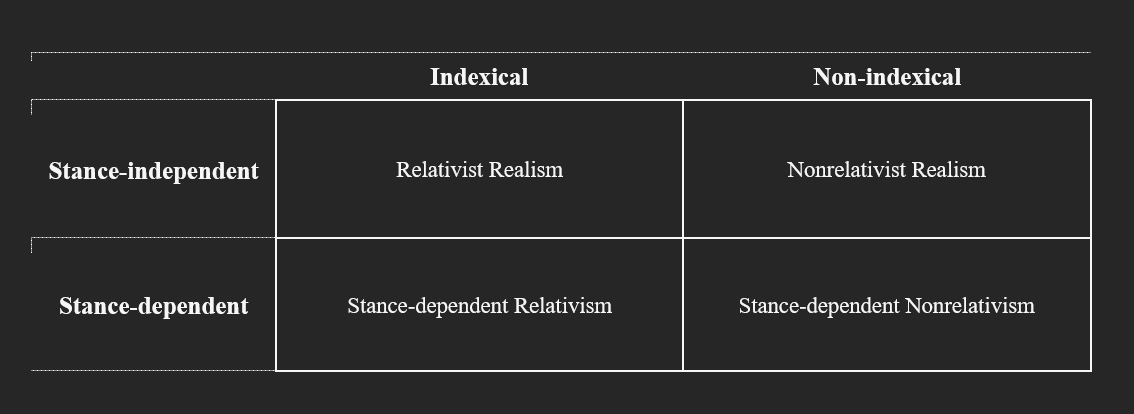
Distinguishing indexicality from stance-dependence illustrates how there are multiple possible metaethical systems aside from non-indexical realism and stance-dependent relativism: you can also combine indexicality with stance-independence and non-indexical systems with stance-dependence, respectively. The latter yields antirealist positions which hold that there is a single standard of moral truth, but that this standard depends on a stance: god’s, an ideal observer’s, and so on. Likewise, you could hold that moral truth can vary depending on which standard it is indexed to, but hold that these standards are stance-independent.
I don’t know of anyone who has ever endorsed such a view, but it is conceptually possible to do so. If this sounds bizarre to you, imagine if someone held that each of us is obligated to abide by the standards of our astrological signs, or imagine a pagan world in which people are expected to abide by the moral standards of the patron religions of their respective city-states. In such a world, “It is wrong to steal” could be true relative to the standards of a Capricorn, but false relative to the standards of a Gemini. There is no good reason to ignore such conceptual possibilities merely because such views aren’t endorsed by contemporary academics.
Another benefit of distinguishing stance-dependence from indexicality is that it clarifies the nature of the philosophical dispute between realists and antirealists. Insofar as moral realism is understood to be the view that there are stance-independent moral truths, it should now be clear that relativism does not entail antirealism. Relativism concerns indexicality, not stance-dependence. Most contemporary moral realists probably want to rule out both stance-dependence and relativism, but technically this would mean that they’d be rejecting antirealist accounts and a subset of realist accounts: relativistic forms of realism. In practice relativists tend also to be antirealists, since they hold that moral claims are made true by the stances of individuals or cultures. But in principle they need not do so.
Yet contemporary moral realists typically favor a conception of morality in which there are not only stance-independent moral truths, but these truths are universal and nonrelative, and thus applicable to everyone. It simply wouldn’t do for people to be subject to different sets of standards. Realists usually want there to be one set of moral standards to rule them all and in the darkness bind them.
3.0 Needlessly Complicating Things
Regrettably, clarity about this distinction alone is insufficient to address relevant variants of relativism. Philosophers often append more to relativism than is strictly needed. As I’ve presented it here, there is a close relation between meaning and reality. What does metaethical relativism commit one to? Only that:
Moral claims can be true or false
Their truth or falsity depends on the standard they’re indexed to
“Stealing is wrong” is true if it’s indexed to a standard that holds that it’s wrong, and false if it’s indexed to a standard that doesn’t hold that it’s wrong. I don’t want to complicate things further than this, but there is one more point to make, and it starts with a question: which moral claims? Whose moral claims is relativism supposed to account for?
Metaethical relativism is intended to provide a descriptive account of the meaning of everyday moral claims, e.g., “She shouldn’t have done that!” or “That man is a monster!” It is first and foremost a descriptive account of language. It’s not about how we should speak or could speak, but about how we do speak. Language is a behavior. Behavior is the domain of psychology. And thus metaethical relativism is ultimately a psychological hypothesis. While it is potentially coupled with metaphysical and other claims, these claims are all contingent on its empirical foundation as an account of what ordinary people are doing when they say certain sorts of things. At its core, then, metaethical relativism is simply the view that when people say things like “[Some action] is wrong,” they mean that the action is wrong according to some particular standard of evaluation among others. That standard could be their personal preferences. It could be the norms of their culture. It could be a set of rules printed on a sheet of paper they found in their basement.
Both Sides Brigade (BSB) has some issues with relativism, however. And according to BSB, they are:
[…] beginning to think that the supposed benefits of relativism pretty much disappear once you make some very plausible assumptions about how exactly it would have to work.
As I will argue, the assumptions BSB makes are not very plausible and do not capture “how exactly it would have to work.” BSB overcomplicates relativism and presumes the relativist wants to take on board many of the theoretical contrivances that motivate moral realism. While relativists can do this, they don’t have to, and abandoning them doesn’t involve paying any significant theoretical price or biting any bullets.
BSB begins with the following account of relativism, provided by Gilbert Harman:
For the purposes of assigning truth conditions, a judgment of the form It would be morally wrong of P to D, has to be understood as elliptical for a judgment of the form In relation to moral framework M, it would be morally wrong of P to D.
This characterization is fine as far as it goes. But BSB raises a concern:
Let’s start with a simple question: Just what, exactly, is a “moral framework” even supposed to be? For most other intrinsically relative statements, it’s easy enough to lay out the specific content of whatever standard makes them true. When I say that I was driving at sixty miles per hour, for example, basic physics tells us that the truth of my assertion depends on a reference frame, in the same way that the truth of my moral assertions (supposedly) depends on a moral framework. But in the case of my car, I can say more than that — I can say that the reference frame that makes my assertion true is, specifically, a coordinate system with its origin point at such-and-such a place. So what would be an equally informative account of the moral framework that, under relativism, makes my moral assertions true?
I don’t see what the issue is. To address the first question: a moral framework is any standard of moral evaluation at all, real or hypothetical. It could consist of a set of abstract normative moral principles, e.g.:
{All agents ought always to impartially maximize utility}
or it could be some complicated set of standards that vary across different types of actions:
{It’s wrong to steal; it’s not wrong to lie; it’s wrong to kill members of your own group; it’s not wrong to kill members of other groups; […]}
However, technically speaking it isn’t sets of propositions that constitute a person’s moral framework. These propositions would be instantiated in some form: written on a sheet of paper, held as a set of values or standards a person endorsed and that were therefore encoded in some way in that person’s brain, and so on.
Now let’s turn to the second question:
So what would be an equally informative account of the moral framework that, under relativism, makes my moral assertions true?
That’s going to depend on the particular form of relativism. Relativism is an umbrella category that captures a range of possible views about what standards or frameworks people are indexing their claims to. Let’s go with a simple one: individual subjectivism. On this view, people are indexing moral claims to something like their personal values, standards, or preferences. I think it’s reasonable to want greater specificity about what values, standards, or preferences are. These are crude, underspecified terms. If we’re dealing with a psychological hypothesis, ideally we’d want to pin down the kinds of psychological states that form the foundation of a given account of metaethics. If BSB’s complaint is that nobody’s really done so, well, fair enough. I don’t think they have myself.
Some of the fault for this lies with relativists themselves. Metaethical relativism existed prior to contemporary analytic metaethics, but it hasn’t flourished under its aegis. Analytic metaethicists have inherited Western philosophy’s historical allergy to empiricism, and by that, I don’t mean analytic empiricism, I mean actual get-your-hands-dirty empiricism. The kind that involves, as the kids say, touching grass. Or more appropriately, digging up some grass and having a look at it under a microscope.
Part of the reason for this is that what moral standards hinge on can, like many philosophical issues, probably be largely set aside as less central to the relevant disputes. Must we pin down exactly what a “preference” is in order for relativism to excel over its competitors? If so, critics would be holding relativism to a standard they rarely hold themselves to. One could always nitpick: what’s a judgment? What’s a decision? What’s an act? If relativism is to be tied up in knots over what exactly moral claims are relativized to, similar persnickety problems would generalize to most of philosophy, including the views of its critics. One should always be mindful to beware isolated demands for rigor.
Note that BSB is comparing the index of moral claims for the relativist to physics, a notoriously precise discipline. Metaethical relativism is dealing in the realm of indexes: a more abstract notion that, unlike the content of physics, does not figure into a set of notions readily amenable to empirical inquiry. Metaethical relativism also remains far less developed than theories in physics, but is this the fault of the relativist? Here are some reasons to be sympathetic to the relativist:
There aren’t that many relativists to begin with
There is little incentive to develop certain aspects of relativism; the same cannot be said for physics
Relativism has been on the receiving end of a sustained campaign of hostility, mischaracterization, and denigration by its critics, so much so that few philosophers explicitly advocate for the position or defend it
In spite of these setbacks, I still don’t see what the issue is. Can relativism provide as informative an account as physics?
No. Most relativists are likely to relativize moral claims to the standards of individuals or cultures. Psychology and sociology simply aren’t as precise or as developed as physics, and in any case few people working in either field are also working in contemporary analytic metaethics. This saddles the metaethicist with numerous obstacles:
Unlike the physicist, the relativist would have to do interdisciplinary work in both philosophy and whatever other fields would be necessary to clarify what “moral frameworks” are in an acceptable way, e.g., psychology, comparative linguistics, and so on
This is exacerbated by the fact that analytic metaethics operates within a fundamentally different paradigm from the natural sciences, so the interdisciplinary work would have to span disparate fields with different methods and frameworks
The fields the aspiring metaethical relativist would be required to work in also don’t deal with metaethical relativism very much, and lack the terminology, methods, conceptual resources, and historical body of literature to support such endeavors
The metaethical relativist thus faces a far steeper challenge than a physicist aspiring to offer an informative account of the relativity of e.g., motion. Given this, BSB’s request for an “equally informative account” of the moral frameworks that make moral assertions true is excessive, and, in any case, the absence of such an account could readily be attributed to the lack of comparative development in the fields relevant to addressing this question compared to physics. BSB is, in short, making an unreasonable, isolated demand for rigor.
BSB’s suggestions are also steeped in analytic presuppositions and assumptions, which only serves to reinforce my objection that contemporary metaethicists fail to appreciate that much of what they’re engaged with hinges on empirical questions about human psychology. Here is BSB’s first proposal:
In everyday life, we generally think of a person’s moral framework as a collection of all the moral principles they rely on to navigate life, like “demeaning others is wrong” or “you ought to help the less fortunate.” And so, at first glance, we might be tempted to think that the moral frameworks we’re talking about here are also sets of moral propositions, at least once they’re systematized in a certain way. But what many people — including many relativists — don’t seem to realize is that relativism’s core commitments explicitly rule this option out.
We might think of a moral framework as a “set of propositions,” but recall that this is an abstraction; the set of propositions reflects some underlying substrate: rules written on stone tablets, psychological states in a person’s brain, and so on.
For comparison, I have taste preferences: I like chocolate, I don’t like lima beans, I like spinach, I don’t like saltines, and so on. One could say that I have a “taste framework” that consists of a set of propositions of this kind. Supposing I’m a gastronomic relativist, and that the claims I make about what food is good or bad reflect my personal preferences, it isn’t the “taste framework” (e.g., the set of propositions that includes {cilantro is tasty}) that makes the statement “Cilantro is tasty” true when I say it; it’s my preference itself. So I’m quite puzzled at how BSB continues:
Here’s the problem: According to relativism, moral propositions are essentially… well, relative. And that means they’re ill-formed and vacuous apart from whatever framework makes them true or false, in the same way it would be meaningless to assert that something is “intrinsically stationary” apart from any reference frame. But if that really is how moral propositions get their truth values, then how could we ever make sense of the propositions that comprise a moral framework? Either each proposition would require its own moral framework, which of course would produce an infinite regress, or else the one moral framework you’ve got would be nothing but a collection of pseudo-propositions that are literally incoherent.
Something has gone wrong here. BSB seems to think that relativists think something like this: that moral frameworks are sets of propositions, e.g.:
{Stealing is wrong; lying is wrong; kindness is good; […]}
…Then BSB supposes that this set of propositions itself somehow makes statements like “Stealing is wrong” true. But this would make no sense. How can the proposition “Stealing is wrong” make the statement “Stealing is wrong” true? Unless it were made true by some more fundamental moral principle, which would simply iterate the same problem, leading to an infinite regress.
It isn’t an abstract set of propositions that makes claims made relative to the framework true. There’s no ineliminable elemental goodness here, where we somehow think a set of propositions that include “X is wrong” somehow makes “X is wrong” true. Wrongness must be discharged in some way: something is wrong when it is in violation of my personal preferences or when it is against the rules prescribed by a given system, or whatever.
So, for instance, a relativist that relativizes the truth of moral claims to personal preferences would hold that it is a person’s preferences that make their moral claims true or false. If a person prefers that people not steal, then this preference makes the statement “It is wrong to steal” true when this person makes such a claim. There’s no incoherence, no infinite regress, no philosophical problem at all. If there were, then it would apparently be a massive problem for a person to say “This pizza tastes good” and that person not be a gastronomic realist. What could they possibly mean? Wouldn’t their gastronomic claims be made true by a “gastronomic framework”? We might continue the argument along the same lines as BSB:
Wouldn’t gastronomic propositions be ill-formed and vacuous apart from whatever framework makes them true or false? How could we ever make sense of propositions that comprise a gastronomic framework? Either each proposition would require its own gastronomic framework, which of course would produce an infinite regress, or else the one gastronomic framework you’ve got would be nothing but a collection of pseudo-propositions that are literally incoherent.
Apparently, there is no way to make sense of taste claims being indexed to people’s personal preferences. There’s just no way to be a relativist about statements like “Pineapple on pizza is tasty.” Such a concern, if true, would prove too much. We should suspect, instead, that something has gone wrong with BSB’s characterization of relativism, or that, at best, BSB is targeting some bizarre form of analytic relativism that retains internally incoherent or poorly-considered features.
BSB provides us with an example to illustrate what the issue is supposed to be:
As an example, let’s say that Frank’s assertions about the rightness of X are made relative to a moral framework F, and that F contains the proposition “stealing is wrong.” If that proposition has no truth-making standard of its own, then it fails to mean anything at all, and so does his original assertion about the rightness of X. (This is because “X is right, relative to [ill-formed proposition]” is itself an ill-formed proposition.)
Why would any relativist have thought an abstract set of propositions that constitute a given standard are what make the statements made relative to that standard true? And makes it wrong how, exactly?
A better way to understand what the relativist is claiming is that if you take some set of standards, rules, and so on, one can simply report whether a given action is consistent with the standard or rule. For instance, you are allowed to kick the ball in soccer, but you may not kick the ball in basketball. Suppose someone said:
Kicking the ball is against the rules.
Suppose we know that this statement refers either to soccer or to basketball, but have no idea which one. Is this statement true or false?
It depends. In practice, this statement will be true or false relative to the game the person is indexing the statement to. People don’t typically need to state which game they’re referring to because context will resolve any such ambiguity. This is why such statements involve implicit indexing. If you’re at a basketball game and you see a player kick the ball into the net, only for the referee to call a foul and point out that “It’s against the rules to kick the ball,” it is fairly clear that they’re referring to basketball and not soccer.
What relativism facilitates is allowing one to index the truth of a claim. In the case of the rules of games, it clearly “works.” We collectively agree on the rules of a given game, and it’s our agreement that establishes what those rules are. Conditional on a given set of rules, when a person makes a claim about an action violating a rule, one simply checks which set of rules the claim is indexed to. Whether the statement is true or false turns on whether the claim is true given the rules of that game. The claim’s truth just hinges on its consistency with the given rule. It’s a separate question entirely what makes the rules true: in this case, some kind of collective agreement or socially constructed set of facts.
I think BSB has mixed up what causes or “grounds” a given moral framework and the content of the framework abstracted away from that cause/grounding, characterized as a set of propositions. The propositions don’t have to pull themselves up by their own bootstraps.
BSB does appear to be aware that this isn’t necessary, and that some other set of facts can fix the truth of the claims in question. This would have to be the case, unless we’re to suppose all indexical claims are somehow nonsensical or incoherent. So I don’t know why BSB was ever tempted to think otherwise in the first place. Yet BSB still seems stuck on the relativist also believing in some kind of irreducible normative moral concepts. He continues:
But if, on the other hand, F’s anti-stealing proposition does come with another proposition that fixes its truth value, then that truth-making proposition would also need to be justified, in which case you inevitably end up with a framework full of infinitely complex propositions like: “Stealing is wrong, relative to a framework that says ‘stealing is wrong, relative to a framework that says “stealing is wrong, relative to…”’” and on and on forever.
It isn’t propositions that fix truth values, typically, but some fact or feature of the world. Sure, a relativist could opt for propositions to do all the work, if they’re some kind of weird analytic philosopher who constantly thinks in terms of propositions. But then the only problem with that particular relativist is that they’re thinking too much in line with BSB and other people who’ve imbibed too much analytic philosophy for their own good. The truth values could be fixed instead by e.g., psychological or sociological facts. The fact that I like chocolate makes the statement “I like chocolate” true. When I say “Chocolate is good” this is just a way of implicitly referencing my taste preferences, and it is those taste preferences (which are psychological facts) that make my statement true. This isn’t complicated or mysterious, and the same can readily apply to the moral relativist:
If “stealing is wrong” means “[I find] stealing wrong” and if when I say something is wrong it means it is inconsistent with my preferences, then if stealing is inconsistent with my preferences, it’s my preferences that make the statement “Stealing is wrong” true. My preferences, not some proposition floating in ethereal semantic space. You don’t get an infinite regress. You just get facts about people’s psychology and facts about whether statements are consistent with that psychology or not.
This isn’t just an issue for unqualified moral claims of the form “X is right” or “X is wrong,” either. The same dynamic applies to any normative assertion, including ones like “It would be good to X” or “X is valuable.” Because relativism frames all normative content as being tied to a particular framework, there’s no collection of irreducibly normative propositions (or, more accurately, pseudo-propositions) out there that could ever pull double-duty as their own truth-making grounds. But if moral frameworks can’t contain these sorts of pseudo-propositions, where else is there to look? If we want to keep the contents of the framework truth-apt, then it looks like we’ll have to consider purely descriptive propositions instead.
This isn’t an issue unless the relativist wants to have irreducibly normative moral truths as the foundation of their relativism. And why on earth would they want that? This is what brings me to the weird kind of analytic relativism BSB thinks has issues…and it does have issues.
The weird analytic form of relativism BSB is criticizing here is one according to which some set of propositions somehow determine what the locally applicable irreducibly normative truths are for each individual. There are multiple moral frameworks, each consisting of a set of propositions, and the propositions are somehow supposed to fix what irreducibly normative facts are applicable to each individual. BSB doesn’t say this, but perhaps each of these moral frameworks can somehow “give” the relevant agent or agents reasons. Is this a mess of incoherent nonsense?
Of course it is. But that has entirely to do with BSB grafting a whole contrivance of analytic nonsense like irreducible normativity onto the account of relativism he’s criticizing, and has nothing whatsoever to do with relativism itself facing any problems.
To put it simply: the only viable form of relativism is one that grounds the truth to which moral claims are relativized in descriptive facts all along. The problem was never relativism. The problem for the view BSB is criticizing here is irreducible normativity. As a moral antirealist, I don’t have a problem with stance-independence or nonrelativism. My problem is, and always has been, with irreducible normativity. Ironically, BSB seems to want to criticize and force concessions from a form of “relativism” that retains precisely the feature of moral realism that many of us antirealists consider its most fundamental issue. The form of “relativism” BSB has in mind here is barely recognizable to me; it’s about as weird and absurd as moral realism precisely because it shares the same feature that makes moral realism so objectionable in the first place: irreducible normativity.
This means that viable forms of relativism will relativize moral claims to some body of descriptive facts. This was how I conceived of relativism all along, so arriving at this point doesn’t involve me making any concessions, or to relativism proper facing any serious issues. BSB’s efforts up to this point have only illustrated the incompatibility between relativism and irreducible normativity. That they’re incompatible should come as no surprise: you can’t be compatible with nonsense.
Let’s call any form of relativism that relativizes normative truths to some set of non-normative descriptive facts reductive relativism. BSB also takes issue with reductive relativism:
The issue here, however, is two-fold: First off, there’s the well-worn criticism that making moral statements relative to descriptive facts about attitudes robs them of any actual normative heft; “X is wrong, relative to facts about what this particular community disapproves of” seems more like an anthropological observation than an actual moral assertion.
The first of these is no “criticism” at all, unless, and only unless, the proponent of such a view sees it as a cost to give up “normative heft.” I don’t. I think “normative heft” is nonsense and that it’s an advantage of an account that it doesn’t include it. It’s an advantage in the same way a good scientific theory does away with demons or mystic energy. Normative heft has about as much theoretical appeal to me as these; probably less, since demons and mystic energy sound cool and normative heft sounds boring.
Consider the latter part of this remark:
“X is wrong, relative to facts about what this particular community disapproves of” seems more like an anthropological observation than an actual moral assertion.
It is a kind of anthropological observation, but notice BSB’s use of misleading modifiers when saying that it seems more like this “than an actual moral assertion.” This use of “actual” is a misleading modifier: a way of implying that “actual” moral assertions couldn’t be anthropological observations, but must instead be something else. But the whole point of such accounts would be that the meaning of actual moral assertions is a kind of “anthropological observation.” (If you’re not familiar with the notion of a misleading modifier, consider checking out my article on the topic here.)
Not only do I find this utterly untroubling, this is exactly the point! Empirical hypotheses about what groups of humans mean when they say things should be a kind of “anthropological” observation about them. After all, the first and foremost task of metaethics is to describe what people mean when they make moral assertions. This is an empirical task, and BSB is objecting to an empirical answer as somehow not being an “actual” answer. The problem here isn’t with relativism, it’s with BSB failing to appreciate what a proper account looks like. My guess would be that this is because BSB fails to appreciate that the central task of these accounts is fundamentally a psychological one. A good explanation should sound psychological in exactly this way.
BSB insists this is some sort of issue for the relativist:
But the bigger issue is that, if relativists really do insist on seeing these expressions as legitimately moral ones, then they’ll have to go on record as saying that at least some purely descriptive facts can have substantive normative entailments all by themselves — and if you’re comfortable saying that, then why not just be a moral realist? If the natural fact that some critical mass of people in a community think X is wrong can produce actual, honest-to-goodness moral wrongness, then why not think other facts could too?
No, BSB, they do not have to go on record saying this. The relativist isn’t obliged to think that purely descriptive facts have “substantive normative entailments.” If they did, they should indeed consider just being moral realists. But again, if the relativist wants to insist that some descriptive fact like a preference “makes it true” that there’s an irreducibly normative fact about what I ought to do, and this fact “gives” me a reason, then sure: why not just be a realist? This isn’t technically realism (since moral truths are stance-dependent), but it sure is weird!
To that extent, I agree with BSB. But BSB is describing a relativist who rejects realism because they think moral truths are stance-dependent, but still wants to keep the irreducible normativity. It’s not realism, but it is something weird and objectionable. And again, ironically, what’s objectionable about it is precisely those features it shares with realism, and not the fact that the position is relativistic or stance-dependent, neither of which (by themselves or together) pose any problems at all. They’re only problems if you combine them with irreducible normativity. Of course they are: everything is a problem when you combine it with irreducible normativity!
I also want to draw attention to the persistent analytic language BSB employs. Look at the last part of this remark:
If the natural fact that some critical mass of people in a community think X is wrong can produce actual, honest-to-goodness moral wrongness, then why not think other facts could too?
First, BSB suggests people thinking something can “produce” moral wrongness, as if “moral wrongness” were some phenomenon independent of people thinking things. This is naked reification, and a strong indication that BSB is still thinking in conventionally analytic terms, whereby people thinking things has what strikes me as a kind of quasi-mystical power to produce things. When I think of production, I think of a farm producing broccoli, or a factory producing cars. Take some soil, seeds, and water, and make something new of it. Take a bunch of metal and rubber and other materials and arrange them just-so, and you get a car. In both cases, the product is something you didn’t previously have. Here, a critical mass of members in a community is supposed to make something new. But what, exactly? “Actual” and “honest-to-goodness” wrongness, apparently.
Suppose tens of thousands of years ago, before we minted coins, different tribes and communities wanted to trade. They all agreed to consider shells a form of currency. Their collective agreement effectively instituted a form of money. Did they produce anything new? Not literally: nothing physical about the shells changed. The only physical change is a kind of abstract fact about the beliefs and attitudes of members of this trade network: it really is instantiated in brain states, or neurophysiology, in some way, but the shells themselves didn’t change at all. A change in behavior followed. And that’s it. Money is socially constructed.
A relativist who thinks communities can institute, act on, and enforce norms may think of the claims people make in that community being made true to the extent that those claims just are claims about the attitudes of that community. The collective agreement to consider shells currency didn’t produce money in some deep sense; likewise, the collective attitudes of a community need not, on a relativist view, produce “actual” honest-to-goodness wrongness, whatever that’s supposed to be. Instead, the extent to which things are “right” or “wrong” is just a verbal description of facts about that community’s standards. There is no “wrongness” in some literal, reified sense. Wrongness just is constituted by the standards of the community. BSB is effectively still thinking in strict analytic reified terms, and projecting that misconception onto relativists, and finding what he sees weird and unconvincing. As he should. It would be weird and unconvincing, if the relativist were obliged to think in those terms. But they’re not.
To address this last question:
If the natural fact that some critical mass of people in a community think X is wrong can produce actual, honest-to-goodness moral wrongness, then why not think other facts could too?
This isn’t a problem for the reductive relativist. If moral claims consistently only describe what some critical mass of people in a community think is wrong, then the reason other facts wouldn’t entail that anything is right or wrong would be an empirical one: that’s just not what people mean when they say things are wrong. BSB’s question would be a bit like saying:
If the natural fact that some critical mass of people in a community think [shells] can be actual, honest-to-goodness currency, then why not think other things could be currency, too?
The answer here is obvious: they could be. They just aren’t. If people started using amber or bone for currency, then it’d be currency. Likewise, if people started using moral claims to describe something other than a critical mass of what people in a community think, then the meaning of their moral claims would change, and what those claims would be relativized to would change accordingly.
BSB might as well ask why any words mean anything. If the word “banana” refers to bananas, why not think some other word, like “manoonoo” could refer to bananas, too? It could. It just doesn’t. Again, and I cannot stress this enough, all relativism requires is an account of what a certain subset of sentences mean. While one can inject normativity into the picture, relativists don’t have to. Objections to such nonreductive forms of relativism simply won’t necessarily carry over to reductive forms of relativism. English sentences of the form “X is wrong” are used to report one’s personal preferences or the standards of their community. No reified honest-to-goodness moral truths need to be “produced” by this, and no irreducible normativity is required.
BSB goes on to argue that attitudes are more fundamental than commands, concluding that:
All this is to say: If you’re a relativist, you should think the content of the moral framework by which a person’s moral judgments get their truth values is a set of non-propositional attitudes.
…Yeah.
And for what it’s worth, this isn’t even a particularly controversial conclusion — in fact, my guess is that most sophisticated relativists don’t see our moral frameworks as being themselves truth-apt, and would prefer attitudes over commands when surveying all the non-propositional alternatives.
Probably, yes. Although I’d point out that there aren’t that many sophisticated relativists to my knowledge, because everyone’s been scared away from the position by the nonstop denigration, mischaracterization, and general hostility and disdain philosophers have heaped on it for decades.
BSB goes on to say that once we get to this point (which is where BSB should’ve started) we still supposedly get problems:
So it’s not as if, by pointing this out, I’ve done anything to disprove relativism. But with that said, I do think problems start showing up very quickly once you ask exactly how it is that these non-propositional attitudes ground our moral judgments.
The first issue is a delineation one:
The first issue, which I’ll just flag briefly before moving on, is that it’s not clear to me what standard is supposed to distinguish a specifically moral framework from any other set of attitudes, given that we all experience feelings of both moral and non-moral disapproval from time to time.
This is an issue. The problem is that it’s not at all clear that the same or similar problems don’t generalize to all metaethical accounts. It’s not as if realists or nonrelativists have offered a satisfactory account of what delineates moral from nonmoral norms. I don’t think anyone has. I endorse the position Stich takes in his article “The Moral Domain,” which you can find here. Stich puts it bluntly:
How can we specify the boundaries of the moral domain?
We can’t, because the moral domain does not exist.
One reason I’m a quietist and not a “moral relativist” or a “moral error theorist” and so on is because these accounts implicitly presuppose a uniform and determinate account of ordinary moral language, which is itself misguided (see here). However, another reason is that I don’t think there is a moral domain. This isn’t a matter of the term “moral” failing conceptual analysis; rather, it’s that the term is a conceptual kludge that arose in some cultures but fails to pick out a legitimate nomological cluster of associated features to constitute a legitimate domain at all; the same is not true of e.g., prudential or epistemic norms.
A “moral” relativist need not worry about this issue much for a few reasons. First, their position may not hinge on morality picking out a special domain of norms. They could be relativists about the category without supposing it’s a natural kind or that it has clear boundaries, and could simply decide, piecemeal, whether any given claim was relativistic or not based on some additional standards or criteria. Second, they might just shrug and acknowledge that there is no such domain and retreat to an even more antirealist position that would hardly vindicate critics of relativism. The problem BSB raises here would only remain a problem to someone who really super-duper wanted to insist that there is a moral domain and that it is relativistic, but that at least some other normative domains weren’t. That relativist may face some problems. But just about any metaethical theory would face similar problems.
Even so, we can address BSB’s claim straightforwardly:
For example, I have a powerful negative attitude towards country music, but enjoying country music doesn’t seem wrong, relative to that attitude — it just seems like something I don’t personally enjoy. Whereas it could be that I have an equally strong negative attitude towards some minor act of immorality, like cutting me off in traffic, that does end up grounding the assertion that cutting me off in traffic is wrong. So what, exactly, explains why one of these attitudes grounds wrongness and not the other?
This isn’t very difficult. The attitude need not be restricted to mere disapproval or dislike. It can be accompanied by other bells and whistles. Consider Alex. Alex has a strong negative attitude towards torture and country music. If asked, Alex would say that torture is morally wrong but that it’s not morally wrong to make or listen to country music. How can Alex reconcile this terrible inconsistency?
Easily. Alex can point to the following sorts of differences:
Alex opposes people torturing, and thinks those who do so should be punished
Alex does not oppose people producing or listening to country music, and does not think they should be punished
This opposition can be characterized in terms of attitudes if you like, but the point is that such distinctions simply are available to people. It is trivially easy for relativists to reconcile how they distinguish what’s “moral” from “nonmoral” in at least this loose sense.
BSB is supposing that the same attitude somehow “grounds” wrongness in one case but not the other. But we can simply point to differences in the attitudes (or beliefs or whatever other psychological states are needed to draw a distinction).
This leads to a bigger question, which has to do with the incredibly broad range of real-life moral discourse. When we engage in moral deliberation or express our moral views, we don’t just limit ourselves to assertions like “X is wrong” or “Y is bad.” We also judge that things are brave, or dishonest, or unkind, and we lay out complex relations like “Erick’s greed was worse than William’s carelessness” or “Contempt is a correct response to shamelessness.” So how are we supposed to understand the way these so-called “thick” moral assertions end up with their truth values, if the frameworks involved contain only assortments of attitudes?
At this point I feel my eyes glazing over. None of these problems are problems. Once again I’ll draw on a gastronomic parody to hopefully pump the intuition that this isn’t a troubling question at all:
This leads to a bigger question, which has to do with the incredibly broad range of real-life gastronomic discourse. When we decide what to eat for dinner or express our food preferences, we don’t just limit ourselves to assertions like “X is tasty” or “Y is gross.” We also judge that things are aromatic, cloying, gamy, unctuous, or funky, and we lay out complex relations like “Gordon Ramsay’s duck confit is worse than Jay Fai’s crab omelet” or “Contempt is a correct response to American cheese.” So how are we supposed to understand the way these so-called “thick” gastronomic assertions end up with their truth values, if the frameworks involved contain only assortments of attitudes?
As I hope you can see, these are non-issues. Thick moral concepts aren’t fully reducible to attitudes, but involve non-attitudinal descriptive facts as well, just like terms like “gamy” aren’t fully reducible to attitudes but to non-attitudinal, and ultimately non-evaluative features of the food we taste. The whole point of thick normative concepts is that they are a combination of normative and descriptive facts. If the subset of normative facts just is a subset of descriptive facts, that’s not a problem at all: one can simply distinguish these descriptive facts (in this case, attitudes) from others: in the case of thick moral concepts, it’d be some non-attitudinal description of people’s behavior or personality, and in the case of food it’d be something to do with the texture, aroma, chemical composition, and so on of the food. There shouldn’t be any difficulties understanding this.
BSB presents a proposal:
The way I see it, there are two general options available. The first would be to say that moral frameworks contain multiple distinct sorts of attitudes, each differing phenomenologically based on the concept they relate to or pick out. On this view, there’s a certain “felt sense” of greed-specific disapproval, another “felt sense” of justice-specific approval, and so on for every other basic moral concept. So when someone says that Sue’s actions were greedy, that claim would be made true by a framework containing some specific BOOgreediness attitude towards whatever it is that she did — where, to be clear, BOOgreediness would be a unique kind of attitude that grounds the truth of the claim “Sue was Greedy,” rather than just expressing generalized disapproval towards her greediness.
This isn’t necessary to account for thick moral concepts because thick moral concepts could be comprised of the same set of “moral attitudes” and whatever distinct, non-normative/non-attitudinal features are part of that thick concept. In other words, the attitudinal side of things could be the same, as long as you vary the non-attitudinal conjunct of the thick moral concept. For instance, opposition to greed and support for justice could both involve the same kind of attitude of approval or disapproval, coupled with the non-attitudinal features of what constitutes greed and justice. This is a non-issue. BSB’s proposed solution to this non-problem is so strange it almost seems like BSB doesn’t know what a thick moral concept is.
The problem with this approach is that I just cannot for the life of me understand what these distinct “felt senses” could even possibly be.
Why would that be a problem for the view rather than a problem with BSB’s own lack of imagination?
Whenever I reflect on my own experience of moral disapproval or approval, I don’t get the impression that any of those feelings come in different flavors at all.
Maybe BSB is conceptually impoverished (I’m joking, if that’s not obvious). However, in all seriousness, BSB may be overgeneralizing based on personal reflection. My feelings of approval and disapproval do sometimes come in different flavors, and I would bet many (if not most) people’s do. This may even manifest in the different emotional responses we have to different kinds of moral violations. Some moral violations are more likely to prompt a disgust response than others. Others prompt anger but less disgust. People’s moral opposition to incest may not feel the same way as moral opposition to corruption or injustice. However, this is largely an aside. Such feelings probably don’t do what BSB claims they’d need to do here, which is to be even more fine-grained: a greed-based attitude, a dishonesty-based attitude, and so on. I share skepticism that anything like this exists. But of course I don’t think it needs to.
What I disapprove of varies, of course, but the disapproval itself sure feels like the same attitude in all cases.
That’s fine, for the reasons outlined above. You don’t need different kinds of phenomenology or attitudes to account for different moral issues or to make sense of different thick moral concepts.
The alternative, then, would be to say that moral frameworks contain only the basic pro- and con- attitudes we all recognize, but just applied to particular specifications that “draw out” the intended moral concepts. I’ll symbolize this as BOO(X), where X stands in for some specification.
For example, we can imagine that Sue is selling her house, and she pulls off some sleazy maneuver to squeeze a couple thousand more dollars out of the buyer. In a case like this, it might be that the judgment “Sue is greedy” is made true relative to the speaker’s BOO(Pursuing more than what you’re fairly owed) attitude, with that specification intended to “draw out” the moral concept of greediness. But the issue here, which you might have noticed already, is that the description given is compatible with “drawing out” multiple different moral concepts; pursuing more than you’re fairly owed is, after all, not only greedy but also unfair and unkind. So no matter how carefully we try to describe the situation in a way that isolates the proper moral concept, there will always be situations where the same pro-attitude is forced to ground multiple moral judgments that are obviously distinct.
I don’t see what the issue is. There’s a distinction between expressing a pro- or con-attitude and why one expresses it. I can disapprove of Sue being greedy because it’s an instance of being unfair, because it’s an instance of being unkind, or both. The feelings and causes of the feelings are dissociable, much as I can like some foods and dislike others for different reasons. I like cold drinks on a hot day because they’re refreshing, but I like hot soup on a cold day because it warms me up. I can say “I like lemonade” and “I like soup” and express the same pro-attitude in both cases, despite there being different features of each associated with me liking them. I might like a particular soup because it reminds me of my childhood and because it tastes good at the same time. What’s the issue here? I don’t see one. And it’s not clear why one’s “boo attitude” towards a moral issue couldn’t have a similarly complicated, compound etiology. Recall that BSB outlines the issue like this:
This leads to a bigger question, which has to do with the incredibly broad range of real-life moral discourse. When we engage in moral deliberation or express our moral views, we don’t just limit ourselves to assertions like “X is wrong” or “Y is bad.” We also judge that things are brave, or dishonest, or unkind, and we lay out complex relations like “Erick’s greed was worse than William’s carelessness” or “Contempt is a correct response to shamelessness.” So how are we supposed to understand the way these so-called “thick” moral assertions end up with their truth values, if the frameworks involved contain only assortments of attitudes?
Thick moral concepts include both evaluative and non-evaluative content. The evaluative content can be a general pro/con attitude and the non-evaluative content could be whatever descriptive features are relevant. That these are dissociable and that thick moral concepts are compound concepts consisting of both evaluative and non-evaluative content that can come apart is the whole point. A person’s assessment of someone as greedy or dishonorable or whatever, on a relativist account, when it is used in such a way so as to include an evaluative component, can simply append a general pro/con attitude to some judgment that also includes descriptive content, e.g., one can judge that someone’s act involves an excessive concern for acquiring things for themselves and that they disapprove of this (they have a general con attitude towards this). In some other case they might judge that a person is cowardly because they acted in a way so as to preserve themselves out of fear at the expense of the welfare of others, and they disapprove of this. And so on. The pro/con attitudes can just be slapped onto whatever descriptive content coincides with the overall thick moral evaluation. If there’s a problem here, I don’t see what it is.
I’ll also pause to illustrate how the normative and descriptive elements of thick moral terms can be dissociated. The judgment that “Sue is greedy” could be used in a non-evaluative way, where it doesn’t even express a person’s disapproval. We can demonstrate this with Gricean cancellation. Here’s how this works. Some statements may be taken to mean or imply something, but subsequent qualification could be used to rule out particular interpretations. Consider this exchange:
Alex: Hey Sam, would you like to go to my birthday party this weekend?
Sam: I’d love to.
Here, Sam’s response isn’t an explicit “yes,” but their response pragmatically implies that they’ve agreed to go. However, suppose Sam qualifies this remark:
Alex: Hey Sam, would you like to go to my birthday party this weekend?
Sam: I’d love to, but I am going to my daughter’s graduation this weekend.
Sam has canceled the conversational implicature in the first response. You can do this with thick moral terms:
Alex: I think Sam is greedy, but I think greed has served him well.
Alex: Of course Sam is dishonest! He’s the best liar I know, and that’s exactly why we need him to join us for this scam.
One can cancel and even reverse any apparent negative evaluation of a person exhibiting these qualities. The descriptive content can come apart from what would normally be an implied negative evaluation. There are also contexts where one could offer a cold evaluation with no pro/con attitude at all, such as a robot describing a person as “greedy.”
Typically context will allow interpreters to recognize whether any given use of a thick moral term is associated with a pro or con attitude. There’s no need for fine-grained distinction, and appending general pro/con attitudes to such terminology faces no serious issues. What would make any given instance of someone saying “Sue is greedy” true or false would depend on the context of the utterance and the intentions of the speaker. Why would this person need to “isolate the proper moral concept”? BSB says:
So no matter how carefully we try to describe the situation in a way that isolates the proper moral concept, there will always be situations where the same pro-attitude is forced to ground multiple moral judgments that are obviously distinct.
It’s not even clear why this would be a problem, but a person who says someone is greedy may be only expressing one attitude at that time, even if they have other attitudes about that person as well. So they could have a con attitude about them being greedy, and a con attitude about them being unkind, but they’re only expressing the former. Or if the remark is intended to communicate both descriptive features, they could just have a con attitude towards both. Again, it’s not clear what the issue is supposed to be.
What, exactly, would be the point of adopting relativism?
This is a strange question. Adopting relativism? This language may be taken to imply something like personally accepting or committing oneself to the view. But relativism is a descriptive account that is intended to capture ordinary moral discourse. It’s about how other people speak. Whether they speak this way or not is an empirical question. BSB has raised what he takes to be problems with relativism, but are these reasons to think this isn’t how people do speak or think, or reasons to avoid personally choosing to adopt the position as a way to convey what one personally means? Because if it isn’t the former, then a proponent of the view could say that whatever problems one has with relativism, it is nevertheless how people speak and so it is true.
After all, if making relativism work requires solving all of emotivism’s problems, plus having answers to all the extra questions that pop up when you introduce an actual property of wrongness, then why not just leave that latter bit off and cut your losses?
Again, if this just is how people speak, then the reason for endorsing it is because it’s descriptively accurate. If it faces more “problems” this is irrelevant, unless these problems are taken to be reasons for thinking it isn’t descriptively accurate in the first place. Relativism isn’t something you have to “make work” other than in the sense of being explanatorily adequate in accounting for ordinary moral discourse. The relativist isn’t introducing a “property of wrongness,” the putative speakers of ordinary language apparently would be (if this is, in fact, part of one’s account). BSB’s language here is obscure. Maybe we’re still in the realm of trying to describe ordinary language, but it’s no longer clear to me that this is what BSB is doing. It sounds more like some kind of idealization that is so abstracted away from ordinary language it no longer looks like we’re addressing what are ultimately empirical questions.
As far as I can tell, there are two main concerns that tend to scare people off from emotivism: The Frege-Geach problem, first off, and then the more general sense that seeing moral assertions as being non-truth-apt expressions requires denying the self-understanding of everyday speakers. (Presumably, most people who make moral judgments take themselves to be doing more than just expressing feelings that are neither true nor false.)
Why presume? This is an empirical question. Why not run studies to address questions like this?
But what about the idea that expressivism requires some illegitimate presumptuousness about the intentions of normal people?
My response, which you might be able to predict, is that relativism has this exact same problem! Recall that relativists see moral assertions as intrinsically relative to a particular moral framework, which means that claims like “X is wrong” will always carry some elliptical standard waiting in the wings. But it seems patently obvious to me that the vast majority of everyday speakers don’t take their moral assertions to be made true solely by their own attitudes, or by anyone else’s. That doesn’t mean, to be clear, that everyday speakers are all moral realists instead — it just means that the average person has a folk conception of moral properties that doesn’t fit with the specific picture relativism paints.
Questions about people’s intentions are empirical. If you want to address these questions, you need to conduct empirical studies. And with respect to this remark:
But it seems patently obvious to me that the vast majority of everyday speakers don’t take their moral assertions to be made true solely by their own attitudes, or by anyone else’s.
…Why should any of the rest of us care what seems “patently obvious” to BSB? “The vast majority of everyday speakers” includes about 8.3 billion people speaking over 7,000 languages. Not all languages treat the terms and phrases relevant to assessing whether speakers are relativists or not the same, as Franzén details here:
Within contemporary metaethics, it is widely held that there is a “presumption of realism” in moral thought and discourse. Anti-realist views, like error theory and expressivism, may have certain theoretical considerations speaking in their favor, but our pretheoretical stance with respect to morality clearly favors objectivist metaethical views. This article argues against this widely held view. It does so by drawing from recent discussions about so-called “subjective attitude verbs” in linguistics and philosophy of language. Unlike pretheoretically objective predicates (e.g., “is made of wood”, “is 185 cm tall”), moral predicates embed felicitously under subjective attitude verbs like the English “find”. Moreover, it is argued that the widespread notion that moral discourse bears all the marks of fact-stating discourse is rooted in a blinkered focus on examples from English. Cross-linguistic considerations suggest that subjective attitude verbs are actually the default terms by which we ascribe moral views to people. Impressions to the contrary in English have to do with some unfortunate quirks of the term “think”.
Evidence about whether people speak or think like relativists would require extensive cross-linguistic and cross-cultural research. How many of these everyday speakers is BSB familiar with? How rigorous and systematic have his interactions with these people been? How many of these languages does he know well enough to critically assess their features for indications of whether those who speak them are inclined towards relativism or not? How many cultures is he familiar enough with alongside the relevant languages to make such assessments? There are over 1,000 distinct languages in New Guinea alone. How many of these languages does BSB speak? How many of the everyday speakers of these languages has he spoken to? My guess is: none, and there wouldn’t be a vindicatory response to any of the other questions I’ve posed.
And yet BSB seems entirely confident generalizing to all everyday speakers despite likely having access to less than 0.01% of them (and not even good access, at that). What’s more, BSB is writing in English and is presumably from a WEIRD population. As I’ve stressed countless times here, WEIRD populations are one of the least psychologically representative populations on the planet, including specifically with respect to their moral judgments, and we have very little data on the psychology of people from non-WEIRD populations, including with respect to their metaethical views. Simply put, BSB is not in a good position to make an informed judgment about “everyday speakers.” BSB’s knowledge is nonsystematic and exceptionally parochial.
Relying on what one finds obvious simply won’t do. Understanding what everyday speakers mean requires extensive empirical research. Neither BSB nor anyone else is entitled to make such sweeping generalizations in the absence of corroborating data.
In fact, if you gave the average person an interpretive choice between seeing their moral judgments as true, but only relative to some non-truth-apt set of attitudes, or just seeing their judgments as expressing those attitudes directly, it’s not at all obvious to me which one would feel “closer” to the folk conception that underlies general moral discourse. Relativism probably wins out on structural grounds, but I wouldn’t be surprised if someone thought the sort of wrongness it provides was unsatisfying enough to make a direct reliance on attitudes more appealing. So if the problem with emotivism is supposed to be that it doesn’t match up with how everyday speakers understand their own judgments, then in my mind, relativists are throwing stones from glass houses.
What we see here is clear speculation about what ordinary people would think or say. If BSB wants to speculate about human psychology, that’s great. There’s already an empirical literature on the topic. Why not go read and address that?