


Over on Twitter, Rian Lobato said:
Because atheism is the default belief in our age (except in philosophy of religion circles) whereas moral realism is almost always extremely intuitive across populations.

I reposted this on Substack and said the following:
There is no good evidence that moral realism is “extremely intuitive across populations.” It’s downright bizarre for people to keep making this unsubstantiated empirical claim.
Rian appears to have taken offense at this remark, and this sparked an exchange, part of which is over on Twitter/X and part of which is right here on Substack. I will be addressing Rian’s initial claim and the exchange as a whole in this post and subsequent posts. My focus here will be on the initial claim and Rian’s subsequent accusation that I am lying about my views.
1.0 The initial claim
There is no good evidence that moral realism is “almost always extremely intuitive across populations.”
However, this remark is vague. Just what does Rian mean by “extremely intuitive”? There’s a lack of quantification here. “Extremely” appears to apply to “intuitive”, suggesting not that lots of people have the intuition, but that the intuitions they have are themselves “extreme.” Whatever that means. Could Rian mean most people have realist intuitions across most populations? Or that it’s common? If the latter, how common? 5%? 10%? And what does it mean for it to be “almost always” intuitive “across populations”? The “almost always” could mean simply that we find that it’s “extremely intuitive” in almost all populations, but again, there’s no quantification about the proportion of people within any given population. For what it’s worth, existing studies have looked at only a handful of populations: the US, Singapore, China, Poland, Japan, Ecuador, Turkey, and perhaps a few others I don’t immediately recall.
There are, in all of these cases, legitimate questions about the representativeness of the samples, since studies often rely on student populations. Furthermore, many of these studies rely on different methods, so there’s a lack of consistency in the measures used to assess people’s views across populations. But even under the most optimistic assumptions—which definitely haven’t been met—in which we assume all of the samples are fully representative of the nations they were drawn from and all the measures were consistent and valid, this still wouldn’t justify the notion that realism is “extremely intuitive” in most populations (if that’s what Rian means), since it’s not reasonable to generalize from a small handful of populations to the rest of the world’s populations unless there is compelling theoretical reason to do so (e.g., the traits in question are closely tied to basic biological functions, e.g., that most populations have livers is a good reason to think most other populations have livers).
It would not, for instance, warrant the inference that indigenous or preliterate societies hold the same views as those tested, or that societies with radically different cultures held the same views. Generalizing to most of the world’s populations requires more work than a handful of studies, even if those studies were well-designed and drew on representative samples (and in this case, the studies have serious methodological shortcomings and didn’t draw on representative samples).
Either way, I think the most plausible interpretation of Rian’s remark is that a very high proportion of laypeople around the world (as opposed to those with formal training in some technical field) are disposed to find moral realism intuitive. But even this isn’t that clear. So at least one issue with Rian’s remark is that it’s slightly obscure what exactly the initial claim is. However, since my position isn’t simply that most people are not moral realists, but that very few nonphilosophers are moral realists or find moral realism intuitive, this will be irrelevant for most points that I make here. In other words, if Rian were making a strong claim, I’d be extremely confident it was false, but even more modest readings of this remark would likely also be false.
There might be ways of clarifying Rian’s initial remark where it would be a bit more defensible, but provided it is intended to be the empirical claim that a very substantial proportion of nonphilosophers have realist intuitions, there simply isn’t adequate empirical evidence to support such a claim, and if the claim is that a majority of people across most populations have realist intuitions, then the claim would be especially unsubstantiated (though it’s notable that Rian never specified most).
So what, exactly, is my position? There certainly are studies purporting to show that moral realism is common among nonphilosophers, with some studies maintaining that it is the predominant view. These studies purport to vindicate the longstanding presumption among analytic philosophers that moral realism is “the common sense” position, what Neil Sinclair (2012) refers to as a “dialectical presumption in favor of moral realism”.
However, as I argue in my dissertation, all of these studies rely on invalid measures. What does this mean? It means that none of these studies employ tools that are adequate for measuring whether nonphilosophers are realists or not. I do not make the more modest claim that these studies have shortcomings but are still generally informative. Rather, I argue that the methodological shortcomings with these studies are so severe that they should not be used as confident tools of assessment at all. This would be a bit like saying that the manufacturing process behind a batch of thermometers is so flawed that we shouldn’t trust the results of the thermometers pretty much at all. While I can’t precisely quantify the degree of signal to noise, I at least attempt to show that there’s likely so much noise that we have little basis for confidence in any apparent signal.
Is this a bold claim? Sure. Could I be mistaken? Of course. But am I lying about this? No. As I outline in exhaustive detail in my dissertation, along with the appendices and supplements that accompany it, there are extensive methodological shortcomings with existing research in experimental metaethics. In fact, I exhaustively canvass all major paradigms and scales used in the field, and critique them individually. Coupled with this, I conducted an extensive series of studies directly assessing how participants interpreted the stimuli in these studies, along with how they interpreted certain key terms and phrases used in most studies.
As I attempt to show in my dissertation, intended interpretation rates are so low that we have little reason to believe participants are interpreting these studies as intended. If you’re wondering how much of a problem that is (or would be, if I’m correct), the answer is that it’s completely fatal to the validity of these studies. Validity in psychology refers to how well a measure captures what it is intended to measure. For comparison, a thermometer is intended to measure the temperature. It’s only a valid measure if the readings on the thermometer adequately (though not perfectly) correspond to the actual temperature. Likewise, if a psychological measure is intended to determine whether a person believes X or Y, it is only valid if it sorts people who believe X from people who believe Y adequately.
Conventional measures used in experimental metaethics rely on self-report: participants verbally report a response, write a response down, select a multiple choice option, and so on. These various responses are reactions to questions, instructions, and prompts that require the participant to interpret what they’ve heard or read. In order for a response to be valid, the participant must interpret the prompt as intended. For example, if I were trying to figure out if a person liked pineapple on pizza, and they interpreted me to be asking them if they liked pepperoni on pizza, a response of “Yes” or “No” would be useless: it wouldn’t indicate whether they liked pineapple on pizza.
Just so, if participants interpret stimuli intended to determine whether they are moral realists or antirealists in unintended ways, their responses are useless. I argue in my dissertation that available evidence suggests few participants interpret experimental metaethics stimuli as intended. I present a wealth of theoretical reasons and point to several forms of circumstantial evidence to support this claim. These reasons aren’t minor, and shouldn’t be discounted merely because they are not themselves direct empirical findings. However, I then spend the latter portion of the dissertation, along with a great deal of work in the supplemental sections, supporting this claim with extensive empirical studies assessing how participants interpret stimuli. I routinely find intended interpretation rates below 10%, and unintended interpretation rates above 30-40% (with the remainder often being unable to be categorized with confidence). These are absolutely dismal rates.
Given my findings, I would put the order of the most reasonable position to take on existing literature as follows:
Folk metaethical indeterminacy: the reason these studies are invalid is because there isn’t a meaningful psychological construct to measure among nonphilosophers, i.e., ordinary people generally aren’t moral realists or antirealists. Studies remain noisy and validity has been elusive because there’s no way to design valid studies in the first place.
Agnosticism: Since available studies are invalid, at best we should simply conclude that we don’t currently know whether nonphilosophers are moral realists or not.
Folk pluralism: Both realism and antirealism are common among nonphilosophers, and their rates vary depending on the population. Among at least some US populations (e.g., students and people on Amazon’s Mechanical Turk), antirealist rates rose to a consistent 75% across seven different measures in Pölzler and Wright’s studies (2020). Since I believe this is the best available study by a significant margin, I think it’d be reasonable to suppose that if we have valid measures of what nonphilosophers think, at least some populations lean towards antirealism. Ironically, since these are US populations, they comprise the bulk of the people moral realists typically appeal to as anecdotal evidence that most people are realists. Don Loeb’s (2008) incoherentism would be a variant of this hypothesis. This would hold that people are pluralists in an inconsistent way, which would result in a form of antirealism. For what it’s worth, I don’t even think the best study has valid measures, as I argue in my most recent paper, Bush (2026).
Folk pluralism/antirealism: This is the view Pölzler and Wright defend: that most people lean towards antirealism but the form of antirealism varies (though they think it largely excludes noncognitivism; notably it probably also excludes error theory but I don’t think they talk about this much).
Folk pluralism/realism: This would be pluralism but with a preponderance of people leaning towards realism.
Folk antirealism: This would be the view that enough people lean towards antirealism that we can effectively regard the remaining realists as outliers. This would reflect the first non-pluralist, uniformist view.
Folk realism: This would be the view that enough people lean towards realism that we can effectively regard the remaining antirealists as outliers.
As you can see, ranked in order from the most to least likely hypothesis, I don’t consider realist-leaning hypotheses to be especially plausible. From this list, Rian most likely endorses (3), (5), or (7). I can see why someone would be disinclined to endorse my preferred position. If so, I think their best bet would be agnosticism or pluralism. I consider agnosticism a very reasonable stance on the literature. This is because I think my case against the validity of existing measures is stronger than my case for indeterminacy. I also consider pluralism (the third option) a somewhat reasonable but slightly iffy stance that fails to fully appreciate the severity of the methodological shortcomings with existing studies. It’s unclear whether the rates of realism Rian thinks there are are so common that they’d go beyond conventional pluralism and put him in categories (5) or (7). Roughly, then, if I had to indicate which positions I think are justified, I’d go with the first two: indeterminacy and agnosticism. That means that, regardless of Rian’s position, I do not consider his position justified, since the only positions I think are justified are ones that hold that claims about lots of people being realists are unsubstantiated.
Yet for some reason, Rian thinks I am lying. There is virtually no good reason to think that I am lying, and Rian offers no concrete evidence or basis for believing that I am. Rian just asserts repeatedly that I must be lying, essentially providing no substantive basis for this accusation beyond dubious speculation about the incentives I might have for doing so and, as far as I can tell, a kind of confused credulity: he appears to be so confident that his preferred hypothesis is “justified,” that I simply must personally agree, and thus if I say otherwise I must be lying. What I’d advise Rian to do is to reflect on the possibility that other people are capable of disagreeing with him.
Suggestions aside, publicly accusing others of lying without any good evidence isn’t just bad form as far as philosophical debates go, it is irresponsible and unethical. Rian’s subsequent conduct reveals a pattern of immaturity and hostility that is shameful, and in this first post, I will exhaustively respond to Rian’s preliminary remarks and address the accusation that I’m lying.
Some people have advised me to not bother. They’re probably right that I shouldn’t bother. I doubt Rian, or his friends, all of whom appear to have a personal vendetta against me and to delight in publicly insulting me, will change their minds about anything or make any meaningful concessions. But I’d like to at least try to reach them, and in doing so perhaps my remarks will be instructive for others. Finally, this is an opportunity to revisit some of my favorite literature from a few years ago, and dust off some old findings and data.
So let’s get started. My post that started this whole exchange was this remark:
There is no good evidence that moral realism is “extremely intuitive across populations.” It’s downright bizarre for people to keep making this unsubstantiated empirical claim.
Given the preceding context, it should be clear what I am saying: that there isn’t good evidence for Rian’s claim, and that the notion that realism is “extremely intuitive across populations” is unsubstantiated. As we’ll see, a great deal hinges on the terms “good” and “unsubstantiated.”
2.0 Accusations of lying
My post prompted a long tweet from Rian. The rest of this post is a response to the following remark:
Dear Lance: there is a substantial experimental literature on folk metaethics showing that ordinary people often display objectivist-seeming moral judgments. Goodwin & Darley (2008), for instance, found moral claims to be regarded as substantially more objective than matters of taste or social convention and in some respects almost as objective as scientific claims. Nichols & Folds-Bennett (2003) found analogous objectivist tendencies in children and Beebe et al (2015) found broadly similar patterns of moral-objectivity judgments across Chinese, Polish and even Ecuadorian samples.
Now, none of that establishes that people are uniformly or universally moral realists. Wright et al., Sarkissian et al., and others provide evidence for substantial metaethical pluralism and context-sensitivity particularly when disagreement is framed across radically different cultures. And there is an additional methodological dispute over whether standard disagreement tasks actually measure metaethical commitments reliably (including, ofc, your own work with Moss - which I personally find pretty weak, since showing that standard probes are open to non-metaethical interpretations does not by itself establish that they systematically fail to track metaethical attitudes and at most it raises a validity concern, and revised later work has explicitly tried to control for alternative interpretations and still found high rates of objectivist responding, especially for clear cases of harm and injustice, but anyway). More recent work such as Sousa et al has in turn argued that some apparently relativist results may partly reflect those very measurement problems.
You may disagree (and you'll) with the evidence. But simply calling "unsubstantied" that objectivist or realist-seeming moral intuitions are widespread and robust enough to constitute a genuine empirical phenomenon across multiple studied populations is simply to lie.

I want to start with the accusation that I am lying:
But simply calling “unsubstantied” that objectivist or realist-seeming moral intuitions are widespread and robust enough to constitute a genuine empirical phenomenon across multiple studied populations is simply to lie.
An alarming number of people are inclined to specifically accuse me of lying, dishonesty, disingenuity, bad faith, and so on. It is so frequent I’ve started keeping a list, and this remark will serve as a prime example of such accusations.
I’m curious why this happens, so if you have any thoughts, please share them. Such accusations are sometimes the result of people being imprecise and simply conflating a claim being false for the claim being a lie. However, I suspect such accusations are part of a broader trend of people with poor theory of mind struggling to appreciate that people can honestly arrive at different conclusions from them, resulting in them inferring that if a person says something that they think is false, that this person must know better and is therefore intentionally lying. Alternatively, people sometimes slightly misinterpret other people’s remarks, and then model the plausibility that the other person is lying on the basis of their misinterpretation. It’s also possible these factors collectively contribute to such accusations, since they’re not mutually exclusive.
As for the claim that I am lying:
I am not. I wrote my entire dissertation on the question of whether nonphilosophers are moral realists. In my dissertation, I defend the following theses:
All existing methods used to evaluate whether nonphilosophers are realists or antirealists rely on invalid measures.
It is not the case that most ordinary people are moral realists or antirealists.
Instead, the best explanation of the existing literature, in conjunction with the theoretical considerations and empirical data I present in the dissertation, is folk metaethical indeterminacy, the empirical hypothesis that ordinary people are neither realists nor antirealists, and that ordinary moral discourse is not distinctively committed to either.
I invested several years in developing and defending these points, and have spoken about them at length both publicly and, most importantly, privately. The notion that I’m lying is preposterous. It would require me to lie about a rather innocuous theoretical point that has little practical application (it’s not like I can leverage these supposed lies to make money or achieve anything of note), to do so consistently for years, and to dedicate the bulk of my academic work to this endeavor.
2.1 Incentives to lie
I certainly could be lying in principle, but this would be an outrageously costly lie for which there is little incentive. When considering whether someone might be lying, it is important to ask what the incentives to do so would be, especially if one lacks a defensible body of external, corroborating evidence of dishonesty (which Rian doesn’t have). Someone pointed out the implausibility that I’d invest so much effort into a lie over on Twitter:
If someone writes 400+ pages about how the empirical literature doesn't support folk moral realism, it's very implausible that they're "lying" when they say the empirical literature doesn't support folk moral realism.
You might disagree with him. But he's obviously sincere.

400 pages sounds like a lot. Yet this actually wildly understates how big the investment was. My dissertation included extensive supplemental sections and appendices. Taken together, the whole document is 1,249 pages. I subsequently created a blog with over 300 posts and a YouTube channel with hundreds of videos where I discuss these topics and have continued to make the same points. I have made, at this point, hundreds if not thousands of comments about my views on metaethics, spanning YouTube, Discord, Facebook, and elsewhere. If I were lying, I’d have to be one of the most obsessive, dedicated, and incredibly gifted liars on the internet. I’d have to keep up the charade and constantly lie to thousands of people. I’d have to lie at conferences, lie to my colleagues, lie to my students, lie to my friends, lie to random people I meet at dinner parties, lie to everyone on the internet, lie in private email correspondence, lie in private messages, lie to my father, lie to my wife, and perhaps even lie to myself. I’d have to just lie lie lie lie lie lie all the damn time. And for what?
Just to insist it’s not the case that we have good evidence that ordinary people frequently or typically find moral realism intuitive?
What on earth would be the point of that? What a bizarre notion for someone to dedicate so much time and effort to lying about.
Keep in mind that I could, if necessary, post private messages or correspondence corroborating my public statements. Or friends or colleagues who know me could testify as to what I’ve expressed in private. My wife could readily recount how obsessive I am about metaethics, and how I’ve made these same points many times to her. If anything, my private remarks to her and others are even more confident and emphatic than my public remarks. If I provided such testimony, what would Rian suggest? That I am so dedicated to my lies that I’ve maintained the same lie in private with the people closest to me for years? Or perhaps they’re all lying too? Is there a grand conspiracy to protect my lie?
Of course these suggestions would all be completely ridiculous. And that’s the point. The notion that I’m lying about this is absolutely silly, and such an accusation would be more of an offense if it weren’t so patently ludicrous as to simply serve to discredit the person making the accusation. Rian’s accusation that I’m lying isn’t just a hostile, shameful, indefensible accusation, it is preposterous to a degree that should embarrass any serious person.
And yet when challenged on the accusation, Rian doubled down. Rian responded to Nathan:
Of course. Because if someone spends 400 pages hammering that "the empirical literature doesn’t support folk moral realism" the only logical possibility is that they’re being absolutely sincere. Never, under any circumstances, could it be:
i) a little academic hunting for citations and tenure;
ii) a guy who already decided the conclusion in the preface and then went cherry-picking studies that confirm what he already wanted;
iii) or maybe (just maybe) simply someone who confuses "I wrote a doorstopper" with "therefore I’m right and honest."
No, no. Given 400 pages = absolute moral purity. If the volume is thick enough, sincerity comes free with the purchase. Thank you for the masterclass in epistemology, professor. Now I finally understand: the more pages, the less chance of bias. Brilliant.
Anyway, the "lying" part was never about "you’re not allowed to disagree with the evidence" (I take it as explicit in the last paragraph). It was about pretending in the post that there is zero support whatsoever for the idea - as if the claim just floats in pure thin air.
The more careful (and honest) move would be to say the evidence is underdetermined, that it can be contested or that it's somehow open to challenge. But Lance “Burro” (as we affectionately call him here in Brazil) won’t touch that: because he’s far more interested in waving to his bubble than in having an actual and reasonable honest debate.
There are numerous problems here. First, Nathan only said that it’s very implausible that I was lying. Yet Rian distorts and misrepresents this remark in his reply, exaggerating it by saying:
Of course. Because if someone spends 400 pages hammering that "the empirical literature doesn’t support folk moral realism" the only logical possibility is that they’re being absolutely sincere. Never, under any circumstances, could it be:
Nathan never said it’s logically impossible for me to be lying, or that I couldn’t be lying under any circumstances. This is an inappropriate distortion of Nathan’s remark. Of course it’s logically possible for me to be lying. It’s logically possible I’m a sentient tuna sandwich. It’s logically possible the Harry Potter universe is real and I’m a wizard. The question isn’t whether it’s logically possible, but whether it’s plausible. And there’s a further question of whether Rian has any defensible basis for sustaining the accusation that I’m lying. It’s not, and he doesn’t. Yet Rian goes on to suggest some possible incentives I might have for lying. Let’s go through each of these:
2.2 Lying for citations and tenure
i) a little academic hunting for citations and tenure;
I don’t believe I’ve applied for any tenure track positions since completing my dissertation, but even if I had, this suggestion would make very little sense. First, how would lying in my dissertation further the pursuit of tenure? Sure, I could defend a bold hypothesis despite knowing it’s a lie because doing so could advance my career. But the hypothesis in question is an obscure and unpopular one that few people would care about; I’d be better served by pursuing a wide variety of more conventional forms of research. And dissertation work contributes very little to obtaining tenure. Obtaining tenure has more to do with publishing, obtaining grants, and performing well after you’ve been hired. Your dissertation is mostly irrelevant.
If I wanted tenure, it would make far more sense for me to have spent much less time on my dissertation so that I could finish it as quickly as possible, while working to publish other work in higher-tier journals. That would actually enhance my CV and make me a more desirable candidate for a hiring committee. That’s the exact opposite of what I did. Rather than doing that, I spent an obsessive, excessive amount of time working for years on my dissertation, doing far more work than was necessary to complete it. I suffered severe burnout. But the most important point is simply that I did this instead of doing things that would improve my tenure candidacy. What I did isn’t merely inconsistent with the suggestion that I did so to acquire tenure; I did pretty much the opposite of what someone should do.
Furthermore, the theses I defend, while bold, are in an obscure, comparatively small interdisciplinary literature that would if anything make me less appealing to many departments, further restricting my appeal as someone to hire for a tenure track job. If I wanted tenure, it’d have made far more sense to do more conventional work in social psychology. In fact, the “he did this for tenure” account is even less plausible than the topic of my dissertation would suggest. I employed a mixed methods approach, which isn’t especially popular, in the service of defending a thesis that is largely of interest to philosophers, not psychologists. And the thesis is one that is extremely critical both of mainstream analytic philosophy and the adequacy of conventional social scientific methods. This is not a position one would defend if they’re trying to win hiring committees over. Most departments are not as receptive to experimental philosophy, and my work specifically critiques even experimental philosophers themselves, which could alienate me both from mainstream philosophers and experimental philosophers, not to mention psychologists. In short: this is not the kind of work someone would do if their primary goal is tenure, for the simple reason that it’s extremely difficult to market and would be of little appeal to most departments and programs. I did this research because it personally interests me and I care about it.
As for the claim that I’d have defended this thesis for citations: this is equally implausible. My publication record isn’t extensive, and I don’t focus on or write about topics that are disposed towards receiving high citation counts. I’m clearly not motivated by a desire to get citations. And anyone who knows me personally will be well aware of my repeated references to Goodhart’s law and the misguided way in which the professionalization of modern academia has led to the unhealthy norm of “publish or perish.” I’m also publicly critical of the peer review system. I’m the opposite of a careerist academic. I pursue topics because they interest me and I care about them, despite knowing they aren’t the most popular or hot topics, and despite knowing this makes the hill I need to climb for my career to be successful much harder. The notion that I would pursue this specific topic and lie about it for tenure and citations is beyond ridiculous and is quite literally the opposite of true, both because of the nature of the research and because this suggestion is completely inconsistent with my overall academic trajectory.
Also, Rian may simply not be aware of how unimportant dissertations are generally considered. They usually aren’t cited that often. They don’t appear in major journals and aren’t typically a major source of citations. If one’s goal were citations, it’d make far more sense to write a high volume of comparatively shorter articles and submit them to prestigious journals. Excessive focus on one’s dissertation rather than focusing on journal articles not only isn’t a good way to obtain citations, it’s the exact opposite of what someone would do if they were seeking citations.
The takeaway from all of this is that my academic history is, at least in this regard, misaligned with the kinds of career-oriented incentives that Rian suggests could motivate me to lie. Thus, my academic history not only isn’t good evidence that I’d lie; it makes his suggestion that I’m lying less plausible.
2.3 Lying due to confirmation bias
ii) a guy who already decided the conclusion in the preface and then went cherry-picking studies that confirm what he already wanted;
This just sounds like a classic case of motivated reasoning and confirmation bias. Yet these cognitive biases typically operate to reinforce what a person believes to be the case. In other words, this is how they typically operate:
A person is convinced of a claim
They are so convinced of the claim this causes them to be extremely biased towards evidence in favor of the claim and against evidence to the contrary
They go out and gather evidence in a way that ultimately amounts to cherry-picking
This isn’t good behavior and it’d be bad if I’d done that, but it wouldn’t make sense as an explanation for why I’m lying. I think Rian may have forgotten what he was accusing me of or is confused in some other way, since presenting this as a basis for why it’s possible I’m lying doesn’t make sense.
Now, if the idea is that I don’t actually believe what I say I do, but went ahead and sought out evidence to support that claim, then this would just be a description of the precise manner in which I developed the lies, rather than an account of why I was lying, so this still wouldn’t make sense as an explanation for why I’m lying.
But the account Rian is putting forward is actually at odds with accusations of lying. This is because it provides an alternative explanation for why a person would go around saying things that are false and that they should know are false. One reason a person might do this is because they are lying. But another is because they were so confident initially that they sought out evidence that reinforced their views, and as they continued to obtain such evidence, they became increasingly confident of their sincere but false belief. This happens all the time. Think of shoddy detectives who are convinced a suspect is guilty, so they go out and dig up evidence consistent with this conclusion and ignore evidence to the contrary. These detectives are caught in a self-reinforcing loop of motivated reasoning and confirmation bias, but their belief in the guilt of the suspect is sincere, even if it borders on delusional. Rian’s suggestion highlights how a similar possibility could account for my claims. In other words, Rian has ironically put forward a suggestion that would be a reason to think I’m not lying.
As an aside, this particular explanation is also an unusually poor account of how the main theses of my dissertation developed. I began planning out my dissertation in 2019. At the time, the goal was to design a new metaethics scale. However, I discovered that Collier-Spruel et al. (2019) had just finished putting together a very good moral relativism scale. I was so upset I hopped in my car and left to visit my fiancée (she was working elsewhere) and spent a week there. Concerns about the validity of the measures used to assess metaethics only gradually emerged after the fact, and as I began various research projects based on my initial suspicions, the theses I ultimately defended in the dissertation gradually emerged, changed over time, and eventually solidified. In other words, the suggestion that I started out with a particular conclusion then “cherry picked” evidence is not an accurate account of how my views developed. Here’s an excerpt from early in the dissertation:
On a personal note, these criticisms are not motivated by hostility towards research on folk philosophy or folk metaethics in particular. After years of frustrating attempts to study folk philosophy, I have grudgingly accepted that a great deal of projects are dead ends. Rather, I am motivated by the desire for philosophers and psychologists working at the intersection of our fields to conduct the highest quality research possible.
I came to my conclusions gradually and grudgingly. This is not consistent with the picture of a person motivated to draw particular conclusions no matter what. Of course, maybe I’m just lying here, too! Maybe I’m constantly lying, all the time!
Finally, it’s worth noting that, generally speaking, when people devise studies they usually are trying to demonstrate a point or reach a desired conclusion. This is a totally normal and nearly unavoidable feature of research. Research projects have purposes and goals, and usually aren’t instances of blind groping for data. We test hypotheses. And we usually have expectations about what conclusions we’ll find, and want. If I’m to be condemned for that, Rian might as well condemn pretty much every scientist in the world. Sure, well-designed studies should be set up so as to optimize the likelihood of falsifying a hypothesis, but in these cases it still isn’t true that the people who design well-designed studies capable of falsifying their hypotheses want them to be falsified. It’s just that honest and competent researchers recognize that the best way to gather good evidence for a hypothesis is to design studies that put their hypotheses at risk of failure.
It’s worth noting that Rian’s suggestion here is mere speculation, as well. He offers no concrete or specific evidence that the mere possibility that I could be objectionably motivated to arrive at particular conclusions actually comports with how my research was conducted. What Nathan was arguing is that it’s not plausible that I’m lying, not that it’s not possible. And yet all Rian is offering are possible factors that might explain why I’m lying. This is not a reasonable or compelling way to respond to Nathan’s objection. In other words, you have an exchange like this:
Nathan: It’s not plausible Lance is lying about his views.
Rian: Well, it’s possible! Here are some possible reasons why he might be lying.
Rian hasn’t really presented any substantive reasons to think I am lying.
Yet another reason why this particular accusation is very silly is the specific suggestion that I “went cherry-picking studies to confirm what [I] already wanted.” This is absurd and the opposite of true. The main reason it’s not true is because I discussed virtually every extant study in the entire field. Cherry-picking involves selectively targeting a subset of a category, but I addressed almost the entire thing. Furthermore, I not only addressed essentially the whole literature, I went out of my way to exhaustively critique those studies, rather than burying or ignoring them. In fact, my engagement with these studies was so extensive it comprised hundreds of pages of supplementary material, far exceeding the ordinary length of a dissertation. I not only didn’t cherry pick, I did the exact opposite of that, to a level totally atypical of academic research and that could reasonably be described as neurotic and obsessive. Not only is this not the behavior of a person cherry-picking, it is the behavior of a person doing the exact opposite of that.
iii) or maybe (just maybe) simply someone who confuses "I wrote a doorstopper" with "therefore I’m right and honest."
This doesn’t make much sense, either. I never claimed that merely because I wrote a lot “therefore I’m right and honest.” Also, how would I be confused about this? I would know if I’m honest or not! I have access to my own brain! The only people in a position to be uncertain about my honesty are other people (unless Rian wants to put forward the proposal that I am also lying to myself; good luck with that). Also, my dissertation is way too large to be used as a doorstopper.
Either way, as a general heuristic, someone putting a lot of effort into something in the way I did is at least less consistent with them lying than someone who put less effort in; people are usually more invested in things they care about and put lots of work into than things they merely want to lie about. (I also want to flag here that if someone wants to take this remark out of context and imply I’m putting a lot of stock in effort as an indicator of honesty: you are bullshitting and quoting me out of context if you don’t factor in the remarks that appear below; I don’t think the effort of writing a lot is a good indicator of honesty).
Of course people can and do invest in lies, and I wouldn’t put much stock in any sort of effort = honesty claim. Either way, though, at best all this point would establish is that the length of a work isn’t a good indication of the sincerity of its author. I agree with that. But note that this doesn’t advance any specific claim about any particular author, such as myself, not being honest; it simply observes that one particular piece of evidence in favor of honesty isn’t very good, which is true. But the onus isn’t on me to prove I am honest; it’s on Rian to demonstrate that I’m not, and that’s a burden Rian hasn’t come close to establishing.
Rian continues his response by distorting and misrepresenting Nathan’s more modest point:
No, no. Given 400 pages = absolute moral purity. If the volume is thick enough, sincerity comes free with the purchase. Thank you for the masterclass in epistemology, professor. Now I finally understand: the more pages, the less chance of bias. Brilliant.
Nathan never made the stronger claim that if someone writes 400 pages this entails that the person has “absolute moral purity.” It’s not appropriate to take a more modest claim and respond to it as if the person had made a far stronger claim. This remark is also dripping with contempt and condescension, which is ironic given that Nathan never said anything rude and was nothing but polite to Rian as far as I can tell, and yet Rian responds with an extremely aggressive, warped, hostile, contemptuous, and condescending response. This is hypocritical given that Rian took issue with my initial critical remark allegedly being condescending:
I didn’t like the condescending way you posted my tweet as if I were just asserting something out of thin air, and I already have a very bad impression of some of your attitudes toward people close to me, such as David Ribeiro. But we can leave that aside. After your reply, we can talk about discussing this.
I don’t think my initial remark was condescending, but let’s suppose it was for the sake of argument. If it’s a slight against Rian for me to be condescending, why does Rian feel entirely fine being condescending to others, in addition to contemptuous, mocking, hostile, and aggressive? If you go over to Substack, you can also see Rian engaging with others there. Rian exhibits a consistent pattern of hostility, immaturity, and condescension throughout his exchanges.
2.4 Pretending there’s no evidence
Rian continues:
Anyway, the "lying" part was never about "you’re not allowed to disagree with the evidence" (I take it as explicit in the last paragraph). It was about pretending in the post that there is zero support whatsoever for the idea - as if the claim just floats in pure thin air.
Rian appears to have misunderstood my initial post. Recall that I said this:
There is no good evidence that moral realism is “extremely intuitive across populations.” It’s downright bizarre for people to keep making this unsubstantiated empirical claim.
Did I say that there’s “zero support whatsoever” for the claim that realism is “extremely intuitive across populations”?
No. I did not. I never made such a claim. I am generally sympathetic to Bayesian approaches to evidence and, as a matter of public record, have explicitly stated that there is at least some evidence for just about any claim. In fact, I think the mere fact that anyone believes a particular claim is evidence for that claim. For instance, I think eyewitness reports of Bigfoot are some evidence that Bigfoot exists. Why? Because such claims are more likely to occur on the hypothesis that Bigfoot does exist than that Bigfoot doesn’t exist. All else being equal, then, eyewitness testimony of just about anything should prompt you to update in favor of the increased likelihood of the hypothesis.
I think there’s evidence for all manner of things I am very confident aren’t true. I think there’s evidence God exists. I think there’s evidence miracles occur. I think there’s evidence ghosts exist. I think there’s evidence for every religion on earth. Evidence comes cheap, and you will not find me claiming or thinking that there’s literally zero support whatsoever for any claim; at least not lately or consistently (as this is certainly something I might have said in the past; if so I categorically retract such claims and in any case Rian didn’t present any even though this would help his case).
Of course there’s evidence that moral realism is “extremely intuitive.” I just don’t think the evidence is good. That’s why I used the qualifier good, for fuck’s sake! Notice what I said:
There is no good evidence that moral realism is “extremely intuitive across populations.”
In case it needs more emphasis, here it is:
There is no GOOD evidence that moral realism is “extremely intuitive across populations.”
Even when I explicitly include qualifiers, people still misinterpret the claim. My claim is that available evidence isn’t good. It doesn’t justify the conclusion.
Rian may have also misunderstood the second part of my remark:
It’s downright bizarre for people to keep making this unsubstantiated empirical claim.
The key term here is “unsubstantiated.” What do I mean by that? Well, suppose a person is accused of a crime. Police investigate, and determine that there’s insufficient evidence to arrest them. They decline an arrest on the grounds that the accusation is “unsubstantiated.” This is a completely normal use of the term. So what does it mean? Does it mean that the police found no evidence whatsoever? No. It means that the evidence they found wasn’t good enough to rise to the level of justifying an arrest.
Here are some dictionary definitions of the meaning of the term. First we have Merriam-Webster:
not proven to be true : not substantiated
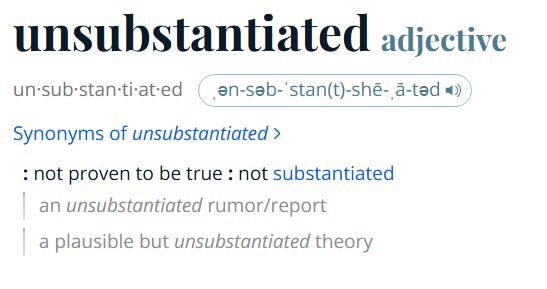
This links to “substantiated.” What do they list as the meaning for that? Here’s the main relevant definition:
: to establish by proof or competent evidence : verify
Here’s another definition from dictionary.com:
not substantiated; unproved or unverified.
I used “unsubstantiated” in the primary, conventional sense relevant to the context: to mean that the claim hasn’t been proven or verified (which, just to be clear, I don’t take to mean “entails the truth of”; others may associate these remarks with something being definitively established as true but I don’t. I take these terms to carry legalistic implications with an implied e.g. “beyond reasonable doubt” where their falsehood remains technically possible but has been ruled given available evidence to be very unlikely. For what it’s worth, I would also find it inappropriate to impose formal logical categories on much of ordinary language; ordinary people rarely think in terms of strict logical possibility when employing these terms).
“Unsubstantiated” is rarely used to mean “literally no evidence at all.” Instead, it’s typically used with the normative connotation that the status of the evidence isn’t good enough to establish the claim being made. This is the sense in which I used the term. That this is what I meant isn’t simply conveyed by the conventional meaning of the term, but by my preceding remark about the lack of good evidence; after all, if I thought there was no evidence, why wouldn’t I say that? And it’s inconsistent with my public record of talking about evidence for moral realism, which I have repeatedly acknowledged and discussed for years.
It appears Rian may have misunderstood my initial remarks, interpreting them to be the stronger claim that there’s no evidence or support, rather than what I actually meant and think, which is that available evidence isn’t good enough to support such claims (though subsequent remarks from Rian suggest he did interpret me this way and thinks I’m lying anyway, but we’ll get to that)…though I would and have defended the stronger claim that the evidence doesn’t even come close to doing so. But that’s a far cry from the outlandish suggestion that there’s no evidence.
Given Rian’s clear and totally unjustified distortion of Nathan’s remarks, exaggerating and warping them beyond recognition, Rian appears to be at best negligent in his epistemic responsibility to interpret what others say accurately. This is unfortunate, because Rian may be trapped in a state in which he misinterprets other people in such a way that if those people were making the stronger and less plausible claims Rian thinks they are, then his frustration would be more warranted, but they aren’t, and so Rian’s reactions are excessive, unjustified misfires that target distorted versions of what others are saying rather than what they are actually saying. A bit of charity and patience would go a long way in facilitating more productive engagement with others, and I’d encourage Rian to consider asking for clarification before leaping to conclusions, e.g., he could have asked me “Are you saying there’s no support whatsoever?” to which I would have readily replied: no, I am not saying that.
Rian continues:
The more careful (and honest) move would be to say the evidence is underdetermined, that it can be contested or that it’s somehow open to challenge. But Lance “Burro” (as we affectionately call him here in Brazil) won’t touch that: because he’s far more interested in waving to his bubble than in having an actual and reasonable honest debate.
The remark about having a debate is especially bizarre, given that I actively seek out and have had more discussions and debates with proponents of moral realism than most academics working on these topics. I might even be the person with the most debates on these topics working in academia. Most academics don’t have blogs and aren’t on YouTube or TikTok or Discord. I am one of the few actively going out of their way to invite challenge and opposition. I can see why so many are reluctant: they have to put up with people like Rian. Who wants to do that? Apparently I do. This isn’t an idle point: I’m barely rewarded for the masochism it takes to respond to posts like Rian’s. Rian’s suggestion that I’d lie for tenure and citations is wildly inconsistent with my actual behavior. I could be writing an article for a journal right now. Or a grant proposal. These would help advance my career far more than responding to random tweets from hostile non-academics.
And yet here I am responding. What has been the reward for my public outreach? To be repeatedly insulted, ridiculed, and mocked by people like Rian, while paying massive opportunity costs in terms of advancing my career. No, Rian, I’m here for the love of the game. I’m here because I care about these topics enough to probably waste my time dealing with accusations like yours.
Returning to the first part of the quote, it makes no sense to claim that this is the more “honest” move. Someone can look at the evidence and disagree that it’s underdetermined. This would not make them dishonest. Honesty isn’t predicated on whether a person reaches the conclusion Rian thinks is most reasonable. Honesty is entirely determined by the intentions and beliefs of the person themselves. If a person sincerely believes something, no matter how preposterous, they’re not lying when they espouse that belief.
One interpretation of available empirical evidence about whether nonphilosophers are moral realists or antirealists would be that the evidence is underdetermined. I think that’s a pretty reasonable take on the literature. Ironically, though, if that were the case, a possible interpretation of this would be that Rian’s claim that moral realism is extremely intuitive across populations is unsubstantiated! At the very least, it wouldn’t be more substantiated than competing hypotheses, barring extra-empirical considerations. This would suggest that Rian himself could be committed to the conclusion that the most honest interpretation of the literature supports my claim and not his.
This is a bit tricky, though, and not something I’m inclined to actually attribute to Rian for two reasons. First, I think Rian’s initial response to me may be based on a misinterpretation of my claim about the status of the evidence (I think the evidence is not good, Rian seems to think I think there’s no evidence, though his remarks are ambiguous and seem inconsistent about this).
Second, to say that a claim is unsubstantiated suggests there’s insufficient evidence for it. In reality, though, if the theory is underdetermined by the evidence it may be very well supported by the available evidence, but simply isn’t strongly favored relative to competing hypotheses that are equally or about equally well-supported. So Rian could maintain that his original claim is true because it’s supported by the evidence (along with other considerations), while also acknowledging that the set of competing hypotheses are underdetermined by available evidence. You could endorse one hypothesis over another for reasons that aren’t reducible to the empirical evidence alone, for instance. Nevertheless, Rian doesn’t present any of those theoretical considerations and barring them it’d be a bit odd both to claim our theories are underdetermined by the data and to endorse one of them in particular; I’ll assume, then, that Rian has reasons for doing so that fall outside the scope of available data.
In any case, let’s now turn to the latter portion of the quote:
The more careful (and honest) move would be to say the evidence is underdetermined, that it can be contested or that it’s somehow open to challenge. But Lance “Burro” (as we affectionately call him here in Brazil) won’t touch that: because he’s far more interested in waving to his bubble than in having an actual and reasonable honest debate.
Rian seems to be suggesting I “won’t touch” the possibility of underdetermination of available evidence. This is false.
First, the theme of underdetermination is critical to the very notion of the core thesis I defend, folk metaethical indeterminacy, and looms in the background of the way in which I discuss indeterminacy and the possible forms that it could take. See Supplement 1, pages S1-40 through S1-45 for an extended digression where I address possible conceptualizations of indeterminacy before clarifying my particular thesis.
Second, my dissertation proceeds in the following steps. First, I attempt to show that existing measures are invalid, and thus we do not have compelling evidence one way or another as to whether most nonphilosophers have realist or antirealist stances or commitments in any appreciable number. Second, I present a series of studies which purport to offer an explanation for why existing studies are invalid and why available data is so inconclusive: that there isn’t a relevant psychological construct to measure in the first place. Existing studies are designed to sort participants into one or another of various discrete categories: realist or antirealist, cognitivist or noncognitivist, and so on. As I argue, efforts to do this are predicated on the notion that such distinctions are reflected in preexisting features of ordinary thought and discourse. I present a series of studies intended to support the abductive conclusion that the best interpretation of available data is that these efforts have failed because such preexisting stances and commitments simply aren’t present in significant numbers among ordinary people.
For comparison, imagine we came across an alien species that had never interacted with humanity or anything we’ve produced and tried to measure whether members of the population preferred Backstreet Boys over NSYNC prior to exposure to either and we tried to determine whether this preference was reflected in the way they speak and think. This would be absurd because an alien population wouldn’t have any preexisting preference and there’d be no plausible basis for supposing such a preference was reflected in their language and thought. My hypothesis is suggesting something along the same lines with respect to the realism/antirealism dispute: that realism and antirealism simply aren’t a feature of the way ordinary people speak or think.
Now, do I insist in the dissertation that this is the only possible conclusion? Absolutely not! I present my data as fairly tentative evidence for this conclusion, acknowledge tensions, and directly consider and engage with competing hypotheses. Of course I think available data can be contested: I contest it and welcome those who would contest my account! Of course I think it’s open to challenge! I myself am one of the people who’s presented such a challenge; that’s the whole damn point of the dissertation! And I certainly don’t think I’ve decisively settled the matter.
Here are some excerpts from the dissertation that illustrate this:
One way these findings corroborate previous research is that the same pattern of realism and relativism emerged across moral and nonmoral domains as prior research using first person measures (e.g., Goodwin & Darley, 2008; Wright, Grandjean, & McWhite, 2013). Participants judged others to be most inclined to support realism and reject relativism for facts, followed by morals, social conventions, and matters of taste. While this corroborates the order of judgments about realism and relativism with respect to these domains, it remains an open question whether or not, and to what extent, any given population is more inclined towards realism or antirealism about morality in particular. (p. 281)
Here’s another:
I am claiming that they have no determinate second-order moral stances or commitments specifically with respect to whether first-order moral claims are stance-independently true or not.
I say most because there are some instances in which ordinary people do hold a determinate stance towards realism or antirealism, and there are some instances of moral judgment and discourse that best fit one or another of competing metaethical analyses. Thus, I acknowledge that there are portions of folk metaethical discourse that are determinate with respect to moral realism and antirealism (see Gill, 2009). My position could be more accurately characterized as indeterminacy with a splash of pluralism, the hypothesis that elements of both realism and antirealism do determinately characterize some instances of folk moral thought and language. However, insofar as this is the case, it is unlikely that ordinary moral thought and language share a uniform commitment to a shared metaethical framework (see Gill, 2009). It also remains an open question how much, and to what extent, ordinary moral thought and language is characterized by determinate metaethical stances and commitments. (S1-1 - S1-2)
Notice qualifications, nuance, and specificity offered here. There are pages and pages of similar caveats, clarifications, and qualifications. I am far more careful than Rian’s remarks would suggest, and he’s done nothing to substantiate the accusation that I wouldn’t touch underdetermination as a possibility. Most importantly, consider this remark:
If people really do have all this exposure to philosophy, then why propose that folk philosophy is (at least in some cases) indeterminate? Why not suspect varied but determinate philosophical stances and commitments? That is, why not embrace folk pluralism instead of folk indeterminacy? This is a good question because most studies on metaethics at least superficially suggest folk pluralism. There are at least three ways to interpret this evidence:
(1) Accept it at face value. Pluralism seems to be true because it is true (e.g., Davis, 2021; Hopster, 2019; Pölzler, 2017; Pölzler & Wright, 2020a; 2020b, Wright, Grandjean, & McWhite, 2013).
(2) Argue for an error theory. There is systematic error in one or more patterns of response. Once accounted for, ordinary people share uniform and determinate stances/commitments (Beebe, 2020, Sarkissian et al., 2011).
(3) Argue for indeterminacy (or agnosticism). Apparent variability is an artifact of experimental design and does not reflect genuine pluralism in ordinary thought and language (Bush & Moss, 2020).
The first is the most straightforward interpretation and seems to be widely accepted among researchers. Given the strength of the evidence for (1), anyone who wants to present a case for (2) or (3) has their work cut out. Not surprisingly, I will present a case for (3). However, there are good arguments for all three views and, at present, there is no decisive evidence in favor of any of these perspectives.
Notice the remark above: I lay out the primary competing alternatives, explicitly state that there are good arguments for them (which does not entail that they’re justified), and explicitly state that the evidence in favor of my view (or any other) is not decisive. Rian’s remark suggests I’m not receptive to alternative characterizations of the literature. This is demonstrably false.
I shouldn’t have bothered to do any of this. Public, unsubstantiated accusations of lying, coupled with insults and mockery, are beneath contempt and don’t deserve a response. Rian has exhibited a consistent pattern of childish, immature, and hostile behavior coupled with an irresponsible and negligent handling of the claims made by others. He’s shown a total lack of charity, a hypocritical willingness to insult and mock others while expressing offense at even the hint of condescension directed his way, and has in general exhibited a pattern of behavior that would prompt most people to block or ignore him. For instance, consider this post, which followed Rian’s recent replies to me:


Here, Rian mocks my appearance by associating me with an unflattering meme. I responded to this on Substack:
You’re not exactly doing a good job of creating a good impression about yourself, given that you are posting things like this. You could try being polite instead of publicly mocking me. Do you think mocking people’s appearance creates a good impression about you? Is this the kind of person you want to be?
Rian replied:
Hey, don’t be so squeamish about it, dude. It’s a joke lol. I couldn’t resist the comparison. It’s SO similar and I had no idea when I’d ever get another chance to use it. As you don’t even believe that there’s something like stance-independent normative facts, what exactly am I supposed to make of the outrage here? Well, unless your subjective state of being personally annoyed by this now suddenly gives you some normative authority over me independently of my own stance, all you’ve really said is that you didn’t like the joke. Which is pretty fine! You can dislike it and I can like it. But if your disapproval is now supposed to generate some norm that somehow (?) binds me regardless of my own stance... well, well, congrats: now you’ve somehow managed to reinvent your own “à la carte realism” (to put it in your own terms) over a joke 😉
This is quintessentially immature and disreputable behavior. Rian also used this as an opportunity to pivot by making this remark:
As you don’t even believe that there’s something like stance-independent normative facts, what exactly am I supposed to make of the outrage here?
I suggested he was making a bad impression of himself, as you can see above. This meme is so ridiculous it’d be hard to experience outrage. This isn’t a matter of like or dislike; that’s irrelevant. It’s a question of whether this is an appropriate thing to post when you’re trying to have a serious conversation with someone. It isn’t. Rian also seems to have poor impulse control (“I couldn’t resist the comparison”) and can’t help but try to mock and ridicule others in a juvenile way. Given this, if Rian is trying to be taken seriously then he’s acting in a way inconsistent with that goal. My suggestion for Rian is to not do these sorts of things and to rein in his impulses.
Several subsequent remarks reinforce the conclusion that Rian has misinterpreted my original claim. Here’s a link to the full exchange. This involved an exchange between Nathan and Rian. I’ll use purple text for Nathan and green text for Rian to help distinguish them.
You claimed he was lying about the lack of support for folk moral realism. This implies he believes there *is* support but he's being dishonest about it
This is extremely implausible
More plausible is that he just disagrees that there's support
Rian replied:
It's lying to say that there's nothing to substantiate this position. There is - it's just that the evidence can be contested.
Justification/substantiation =/= being the truth. That's Epistemology 101.
Nathan responded:
It is very likely that Lance is sincere when he says the extant empirical literature doesn't count as good evidence. Or would you say he does think it counts as good evidence?
To which Rian replied:
The other option is that he’s dumb enough not to know that something can be substantiated or justified without necessarily being true, which is something you learn in basic epistemology. But I wanted to give him the benefit of the doubt.
Nathan:
It is very unlikely that Lance thinks folk moral realism is justified. If he doesn't think it's justified and he says there's no good evidence for it, this does not seem dishonest to me. This just sounds like him expressing his sincere opinion
Rian:
As I said, there is empirical justification for moral realism being intuitive. Justification does not, however, imply that the position is true: we can have reasons for believing something and still be wrong.
I gave the example of naturalism/atheism in my own case. A person who has justification for believing something is rational in believing it, in the sense that the belief has some grounding or substantiation rather than simply being asserted out of thin air, as Lance seemed to imply, while still being wrong for X or Y reasons.
So Lance is either lying when he says there is no justification whatsoever, or he is dumb enough to confuse a position having justification/substantiation with that justification being sufficient to make the position true.
Nathan:
To have *any justification at all* is not the same as *being justified* or having *good justification*.
When Lance says there's no *good* evidence, it's extremely likely that he does not consider the extent literature as good evidence because it contains confounds, etc.
Rian:
The point is exactly that he has to be lying when he says it isn’t good justification (in the only sense in which a justification can properly be called good: that it makes it rational to hold the belief) or else he’s dumb enough to think a good justification has to settle the truth (almost every empirical literature in this area has confounds, so simply contesting can't be sufficient to say that a justification isn't good - it's just that, as every justification/substantiation can be, it's doesn't automatically is perfect to settle the truth).
To be honest, I think Bush is both dishonest and dumb enough to be doing both (that’s an inclusive disjunction).
Nathan:
This doesn't mean that Lance is unbiased or that it's logically impossible for him to lie.
But if you think he does genuinely disagree with you, then that entails that he isn't lying!
What a mess. Let’s start cleaning this up. For the most part, I naturally believe Nathan has the right of it, while Rian remains confused, belligerent, and mistaken. Let me first clarify that I don’t quite agree with this remark from Nathan:
More plausible is that he just disagrees that there’s support
This is ambiguous. By disagreeing that “there’s support,” does this mean I disagree that there’s any evidence in favor of a view, or that the evidence in favor of the view isn’t sufficient to justify believing the view is true, or that there isn’t enough evidence to justify believing the view is the best explanation? I support the latter two claims (that belief in folk moral realism is unjustified and not the best explanation of available data) but not the first. Careful, Nathan! Yet the problems with Rian’s remarks are far more severe.
It's lying to say that there's nothing to substantiate this position. There is - it's just that the evidence can be contested.
Justification/substantiation =/= being the truth. That's Epistemology 101.
First of all, no, it isn’t lying to claim that there’s “nothing to substantiate this position.” Whether a claim is a lie or not has nothing to do with the content of the claim and everything to do with the relation between the claim and the beliefs of the person making the claim. This would be a lie if the person making this claim believed it to be false, and it wouldn’t be a lie if they believed it to be true. Rian may not entirely understand what it means for a person to lie. A lie occurs when a person intentionally states what they believe to be false.
In order to show that I am lying, Rian would have to make a case that I am intentionally making claims I myself believe are false. It’s always possible I am just wildly mistaken about something. People frequently are. That doesn’t make those people liars. Rian and many others are far too quick to accuse others of lying when it would suffice simply to claim that the person’s remarks are false without having to make further inferences about the beliefs of the person making those claims. Rian has presented no good evidence or reasons to sustain the claim that I am lying. Just about the best reason available would be that the claim I’m supposedly lying about is so outrageous I couldn’t honestly believe it. But this wouldn’t be a very defensible appeal, since lots of people believe all sorts of stupid and mistaken things. Why not just accuse me of profound ignorance or stupidity?
But the more serious problem with Rian’s remark is, again, ambiguity. Just what does it mean to say that “there’s nothing to substantiate this position”? When I said the claim was unsubstantiated, I was making a claim about the degree of evidence:
Available evidence is not good enough to support the conclusion that moral realism is extremely intuitive across populations.
Here Rian says “nothing to substantiate this position.” This use of “substantiate” is ambiguous between at least three interpretations:
Support/evidence for
Justify/warrant belief in
Establish/confirmed by a sufficient body of available evidence and considerations to be considered verified (a higher standard than the second)
I would only reject (2) and (3), but not (1). Rian’s follow-up remark appears to rule out (3):
Justification/substantiation =/= being the truth. That’s Epistemology 101.
“Substantiation” could be being used alongside “justification” to mean something like the fact that a claim is justified/supported doesn’t entail that it’s true, or it could be used as a synonym, where “substantiation” just means “justified” or something similar. It’s not clear here. So it remains unclear at this point what exactly Rian means when he uses the term “substantiated.”
Nathan’s response pivots back to my original remark about the absence of good evidence:
It is very likely that Lance is sincere when he says the extant empirical literature doesn't count as good evidence.
Or would you say he does think it counts as good evidence?
Rian’s remark is, once again, not very helpful:
The other option is that he’s dumb enough not to know that something can be substantiated or justified without necessarily being true, which is something you learn in basic epistemology. But I wanted to give him the benefit of the doubt.
How flattering. I’m aware the term is an epistemological one and I’m aware of the logical possibility that a position considered “substantiated” could be false. One might question Rian’s own understanding of these concepts. However, from the exchanges I’ve seen Rian engaged in I see little indication Rian has any better a grasp of these terms, their standard uses, or their application to philosophical matters than myself or the people he’s arguing with. Yet I don’t personally think not having a sophisticated grasp of these terms would mean that a person is “dumb.”
Nathan pivots back to commenting on whether I think the evidence is good:
It is very unlikely that Lance thinks folk moral realism is justified. If he doesn't think it's justified and he says there's no good evidence for it, this does not seem dishonest to me. This just sounds like him expressing his sincere opinion
That’s correct. I don’t think belief in folk moral realism is justified. That would require an adequate degree of evidence, which I don’t think we have. Now look at Rian’s response:
As I said, there is empirical justification for moral realism being intuitive. Justification does not, however, imply that the position is true: we can have reasons for believing something and still be wrong.
If by “empirical justification” Rian means “sufficient evidence that it would be reasonable to conclude that moral realism is intuitive” (this still lacks quantification, so it’d be helpful to have a more precise claim like “among most people in most populations") then my position is: no, there isn’t. If Rian is instead claiming merely that there’s some evidence without quantification then of course there is, but the latter claim would be trivial. This difference is extremely important, but Rian simply isn’t clear. There’s a difference between there being some evidence for a view, and there being good arguments for a view, and that evidence and those arguments being good enough to justify the view.
Rian continues:
I gave the example of naturalism/atheism in my own case. A person who has justification for believing something is rational in believing it, in the sense that the belief has some grounding or substantiation rather than simply being asserted out of thin air, as Lance seemed to imply, while still being wrong for X or Y reasons.
This still isn’t clear. What does it mean to have “some grounding or substantiation”? Some? Some could mean literally any quantity above zero. If that’s the case, then there’d be at least some “grounding or substantiation” for just about any belief at all (e.g., the earth being flat, every conspiracy theory, and so on), especially if you endorse phenomenal conservatism and think the mere fact that something seems to you to be true provides some justification. Rian isn’t being clear about the standards here. “Some” grounding or justification typically wouldn’t be regarded as sufficient to justify or make it rational to believe something, especially because it would matter whether there is a greater amount of grounding or justification for an alternative account.
Rian contrasts this with a claim being “asserted out of thin air,” which he says “Lance seemed to imply.”
No I didn’t. I said the claim was unsubstantiated. This does not imply that the claim was “asserted out of thin air.” I’m aware and have always been aware that people who think moral realism is intuitive have reasons for thinking this. I don’t think they have no reasons; I think their reasons aren’t good enough to substantiate claims about realism being intuitive among nonphilosophers. That I’m aware they have reasons and have presented evidence for their claims is a matter of public record. In short: claims can be unsubstantiated without being asserted “out of thin air.”
What has happened here is that Rian has misinterpreted me, reading phantom “implications” into my remarks that weren’t present and that he simply imagined. It’s unfortunate Rian has opted to hold me accountable for claims I didn’t make and slights I didn’t commit.
So Lance is either lying when he says there is no justification whatsoever, or he is dumb enough to confuse a position having justification/substantiation with that justification being sufficient to make the position true.
The claim that there’s “no justification whatsoever” is ambiguous. “Justification” could be used to mean anything that could serve as evidence and thus potentially justify a belief, regardless of whether the total amount of evidence for and against a given position was sufficient to justify holding the position. Alternatively, “justification” could refer to there being enough evidence to justify or make rational belief in the claim in question. Roughly, there would be at least two interpretations of “no justification whatsoever”:
That there’s no evidence for Rian’s claim
That there’s not adequate evidence to make Rian’s claim justified or rational
Once again, Rian simply isn’t clear about what he means. I’d only endorse the latter claim and not the former. If Rian is making the first claim, then that’s not something I’ve ever claimed. If he’s making the latter claim, well, I think the claim is true, so I’m not lying about it. Once again, it makes no sense to insist someone is lying merely on the basis of the nature of the claim itself. Even if you think the claim is preposterous or clearly wrong, that still doesn’t mean that if someone makes such a claim then they’re lying. This puts Rian in a very bad position. If on disambiguation he opted for the “no evidence” claim, then I don’t endorse that and never made such a claim, in which case his accusation would be false. If he instead opted for the “adequate” evidence claim, then I do endorse that, but it’s no longer clear why he’d insist I was lying about it. It’d be ridiculous to think that if someone holds that one or more views they reject are unjustified, that therefore this person must be lying. Theists routinely think atheists are not justified in their atheism; does this mean they’re lying? No, of course not. Thinking alternative positions are not justified is ubiquitous and in no way suggests a person is lying. Thus, on either of the disambiguations provided here, Rian’s accusations wouldn’t make any sense and would be indefensible.
Needless to say, the dichotomy he’s offered is absurd and indefensible, and he provides no good reasons to think it’s true. Most of Rian’s remarks consist of assertions and repetitions of those assertions, with little in the way of supporting arguments or evidence.
Nathan appreciated the ambiguity and immediately pointed it out:
To have *any justification at all* is not the same as *being justified* or having *good justification*.
When Lance says there's no *good* evidence, it's extremely likely that he does not consider the extent literature as good evidence because it contains confounds, etc.
Now we can see how Rian resolves the ambiguity:
The point is exactly that he has to be lying when he says it isn’t good justification (in the only sense in which a justification can properly be called good: that it makes it rational to hold the belief) or else he’s dumb enough to think a good justification has to settle the truth (almost every empirical literature in this area has confounds, so simply contesting can't be sufficient to say that a justification isn't good - it's just that, as every justification/substantiation can be, it's doesn't automatically is perfect to settle the truth).
To be honest, I think Bush is both dishonest and dumb enough to be doing both (that’s an inclusive disjunction).
Rian resolves the ambiguity in the direction of the second of the two notions of justification above:
That there’s not adequate evidence to make Rian’s claim justified or rational
No, Rian, I think the claim you made isn’t justified in precisely the sense that I don’t think you have good enough evidence for it to be reasonable to believe what you claimed. Why would I have to be lying about this? You have a few positions you can take for people who hold contrary views:
That their views are also true
That their views are not true, but the person who holds them is justified in believing them
That their views are not true, and that the person who holds them is not justified in believing them
With respect to folk moral realism, I endorse (3). Rian seems to think that the evidence is good enough that one is justified in believing his claim. I don’t. The mere fact that there’s contestable evidence to support his claim doesn’t mean that I must conclude that the evidence is good enough to justify belief in folk moral realism. I have never suggested that I am so confused I think that people’s claims must be either irrational or true, and that there’s no possibility a person could rationally hold views contrary to my own. Of course I think that’s possible, and I’ve never said anything that would suggest otherwise. Rian’s dichotomy is a completely manufactured fantasy that has no substantive basis in what I actually said. Finally, we have this remark:
To be honest, I think Bush is both dishonest and dumb enough to be doing both (that’s an inclusive disjunction).
What should we make of this? Rian has presented no good reasons to think I’m lying or that I’m dumb. Both of these claims are also unsubstantiated.
Rian’s consistent pattern of belligerence, lack of charity, penchant for public mockery, confusion, distortion and misinterpretation of other people’s claims, ambiguous and imprecise claims, general lack of supporting argument and evidence for his claims, and overall conduct all suggest that Rian may lack the acumen to assess how honest or intelligent I am. From all appearances, Rian is an immature, ignorant, hostile person. He appears to have a personal grudge against me, given his remarks about his friendship with David Ribeiro:
I didn’t like the condescending way you posted my tweet as if I were just asserting something out of thin air, and I already have a very bad impression of some of your attitudes toward people close to me, such as David Ribeiro. But we can leave that aside. After your reply, we can talk about discussing this.
I blocked David a few years ago for endorsing a false accusation of lying. David seemed to be extremely aggrieved by this and began showing up on YouTube in comments and streams repeatedly accusing me of lying and claiming he had evidence that I lied. He does not, and his behavior arguably constituted harassment.
Rian appears to have formed his bad impression based off of the confused errors of his friend, David. If I had to speculate, I would suggest that they have formed a distorted conception of me in their minds as a dishonest person pretending to hold views that I don’t really hold mostly resulting from David being upset about me blocking him. I usually block anyone who accuses me of lying, which is weirdly and surprisingly frequent.
This is unfortunate, as it’s very difficult to disabuse people of these notions. What I am dealing with appears to be people with an unfortunate and likely intransigent personal grudge against me who are likely to interpret what I say in light of that grudge. This will inevitably result in them seeing lies and subterfuge where none exists. I doubt there’s much I can do to remedy this. I can only hope that if I repeatedly address them in a more civil manner than they’ve addressed me it might dawn on them at some point that maybe, just maybe, they screwed up and got this one wrong. I’ve seen some of David’s remarks elsewhere, and the sad part is we seem fairly aligned on many issues. I think if the particular situation where I ended up blocking David hadn’t occurred, we may be on quite friendly terms. So I’ll take this as an opportunity to invite David and Rian to have a discussion with me. Maybe we can clear matters up. Maybe we can’t. But I’d rather be on good terms with them than on bad terms. Rian’s loyalty and commitment to his friend are commendable. But your friends can be wrong.
As a final note on the accusation that I am lying, I want to stress what I take to be one of the strongest reasons to believe these claims are so baseless and misguided: it would be pretty easy for me to provide testimony from friends and family who speak to me privately. I express the same views, including the view that there’s no good evidence that people are moral realists repeatedly in these contexts. For Rian to be convinced I’m lying, I’d have to maintain the same lie in my private life. This is completely silly. It’s absurd to suppose that I’d put that much effort into so trivial a lie.
While I am willing to meet with and discuss these matters with Rian, I will not pull punches on how poor his conduct has been (along with David’s). The accusation that I’m lying is so preposterous, obnoxious, unsubstantiated, and downright unethical that it doesn’t deserve a response. I would be entirely within my rights to ignore Rian, block him, and go about my business. Publicly accusing others of lying without adequate evidence isn’t just foolish, it is immoral, and Rian should be ashamed of both the accusation and his subsequent juvenile behavior: the insults (dumb, burro, etc.), and the meme mocking my appearance.
I have opted to respond to Rian anyway. My prediction is that Rian will make no concessions, apologize for nothing, and continue to maintain that I am lying, dumb, or both, despite my having thoroughly refuted every confused, unsubstantiated, and outlandish claim he’s made so far.
I hope I’m wrong.
References
Bush, L. S. (2026). Why training paradigms won’t rescue experimental metaethics. Review of Philosophy and Psychology, 1-26.
Collier‐Spruel, L., Hawkins, A., Jayawickreme, E., Fleeson, W., & Furr, R. M. (2019). Relativism or tolerance? Defining, assessing, connecting, and distinguishing two moral personality features with prominent roles in modern societies. Journal of personality, 87(6), 1170-1188.
Loeb, D. (2008). Moral incoherentism: How to pull a metaphysical rabbit out of a semantic hat. In W. Sinnott-Armstrong (Ed.), Moral psychology: The cognitive science of morality (Vol. 2, pp. 355-386). Cambridge, MA: MIT Press.
Pölzler, T., & Wright, J. C. (2020). Anti-realist pluralism: A new approach to folk metaethics. Review of philosophy and psychology, 11(1), 53-82.
Sinclair, N. (2012). Moral realism, face‐values and presumptions. Analytic Philosophy, 53(2), 158–179.
"I’m curious why this happens, so if you have any thoughts, please share them."
If I may, I want to share a speculative hypothesis. I, of course, cannot read minds and am just guessing, but I think this guess may be beneficial for looking atvthis interactions from a different point of view. A quick note; I work as a psychotherapist and as a result have become accustomed to analyzing interactions on two semi-parallel levels (i.e. what is said and how it is said).
So, with that long intro, my speculation is that the reason this happened is due to meta communication issues, rather than the content of claim per se. To me, it seems that your initial tweet can be perceived as terse, inconsiderate of the other sides evidence t, and excessively oppositional. Not saying that it is an accurate interpretation, just that it's a possible one. And usually, when people perceive a communication as an attack, their responses would lean toward a less charitable interpretation of the other person's behavior in general. Hence, the accusation of lying