


1.0 The unintelligibility thesis
The philosophical position I defend which has generated the most ire is the unintelligibility thesis. This is the thesis that certain terms and concepts used in contemporary metaethics are not meaningful, specifically irreducibly normative reasons. An irreducibly normative reason is a normative reason that cannot be reduced to, redescribed, or in any other way understood in purely descriptive terms. It is normative simpliciter. I don’t think the claim that there are reasons of this kind is true or false. I think it is meaningless: there are no conceivable facts to which such a claim could correspond, even in principle. Those who claim to “have” the concept of irreducibly normative reasons are conceptually confused. They don’t have such a concept, because there isn’t a concept to have.
Many people take issue with this. Some see it as uncharitable or insulting. Still others find it so incredible I could believe irreducibly normative reasons are an unintelligible concept that they think I am lying or pretending to hold such a view. Others see it as absurd or obviously wrong. Still others maintain that my basis for such a claim is rooted in an appeal to incredulity, an informal fallacy whereby one maintains that, because they cannot imagine how something could be true, it must be false.
All of these claims are wrong, and my goal in this post is to explain why.
2.0 The UT is insulting/uncharitable
Some people claim that to suggest others are employing meaningless concepts is uncharitable. This charge makes little sense because the claim that the position is unintelligible is my claim, and isn’t itself an attempt to characterize the position or the arguments for the position as expressed by its proponents. While it’s possible my conclusions are based on an inaccurate presentation of the view, I have yet to see any reasonable case that I am mischaracterizing what proponents are saying, beyond not accepting claims I am entitled to reject at face value (specifically, the insistence that the claim is intelligible). Being charitable does not, after all, require accepting someone’s position or abstaining from having a position of one’s own that runs contrary to that position.
A related accusation is that it’s insulting to suggest serious professional philosophers could hold an unintelligible position. Even if this were true, it would be irrelevant as to whether I were correct. If the position is true, then however insulting people may find it, that is an unfortunate consequence of the truth. But I also deny there’s anything especially rude or insulting about the UT. Consider: is it insulting to consider a person’s position false? Presumably not. So let’s compare how insulting it is to suggest a term is unintelligible rather than false.
Suppose a group of people have all the knowledge, tools, and resources available to adequately solve a problem, but consistently fail to solve it, anyway. They keep arriving at false conclusions. We might conclude that these people were incompetent. How else would we explain their failure, if they have all the tools available to succeed? But suppose instead that these people had the wrong tools for the job. They were using the wrong methods, or were confused about some fundamental aspect of the task. As a result, they were unable to succeed because of this more foundational mistake. Once this foundational mistake was corrected, they solved the task with no problem and arrived at the correct conclusion. In this latter case, they aren’t incompetent; it’s just that one small mistake at the start can have cascading consequences or prevent a downstream solution.
This is comparable to charging a philosophical position with being false rather than unintelligible, respectively. My position is that philosophers have been inducted into a poor set of tools and methods for solving philosophical problems and that, as a result, they are consistently led astray. I do not think this is because they are stupid or incompetent. I think it’s natural to work within the constraints of a set of tools one is taught to use. Humans are cultural organisms, we specialize in specific tasks, and we typically learn and function best within the strictures of social institutions that support and maintain the cultural transmission of semi-codified bodies of knowledge that constitute bounded task categories, e.g., “hunting” or “building”. In other words, we are not totally freewheeling engines of innovation and thought; we are bounded agents whose knowledge is heavily embedded in social institutions. In our ancestral past, hunters would pass on their knowledge to successive generations. Boat makers, fletchers, builders, foragers, and so on would do the same. Bad ideas could be and were passed along with the good ideas, due to quirks in how cultural transmission operates. A person may incorporate an irrelevant step, or rituals may emerge, that serve no direct functional purpose but piggyback along the functional tasks we engage in.
I believe much of academic philosophy operates in a similar fashion. We don’t learn the best methods. We inherit the methods of our predecessors. Just as we absorb our culture’s languages, ethos, norms, standards, style, and so on, people within academic disciplines adopt the subculture and traditions of that discipline. For productive disciplines, this is mostly a good thing. The sciences have flourished as a result, and philosophy has made halting progress and occasional breakthroughs, including its contributions to science. I think philosophy still has more to do, and that it isn’t a worthless discipline. But I do think analytic philosophy is still operating within a narrow paradigm that clings to a misguided 20th century conception of language and meaning that was heavily corrupted by early and misguided notions about language and cognition, which was further warped by the malefic influence of Chomskyan views of language. But that’s a digression. My point here is that misunderstandings or conceptual errors can have deep and, importantly, understandable roots. To be caught up in a web of verbal and conceptual confusion that results in a commitment to meaningless concepts does not require stupidity or incompetence; it merely requires allying oneself with the wrong intellectual tradition.
Conversely, suppose we took a conventionally antirealist position towards the realist’s position: that their position is false. If I were a conventional analytic antirealist, and bought into the mainstream assumptions of the field, I’d be in the unfortunate position of believing that the methods we’re using are sufficient to get the job done; they might even be the best or only viable methods available to us. If we use them properly, they should work, and we should arrive at correct conclusions. And yet, on such a view, moral realists get it wrong anyway. They have all the tools at their disposal to get the right answer (moral antirealism) but endorse the opposite. Why don’t we consider this perspective insulting? Why isn’t this even more insulting than concluding they’re using the wrong methods? For comparison, imagine two positions on why an engineer failed to build a bridge:
They have exactly the right tools and are fully capable, but failed anyway
They lacked the proper tools, and thus couldn’t have succeeded at the task
Which of these is more of an indictment of the competence of the engineer? I think the first of these is, if anything, the more insulting of the two. Likewise, calling another person’s position false may, in certain contexts, be a better candidate for a rude or insulting stance to take than accusing them of having an unintelligible position.
One might argue that to accuse someone of unintelligibility is still more insulting. It implies greater confusion or mistake. This isn’t quite right. It implies a more fundamental mistake, but a more fundamental mistake isn’t necessarily one that carries the implication that the person committing it is more foolish, or incompetent, or worthy of critical judgment. A more fundamental mistake could be less obvious and have less to do with one’s competence, for reasons outlined above. Or we might suppose that the nature of unintelligibility is itself somehow more intrinsically insulting. It’s one thing to say what someone says is false, but to say it’s not even false? That’s going too far. Only I don’t personally think of it this way at all. The false/unintelligible distinction is a qualitative distinction in the form of error; it isn’t a measure of the degree of error. I could repeat iterations of these sorts of concerns ad nauseam.
My point is simple: to hold that a particular term or concept is meaningless, and that any positions based on it are in error, does not in itself entail anything especially insulting, negative, or critical about those who made the ostensible mistake, relative to simply maintaining that the view in question is false. I, at least, don’t think of it this way, and thus at the very least cannot be accused of intending to insult others. If others find my position on the matter insulting or offensive for inscrutable or unwarranted reasons, then I am sorry to say, but that’s on them. So I’d ask that people dispense with these sorts of objections. I’m not insulting anyone and I’m not trying to insult anyone. Thinking a position is the result of the kinds of linguistic/conceptual confusions Wittgenstein and others have outlined is no more an indictment of the competence of the thinker than simply saying they’re wrong, and is perhaps less of one.
And again, whether I’m being rude or insulting is irrelevant to the truth of the unintelligibility thesis.
3.0 I am lying or pretending to not understand the relevant concepts
A related objection to my position is that I am lying, pretending to not understand the concept in question, that I am “disingenuous,” or that I am operating in bad faith. Others have questioned whether anyone has seriously accused me of this, so I began a channel on my Discord where I and others can document accusations of dishonesty like this. Several have been directed at me. Here are a handful of examples:


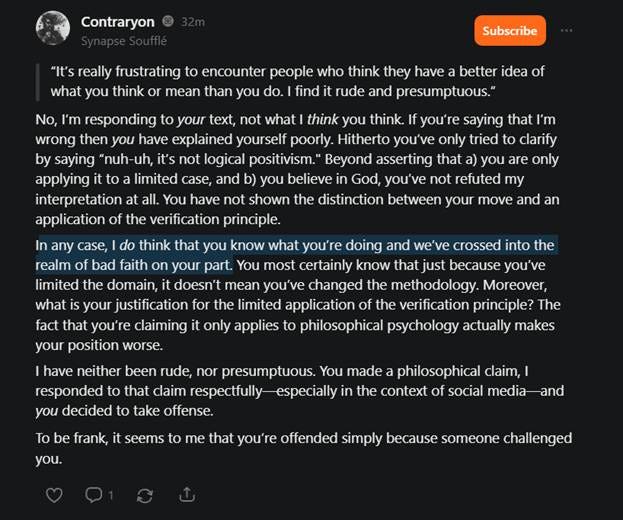
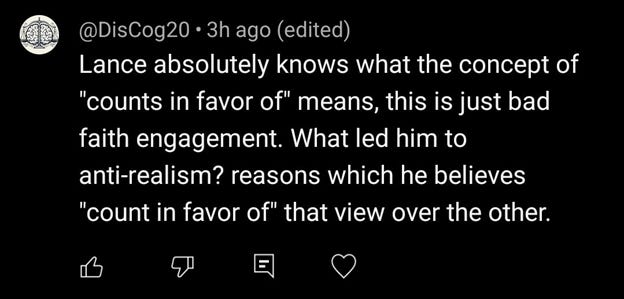

Note that these are just a handful I’ve happened to collect, only after years of similar examples. These accusations are, uniformly, baseless and ridiculous. I can only speculate that the main reasons people make these accusations are that (a) they are so incredulous someone could disagree with them that they presume the person must be lying, which says more about their own intellectual limitations than my own and (b) they don’t have substantive objections, since one would presume if they had them they’d present those instead of making baseless personal attacks.
In any case, there’s a trend of people accusing me of bad faith, dishonesty, disingenuity, and so on. None of these people could produce a single iota of credible evidence to support the notion that I am lying or engaging in bad faith. This is ironic, given that the rest of this post is about appeals to incredulity, yet the entire basis for people making these claims appears to be their own personal incredulity that I would claim not to have concepts or beliefs they have (and that they may consider obvious). The difficulty they have imagining how someone could not share the same concepts as them is quite strange; some people don’t have mental imagery or don’t have an internal monologue. Is it so hard to imagine some people don’t have certain concepts or can’t/won’t grasp something, even if others can grasp it? Some things are just beyond some people. That’s why I take the claim that I am “conceptually impoverished” or even brain damaged more seriously; I know I’m not lying, so if there is a meaningful concept in play here, the issue is my inability to access it, not my secretly having it and pretending not to.
I’ve been on the fence about addressing these sorts of comments, though. These kinds of accusations are barely worth dignifying. Unless you have substantive evidence or reasons for believing someone is being dishonest, such accusations say more about the accuser than the accused. Accusing someone of dishonesty merely for articulating a position you find implausible suggests a failure of imagination (they can’t imagine someone disagreeing, so they must not!) or intellectual laziness (it’s easier to dismiss a view you find implausible than engage with it), and may even imply that they themselves are disposed towards dishonesty (dishonest people may assume others are inclined to be dishonest, because they assume others think similarly and have similar motives).
I’ve said this before, but I’ll say it again here: my philosophical positions are very much woven into my personality. I am obsessed with metaethics and talk about it constantly offline with friends and family. They could all readily attest that I say exactly the same things privately as I do publicly (with, if anything, even more fervor). I’ve even thought about posting testimony just to make the point. What are my accusers going to do, then? Accuse me of lying to my friends and family? Insist the testimony is made up? Am I hiring paid actors? At a certain point, these accusations of dishonesty become painfully silly; they’d require implausible levels of conspiratorial organization on my part, or they’d require the insistence that I keep up the same act in private and that I have done so nonstop for years. I’d have to pretend to students when I teach courses, pretend to my wife, pretend to all of my friends, pretend in private email correspondence, pretend in my publications and at conferences, and so on, all of which express a consistent set of views. And what would be the motive? Do I profit somehow from all the lies and pretending? The primary consequence of me expressing these views hasn’t been fame or fortune or notoriety. It’s been frustrating dealing with annoying and baseless accusations that I’m pretending or being dishonest! I have not enjoyed the consequences of expressing these views. There have been few benefits, and mostly costs. And yet another irony is that the people accusing me of lying (again, what is the motive?) are themselves constituting the primary cost, and thereby are contributing to the lack of incentive I would have for lying in the first place.
And, of course, even if I were lying, that would be irrelevant to whether the position in question is true; the quality of a position does not turn on the honesty of the person articulating it. If a person who believed the earth was flat went around lying that it was round and presented arguments that it was round, those arguments would stand or fall on their own merits. Arguments aren’t worse because the person presenting them doesn’t believe them. So, just like the accusation that my claim is insulting, whether I was pretending to endorse the unintelligibility thesis would likewise be irrelevant.
4.0 Appeals to incredulity
Finally, one response to the unintelligibility thesis is to insist that my position relies on an appeal to incredulity. An appeal to incredulity is an informal fallacy. Informal fallacies are not formal errors in the logical structure of an argument, but turn instead on extraneous considerations related to the content of the argument and the inference patterns associated with it. Such fallacies are broad in scope, but typically relate to the drawing conclusions on the basis of irrelevant considerations or drawing conclusions that simply don’t follow from the premises in question, not because of the structure of the argument, but because of the specific content of the premises themselves. For instance, the claim that someone’s position is incorrect because that person is ugly would be an informal fallacy known as an ad hominem: that a person is ugly is irrelevant to whether their conclusion is true.
Usually, anyway. Informal fallacies are not uniformly applicable so long as some minimal, superficial conditions are met. Claiming that we should reject someone’s conclusions because they are stupid, ugly, or smell bad may look like an ad hominem, but the mere fact that your basis for rejecting their conclusion is also an insult does not entail that you’ve committed a fallacy. What matters is whether the insulting claim is relevant. Sometimes it will be. What this illustrates is that informal fallacies differ from formal fallacies in that they often lack principled, rigid application conditions; one must be attentive to the context and content of the argument to correctly assess whether a given inferential mistake has been made. Take the case of the “ad hominem” of saying someone is wrong because they are ugly. Is this necessarily a mistake? No, it isn’t. Suppose that the person in question made the following argument:
P1: I am beautiful.
P2: If I am beautiful, people should shower me with praise.
C: People should shower me with praise.
Arguing that this person’s conclusion is false because they are ugly is, in fact, relevant. It’s relevant because it would entail that P1 is false. As such, saying someone is wrong “because they’re ugly” isn’t necessarily a fallacy. It’s only a fallacy when it’s irrelevant. And any irrelevant consideration would be a “fallacy” in virtue of the simple fact that it’s irrelevant.
Informal fallacies like this are really just a label we slap onto recurring mistaken inference patterns. They are not uniformly applicable to every and any situation in which the event that is often associated with the fallacy occurs. Not every insulting remark used as a reason to reject a conclusion is an ad hominem, and the same holds true of many other informal fallacies. Take the slippery slope fallacy. This “fallacy” occurs when a person unjustifiably claims that if we take a particular course of action, this will lead to a chain of events that will terminate in undesirable consequences, and that, because of this, we shouldn’t take the initial course of action. For instance, someone might argue that we shouldn’t allow polygamy because it would obliterate all standards and guidelines for restricting marriage of any kind. Next, we’d have to allow marrying animals or sandwiches, which would lead to a breakdown in the norms and guidelines that sustain civilization, ultimately culminating in our extinction.
The problem with this line of reasoning is that it’s an open question if and when it’s “fallacious”. If someone actually has arguments or reasons for thinking a particular cascade of catastrophic consequences would follow from a given course of action, there’s no reasonable sense in which it’s fallacious. Suppose we had a crystal ball and it turned out that allowing polygamy would lead to human extinction. It would make no sense to insist someone presenting an argument against polygamy was therefore committing a fallacy. They’d be correct and correct for justifiable reasons. There’s no reasonable sense in which such inferences could be a “fallacy.” (Just to be clear: I don’t think polygamy would lead to human extinction. The example is intentionally far-fetched to illustrate that how far-fetched something is does not entail that it is fallacious. One could in principle have good reasons for reaching conclusions that seem bizarre or implausible to us given limited information). Personally, I barely see the need to recognize this as a “fallacy.” It’s simply that sometimes claims about the consequences of an action are false (or at least unjustified) and sometimes they’re not.
This brings us to appeals to incredulity. What, exactly, is an appeal to incredulity? First, it is often called the personal incredulity fallacy. The “personal” element of the fallacy is important here. The mistake occurs when someone infers from the mere fact that they are unable to imagine how something could be true or find themselves incapable of believing that something is true, that therefore it’s false. It more or less amounts to reasoning like this:
“I can’t believe it! So it must be false!”
Does my rejection of the intelligibility of irreducibly normative reasons turn on an inference like this? And does it exclusively depend on my personal claim to be unable to understand the position? No. I have never made any inference from the mere fact that I don’t have or understand the concept to the conclusion that therefore, because of this fact alone, the concept is unintelligible.
There are also asymmetries between my position and standard characterizations of appeals to incredulity. Typically the “fallacy” has to do with concluding something isn’t or can’t be true, not that it is unintelligible. And these are typically predicated on a direct inference about one’s own psychology, independent of any considerations about why they’re unable to regard the claim in question as true. As with other informal fallacies, it’s simply not the case that any instance in which a person both thinks:
(1) I don’t understand [claim]
(2) Claim is false/nonsensical
…that they are necessarily committing some kind of fallacy. The only time this is a fallacy is if one concludes (2) on the basis of (1) in the absence of any relevant considerations that would account for (1) in such a way that it would warrant drawing the conclusion that (2). As with ad hominem and slippery slope “fallacies,” whether or not a mistake is occurring depends, crucially, on contextual considerations. Suppose a mathematician encounters someone who insists:
The number four is prime because God says so.
If the mathematician finds themselves unable to conceive of how 4 could be a prime number, and concludes that it isn’t, are they committing a fallacy? Is this an “appeal to incredulity”?
No, it isn’t. It is, in fact, in virtue of their understanding of prime numbers and the number four that they can’t imagine how four could be a prime number: its characteristics preclude it, by necessity, from being prime. As such, there is a good reason why they can’t believe four is a prime number: because the characteristics of prime numbers and the number four are inconsistent in such a way that it is impossible for four to be a prime number. It is, in fact, knowledge of these concepts that ensures that one can’t imagine how four could be prime and can’t believe it. Thus, there are at least some (there are, in fact, many) situations in which one’s inability to believe or comprehend something is a direct result of having a proper understanding of the conceptual matters under consideration. Correct understanding can close off the ability to conceive of something being true which is fundamentally at odds with e.g., matters of logical necessity or that would be incoherent on reflection. Can you imagine, for instance, that dogs have all the exact same characteristics, but are nevertheless a type of reptile? I can’t. Because I think being a reptile is constituted by precisely those properties that I am being asked to hold constant. The suggestion is a nonsensical one. There’s no special “reptile essence” that floats free of the features of dogs and reptiles.
Consider another case. We encounter a person who has been drugged, and the drug in question is known to cause temporary confusion and cognitive dysfunction. We find the person saying things like:
All the blorgnovs are smirgalong! Shabba shabba shabba!
…before screaming, then giggling, then rolling around on the floor. Is it reasonable to conclude that this person is talking nonsense? Is it a fallacy to find oneself unable to believe that all the blorgnovs are, in fact, smirgalong?
No, it isn’t. Once again, contextual considerations, including background knowledge, matter. One has good reason to believe this person is talking nonsense, as indeed they might be. And if someone is talking nonsense, then what they’re saying has no determinate truth value. Is this true or false?
Shabba shabba shabba!
Or how about this?
Lkjasdl lajkwertl qlkjwel jypqpe.
These strings of letters are neither true nor false. The former is just gibberish, while the latter is random letters I typed out. Nonsensical claims don’t have a determinate truth value. And one may be justified in appraising certain remarks as nonsensical, and therefore incapable of being true in principle, either because one has a good understanding of the conceptual landscape in question, or good background reasons to think apparent nonsense is nonsense (e.g., because it is being uttered by a person with cognitive impairment due to drugs known to cause people to babble nonsense).
This is roughly the situation I am claiming to be in with respect to appeals to irreducible normativity. I could be wrong. It’s possible that I am deluded and that the only reason I reject the meaningfulness of the concepts in question is my personal incredulity. But this is something someone would have to demonstrate via arguments and evidence. It is not transparently the case that I am moving straight from “I don’t get it” or “I find this unbelievable” to “therefore it’s not true” or, in my case “therefore it’s not intelligible.” This isn’t something I’ve said or done, and, in any case, even if I had in the past, I universally retract all such remarks and denounce them as mistaken. As such, any continued insistence that this is an inference my position is currently based on would be at best outdated, but more likely was never true to begin with. So, if I’m not explicitly or transparently committing a fallacy of an appeal to incredulity, those who accuse me of doing should do something quite simple:
(1) Provide direct quotes of my remarks (especially recent ones)
(2) Show how those remarks illustrate that I’m committing the fallacy.
I have yet to see anyone do this. I believe there’s a good abductive explanation for this: because I haven’t done this, and the people accusing me of appeals to incredulity can’t provide receipts showing that I have actually done so.
In short: claiming that something is inconceivable, nonsensical, or that one cannot understand how it could be true is not necessarily fallacious; it is only fallacious if one moves directly from the mere fact that one cannot imagine or accept the truth of a claim to the conclusion that the claim is false. This isn’t something I endorse doing (at least not knowingly), so I am not committing this particular fallacy…unless someone could show that I’ve unwittingly done so, which they haven’t.
This alone is reason enough to reject these criticisms. However, the emptiness of the charge is overdetermined by other considerations. Foremost among these is the fact that I offer more reasons for rejecting the meaningfulness of the terms than a mere appeal to my personal lack of the concepts in question. My primary reasons are not inductive inferences based on my personal experiences. Rather, they are abductive. I believe a decent case can be made that the concept is not part of ordinary thought (and it certainly isn’t part of ordinary language) and is instead an obscure technical term that arose only among academic philosophers.
Along with this, I believe I can offer some debunking considerations that can account for why philosophers would be drawn to the notion, despite its unintelligibility; this largely turns on Wittgensteinian considerations, namely that the methods and presuppositions of contemporary analytic philosophy render philosophers vulnerable to certain conceptual errors rooted in confusions and errors related to language and meaning. It also turns on pragmatic considerations about whether the use of the term or concept would make any practical or detectable difference to experience, on the fact that its proponents often concede that there is no non-circular way to convey the meaning of the concept (and that it is therefore unanalyzable, incommunicable, or ineffable) coupled with my belief that all concepts are built up on the basis of percepts and models associated with them that, collectively, are at least in principle communicable, along with the fact that there is no good reason to think I am uniquely incapable of comprehending this particular concept. Collectively, these considerations form an abductive basis for my position. Simply put, I think the unintelligibility of irreducibly normative reasons is the best explanation for:
The insularity and obscurity of the concept
The inability of its proponents to convey the meaning of the concept in a non-circular way not only to me, but to anyone (including one another)
The reliance proponents have on designating the concept “primitive” (this is a misnomer; the issue with the concept isn’t that it’s primitive), unanalyzable, ineffable, incommunicable, and so on, without any principled reason for doing so beyond their mere inability to communicate its meaning
The lack of pragmatic implications, i.e., whether we had or didn’t have irreducibly normative reasons would make no practical difference
Explanatory superfluity: irreducibly normative reasons don’t provide a better explanation for any uncontroversial observations or phenomena
Deliberative superfluity: irreducibly normative reasons are not convincingly required for deliberation or any other intellectual activities
Debunking considerations: we can explain why philosophers would be motivated to believe in irreducibly normative reasons, and how and why these mistakes have occurred as a result of the methods and presuppositions of contemporary analytic philosophy coupled with factors associated with enculturation, rhetorical advances of advocating for realism, and motivated reasoning
Collectively, these reasons for rejecting the meaningfulness of the concept constitute a cumulative abductive case. The fact that, in addition, I believe the inability of proponents of the concepts to communicate them to me in conversation constitutes additional, auxiliary inductive evidence is virtually an afterthought. In other words, this is one more piece of evidence:
Numerous interactions with proponents of the intelligibility of irreducibly normative concepts have resulted in their consistent failure to convince me of the meaningfulness of the concept, and if anything has actually increased my confidence that it isn’t meaningful due to how these conversations tend to go (i.e., nowhere)
This inductive evidence forms one small part of the overarching basis I have for rejecting the intelligibility of the concept. And yet unscrupulous and dishonest people like the YouTube commenter DisCog20 ignore this and focus only on the inductive component of my objections. This can be seen in this comment exchange between myself and DisCog20, who is also one of the people who accused me of “bad faith” without any evidence in the screenshots above. I provided both inductive and abductive reasons for rejecting the intelligibility of irreducibly normative reasons. Here was a remark that I made:
My basis for thinking it isn’t meaningful is predicated on inductive reasons (such as the inability of realists to explain what they mean) and abductive considerations (the concept is explanatorily superfluous, we have better explanations of all relevant data, we can explain why realists would make the mistake, etc.).
Here is how DisCog20 quoted me:
“My basis for thinking it isn’t meaningful is predicated on inductive reasons (such as the inability of realists to explain what they mean)” - - -
This is hilarious, YOU not being able to understand what they mean when they provide explanations does not mean they can’t provide any, this is a classic case of your own incredulity leading you to believe the concept must be unintelligible, and thus, you are in fact doing the very thing you are denying.
Notice how DisCog20 cuts off the quote in the middle of the sentence right at the end of the parenthetical, which gives the misleading impression that my only reason for thinking the concept isn’t meaningful is my “own incredulity.” Why someone would do this in a public forum where anyone could see they snipped the quote off is beyond me. This is an extremely dishonest and slimy thing to do, which is ironic since DisCog20 began the thread by accusing me of dishonesty and accused me again of “bad faith” in this very discussion. I would suggest to DisCog20 that they look in a mirror. If you readily think others around you are dishonest, this may reflect the fact that you yourself are a dishonest person and so you suspect others of dishonesty.
However, I want to make a more general point about how unsuitable an accusation of “appeal to incredulity” is for any accusation that a certain term or concept isn’t conceivable: conditional on the position being correct, it would have to be the case that anyone who is thinking correctly about the matter would be unable to understand the concept in question. People who understand prime numbers can’t “understand” the notion of “four as a prime number.”
Suppose a group of people were going around saying nonsense as a matter of stipulation, i.e., they definitely are saying nonsense, and there’s no legitimate dispute about the matter. Anyone who came across these people who wasn’t duped or confused into thinking these people were saying something meaningful wouldn’t be able to understand them because there wouldn’t be anything to understand. As such, they’d be unable to report understanding them. In short: if something is incapable of being understood, then nobody could understand it. As such, it should always be the case that someone with a correct perspective on the matter wouldn’t be able to understand it.
This is quite different from standard applications of appeal to incredulity. Note that it is standardly used to refer to cases where a person can’t imagine how something could be true, so they conclude it isn’t. Such cases don’t typically deal with accusations of meaninglessness or unintelligibility, where the very matter in contention is whether it is possible to imagine the thing in question. Rather, they deal with propositions (assertions about what is true or false) that are presumptively intelligible, and the only question is whether they are true or not. The extension of “appeal to incredulity” to claims of unintelligibility is inappropriate and misguided. Here’s why:
The person endorsing an unintelligibility thesis maintains that a given concept is not meaningful. The critic asks why. The proponent of the unintelligibility thesis offers reasons for thinking it is unintelligible. In addition, they may note that they are unable to understand people who employ the concept, and this may form part of their evidence. The defender of the concept may then focus exclusively on this fact to insist that the proponent of the unintelligibility thesis is making an appeal to incredulity, insisting that their inability to understand the concept is no reason to reject its intelligibility. This is misguided for two reasons. First, it is misguided insofar as the proponent of the unintelligibility thesis has other reasons for rejecting the intelligibility of the concept, as already noted. But it is also misguided because, conditional on the proponent of the UT being correct, it must be the case that they’re unable to understand the concept in question. As such, the inability to find the concept intelligible would only be a problem if the concept were, in fact, intelligible, which is precisely what the proponent of an unintelligibility thesis is denying. The only issue is whether it is appropriate to conclude that the concept in question is unintelligible merely because one is personally incapable of understanding it.
So, do I deny that irreducible normativity is unintelligible merely because I can’t understand it? No. This gets the causality backwards. My thinking isn’t:
I don’t understand it, therefore it’s unintelligible.
It is:
I don’t think this is intelligible, which would explain (among other things) why I’m not able to understand it.
…but it also explains other things, like the inability of its proponents to give non-circular definitions, to clearly communicate what they mean, why the concepts in question don’t appear to have any practical implications if they were true, and so on. More importantly, my primary concerns are those that are publicly evaluable and have nothing to do with my personal inability to understand something. The main question is whether the truth of the notion in question would make any practical difference or not. I contend that irreducibly normative truths wouldn’t.
5.0 Closed and open concept spaces
However, there’s another route I want to explore: closed and open concept spaces. A concept space is a conceivable set of interrelated concepts, such as geometric shapes, animals, moral transgressions, or numbers. An open concept space is one in which one can conceptualize freely, adding to the conceptual possibilities in a way that allows an infinite or quasi-infinite capacity to build on that space. Take the notion of an animal. Can one conceive of a six-legged elephant? A flying purple centipede? A species of squishy glowing mushrooms? Sure. And one could add to this list arbitrarily. But other concept spaces have inherent restrictions and limitations. For instance, there are no integers between 1 and 2. Imagine someone said:
I am referring to the integer between 1 and 2.
This person is talking nonsense, but it might not strictly be unintelligible nonsense. I think there is, in fact, a sense in which it is literally nonsense: conditional on understanding what it would mean for something to be an integer, the notion of an integer between 1 and 2 is nonsensical; there couldn’t be such a thing in principle. The concept space of integers doesn’t allow this, and a person who tried to refer to an integer between 1 and 2 isn’t merely failing to refer to something that exists, but would be conceptually confused. Some people may not like the notion that this is nonsense rather than false. I won’t die on that hill, so we can move on to consider other examples where I think the nonsensical nature of certain notions may be harder for people to resist.
Some concepts derive their meaning in part from the role they play in relation to other notions. Take the notion of taller. If you understand what it means for something to be tall, then understand that something can be tall only relative to some standard, or frame of reference. When someone says “Wow, your child is tall,” they do not mean tall relative to the typical size of a skyscraper or an NBA player; they mean “relative to other children” with, perhaps, some implicit presumptions about the children one is referring to. If we lived in a world with multiple civilized species, some of which had much taller children, the remark in question would presumably not include that species and would instead mean something like “relative to children of your species.”
Now suppose someone were to insist someone was taller simpliciter. They were simply intrinsically taller. When you ask, “Taller than who or what or with respect to what standard?” They say:
No! You don’t understand. This person is simply intrinsically taller.
If you again ask who or what they’re taller then, they respond that you are not understanding. They’re not taller than anyone or anything, they are taller simpliciter.
This is the sort of claim I think of as nonsense. I don’t know how much we might want to blur the lines between falsity and meaninglessness but suppose the person making this claim was unable to articulate what they meant by it, and insisted the concept was “unanalyzable.” What would you think of this? I’d think this person was confused and full of baloney. Why? In virtue of my understanding of “taller”, I understand that something can only be “taller” relative to some standard or reference, whether it be some other person or thing, or some abstract notion, e.g., “taller than the median redwood tree,” or “taller than the typical coal miner in 1932.” You could not just be taller simpliciter. This isn’t some mysterious notion; it isn’t a notion at all. It is a kind of stray use of words that doesn’t simply attempt to refer to something conceivable but fail. A person who claims to be able to conceive of the notion of “taller simpliciter” simply does not understand how the rest of us are using the term “taller.” Our use precludes the notion of “taller simpliciter.”
I think of normative concepts in a similar way. I cash out normative considerations in terms of a relation between goals, values, or standards, and some means of complying with or achieving those standards. This could be crudely conveyed via conditionals, or hypothetical imperatives, i.e., if you value wellbeing, then you ought to avoid intense pain. In other words, normative considerations are conceptually constituted by a means-end relation between some value and some means of acting in accord with that value. Take, for instance, this sentence:
It is morally wrong to punch people for fun.
An antirealist analysis like mine could make sense of this as asserting something like:
If you value X, then it would be inconsistent with this value to punch people for fun.
…where X could be any standard or value where this consistency relation would obtain, i.e., if you valued respecting others, not causing recreational harm, valued complying with the dictates of a God who prohibited punching people for fun, and so on.
Note how on this account normative considerations are reducible to a type of descriptive fact. That is, they are reducible to a fact about what is the case. As such, any normative terms like ought, should, good, and so on can be eliminated from the analysis. Normative talk can thus be reduced or eliminated, such that the meaning of a given normative statement could be effectively translated into purely descriptive terms. There is, in other words, no irreducible normativity. All normativity is reducible to descriptive considerations. To put it simply: I consider normativity a purely linguistic phenomenon; normative considerations are not conceptually or metaphysically distinct in any substantive way. Note that this does not mean I regard normative facts as a kind of hypothetical imperative. I do not think that one’s goals, desires, or standards “give” one reasons or “make it the case” that one ought to thereby perform or refrain from performing some action. Such construals fail to fully discharge “normativity” involved, and thus still retain irreducible normativity.
In contrast, irreducible normativity is precisely in opposition to this. Note the term irreducible: irreducibly normative reasons just are reasons that have “normative” properties of a kind that cannot be reduced in principle. They are, at the very least, conceptually irreducible, and on some accounts normative facts would be metaphysically distinct, too. How does the proponent of irreducible normativity analyze this same sentence?
It is morally wrong to punch people for fun.
…on such accounts, there are stance-independent moral facts such as “it is morally wrong to cause unnecessary suffering.” These facts give you a reason to abstain from punching people for fun. These reasons could be overridden by other considerations, but one at least has some reason, all else being equal, to perform the action in question. But what does it mean for you to “have a reason” to perform the action in question if that reason cannot be reduced to a descriptive fact? In contrast to the conditional means-end relation account I offered, there is little further that could be said. After all, if the normative reasons in question are irreducible, they can’t be reduced to descriptive considerations in principle (otherwise, they’d be reducible). Parfit and others say that normative reasons “count in favor” of the action, but this is just another way of saying the same thing. Generally speaking, proponents of irreducible normativity just don’t have much more to say. The concept of an irreducibly normative reason is supposed to be “primitive,” “properly basic”, “unanalyzable,” and so on: all just terms that amount to an acknowledgment that one is unable to explain what the terms mean. Here is what Parfit says on the matter:
When Williams argues that there are no such reasons, his main claim is that Externalists cannot explain what it could mean to say that we have some external reason. I admit that, when I say that we have some reason, or that we should or ought to act in a certain way, what I mean cannot be helpfully explained in other terms. I could say that, when some fact gives us a reason to act in some way, this fact counts in favour of this act. But this claim adds little, since ‘counts in favour of’ means, roughly, ‘gives a reason for’. Williams suggests that the phrase ‘has a reason’ does not have any such intelligible, irreducibly normative external sense. When he discusses statements about such external reasons, Williams calls these statements ‘mysterious’ and ‘obscure’, and suggests that they mean nothing. Several other writers make similar claims. (Parfit, 2011, p. 272)
I don’t know who these other writers are, but if it’s in fact the case that at least some of these philosophers have made such claims, then I’m not alone in suspecting that the concepts in question are unintelligible. Notably, Parfit suggests that at least one reason others have given for thinking the terms aren’t meaningful is that their proponents are unable to explain what they mean. It’s also not clear whether Williams actually thought what Parfit says he did (I’ve been unable to find any clear indication that Williams thought external reasons were unintelligible and if you know of any sources that clearly address the matter, please share them. What I have seen suggests Williams, at least some point in time, did appear to think the notion was meaningful).
Now, it would be one thing if Parfit and others went around giving detailed explanations of what the concepts meant, and others (myself, perhaps Williams, and perhaps these other mysterious philosophers Parfit refers to), just scratch our heads and claim to not get it. Compare, for instance, to me claiming that nobody has been able to explain how airplanes work. There are detailed explanations of how they work. It’d be quite bizarre for me to ignore these. But almost everyone I’ve interacted with who has tried to offer an account of irreducibly normative reasons has said things similar to Parfit. I have seen a few attempts, but these struck me as changing the subject or failing to articulate what I take Parfit and others to express, though I grant there could be more out there I haven’t seen yet. Of course there could be. This is a position I could readily update if given new information.
But so far, in most cases this doesn’t appear to be what’s going on. What’s going on is that Parfit and others are making appeals to mysterious concepts they themselves are unable to explain. Most concepts are not like this. They can be explained. So what do Parfit and others do when cornered with the awkward situation of claiming to “have” concepts they themselves can’t explain? In virtue of their inexplicability, they tend to designate these concepts as being “unanalyzable,” which is just a way of saying that they “have the property of being unable to be explained.”
How convenient.
How does this not raise a red flag for anyone who isn’t already familiar with this exchange? Imagine if scientists went around claiming to have discovered new phenomena, but that they can’t prove it to others because the phenomena is “undemonstrable.” This would be laughed at by other scientists. It’s not clear to me why we shouldn’t be at least a little suspicious of mysteriously inexplicable concepts. Now, one might insist that perhaps some concepts aren’t explicable. Okay. Fine. Which ones? Why are they inexplicable? How did they figure out these concepts couldn’t be explained? And in general how do we determine when a concept is or isn’t explicable? What standards do we use? I have yet to see any clear or principled basis for determining what concepts are inexplicable that wasn’t predicated on presumptions at least as contentious as my own views. Even if the claims in question enjoy greater acceptance among philosophers more generally, this doesn’t entitle them to presume these background assumptions are correct. The rest of us are not required to grant that there are inexplicable concepts, nor are we required to grant that philosophers may declare a particular concept inexplicable and the rest of us are obliged to accept this without further argument.
So why, exactly, are those who appeal to these concepts entitled to simply declare them inexplicable? Why do my critics hassle me so much for suspecting these concepts aren’t meaningful, but they don’t turn around and hassle those who appeal to these concepts by agreeing with me that it’s quite suspicious that philosophers are out promulgating concepts the content of which they are unable to explain, and, apparently, don’t have any good explanations for why they’re not able to explain what the concepts in question mean?
They typically just throw up their hands and help themselves to the presumption that that’s just how some concepts are, and vaguely gesture at some motley array of other allegedly inexplicable concepts. This won’t do. Even if other concepts were inexplicable, one doesn’t simply get to declare whatever concept they want to likewise be inexplicable. How did they determine that they couldn’t explain irreducible normativity? And how would we distinguish a meaningful but inexplicable concept from instances in which people think they have concepts but the reason they can’t explain them is because they are confused and do not, in fact, understand or “have” the concepts in question? If we have no criteria for distinguishing between these two cases, then why should we be so confident irreducibly normative reasons are a meaningful but inexplicable notion, rather than confused nonsense?
At least one of the most serious problems with proponents of inarticulable concepts of this kind is that all the sources they have at their disposal are entirely private, inaccessible to, and cut off from any sort of public evaluation. If I went around saying that engineers were talking nonsense, they could readily demonstrate otherwise by building bridges and buildings that stood. Doctors could save lives. MMA fighters could consistently win fights. In substantive practical domains, the meaningfulness of the concepts people employ can be cashed out and corroborated by their actions.
No similar tests exist for the notion of irreducible normativity. It is ephemeral; its meaningfulness is entirely contingent on the testimony of people who purport to “have” the concept. There are no considerations subject to independent, external corroboration that would enable us to know whether a community of speakers who claim to “have” a concept, such that the concept is meaningful, without “acquiring” or “having” the concept ourselves, unless, and only unless, we do, in fact, employ such independent standards. If such standards are available, then proponents of “unanalyzable” concepts should agree with us that there are such standards, and then demonstrate that their concepts do, in fact, meet these public standards. If so, then it’d be possible for anyone incapable of acquiring the concept to at least know that other people have it. If, instead, the only way to confirm the meaningfulness of a concept is to partake of it, and there are no public means of corroboration, then there would apparently be an unbridgeable epistemic chasm between the haves and have nots, and those who don’t have the concept in question are simply out of luck.
I find this whole situation a bit bizarre and more than a bit dubious. There is far more to say about how strange the notion of unanalyzable concepts is, but I’ll simply note that we are not obliged to grant that there are any such things as unanalyzable concepts, nor have proponents of irreducibly normative reasons done much to argue for or demonstrate that the concept of an irreducibly normative reason is, in fact, incapable of being analyzed. In my experience, they simply assert that this is the case, and leave it at that. This is not a satisfactory way to make a case for one’s position. There’s far more to say about the questionable dialectical moves realists make with respect to this notion, but for now I want to appeal to the distinction between open and closed conceptual spaces. If the dispute between myself and proponents of the intelligibility of irreducibly normative reasons is to be resolved by the sorts of standards and considerations I appeal to, e.g., practical relevance, ability to distinguish circumstances in which there are irreducibly normative facts vs. situations in which there aren’t, and so on, then my opposition is playing in my court, and I think they’ll lose.
But if, instead, these methods are somehow inappropriate, and the matter is to be resolved primarily or exclusively by a priori considerations, then we’d be playing in the rationalist’s court. In that case, then, let me suggest that, conditional on this being the appropriate approach, then I see no reason to privilege the intuitions of my opposition over my own reasoning on the matter.
Normativity “strikes” me as conceptually closed. Just as the notion of “nonrelationally taller” is nonsensical, since “taller” just is a relational notion, such that for a given thing to be “taller” is for it to be taller in relation to something else, so too can norms only be meaningfully understood in a similarly relational manner: it is only meaningful to say that something is good or bad, right or wrong, required or prohibited, and so on, in relation to some set of standards. Something can be good for someone or according to some standard. But the notion that something can just be good simpliciter or that you can be required simpliciter and that these facts “give” you reasons independent of any goals, standards, or values, isn’t simply false, it is a kind of incomplete thought. It’s a bit like if someone were to cut off a remark mid-sentence. It makes no more sense to say something is good full stop than it does to say:
Put the shoes.
…this is an incomplete sentence. Likewise, to say something is “good” and to have this not be discharged in some implicit or explicit way: good for or with respect to makes no more sense than to say someone is taller but then insist they’re not taller than anyone or anything or in relation to any standard.
People who understand relational terms understand why it would make no sense to insist something is nonrelationally taller. Likewise, people who understand normativity understand that normative concepts are relational. Simply put, then, moral realists are conceptually confused, and their position consists not in getting the facts wrong in a direct sense, where they are making substantive claims about what is the case, but those claims fail to refer. Instead, the mistake they’re making is more like bad grammar, a bit like someone insisting that “Put the shoes” is meaningful. To “put” requires both an object and some location (literally or metaphorically) where the thing is to be placed. Context surrounding such a remark could allow one to make sense of it, but imagine someone insisted you can simply put things, simpliciter. This person has simply misunderstood the way “put” works, at least by others. If they want to employ some proprietary use of the term, they’re welcome to do so…in which case they’re invited to explain what they mean. If proponents of irreducibly normative reasons feel fine leaning on their own conceptual competence to maintain that they have the concepts in question, then I see no reason why I should be prohibited from doing so myself: in virtue of my correct understanding of the relevant concepts, I judge the realists in question to have misunderstood how normative terminology works, and drawn confused, nonsensical conclusions on the basis of this misunderstanding. If we’re to speak of intuitions, I might say that this is how things “seem” to me.
I’m being a bit tongue in cheek here. I don’t actually think this method works. Suppose I insist this is how normative concepts work, and realists disagree (as I am sure they do). How are we to resolve this dispute, if we cannot avail ourselves of empirical evidence about actual ordinary usage? Analytic philosophers may have something to say on the matter, but I think the answer is that there simply are no viable methods that can settle the matter. If we insist that facts about the meaning of ordinary normative discourse don’t turn on empirical considerations about actual usage, then my opposition is already helping themselves to assumptions about language and meaning I reject and am under no obligation to accept. To settle that matter, we’d have to pivot to a more fundamental discussion about language and meaning. But if the realist insists on helping themselves to the very methods I reject for settling these questions, then the only way to settle that dispute would be to have a discussion about even more fundamental metaphilosophical considerations. This process of getting even more fundamental would then need to be repeated until we arrive at a point where we agree on the methods used to settle a given dispute, we’d need to settle that dispute, and then we could move forward.
This is what I think is at the heart of so many philosophical disputes, and one reason I think they remain so intractable: philosophers are arguing at one or more steps removed from more fundamental disagreements, and either don’t realize it or don’t care. This makes about as much sense as people competing to see who will “win the game,” but nobody agrees on what the game is or what the rules are. This is the dismal state of much of contemporary analytic philosophy. Disputes remain intractable because most arguments concern matters that are contingent on one’s background commitments and metaphilosophy, but philosophers rarely adequately unpack what those commitments and metaphilosophical positions are, or pause to comprehensively resolve them before proceeding. They are trying to win games without agreeing on what the rules are. Even when they do agree, they often rely on faulty presuppositions that won’t allow them to succeed, which can be even worse than unclear rules: one may have the superficial impression of a viable set of rules, but they actually result in unwinnable games, a bit like having a hand in Solitaire that you cannot possibly win. It’s worse than trying to play chess with a pigeon. It’s like trying to play with a flock of pigeons without any clear sense of what the rules are or what any of you are playing.
References
Parfit, D. (2011). On what matters (Vol. 2). Oxford, UK: Oxford University Press.
Thanks a lot, Lance. Reading your work helped me deepen my understanding of irreducible normative reasons. I think it's a baseless metaphysical belief that helps found certain moral realist views. It's just a dogma of a certain belief system. It's unintelligible by design from a metaethical point of view, but it's totally okay from the point of view of a believer. I think there are just some realists who cannot fathom not believing in that. And that's why you get so many accusations of being disingenuous. For some people, normativity is not about analyzing actions, but forcing people to do or not do some things.
(Smirks in Mandik) So you could say you’re an “irreducibly normative reasons quietist”?