


The goal of descriptive metaethics is to account for the meaning of ordinary moral claims (Gill, 2009). Ordinary moral claims are the kinds of moral utterances that occur in everyday contexts. They might look something like this:
“Stealing is wrong.”
“Alex is dishonest”
“Violence is never the answer.”
A great deal of descriptive metaethics focuses on whether (i) such utterances can be true or false (ii) do they refer to stance-independent facts (i.e., facts that are not made true by the beliefs or values of individuals or groups), and (iii) if they are stance-independent, if there are any such facts
All traditional metaethical positions provide a categorical response to each of these questions:
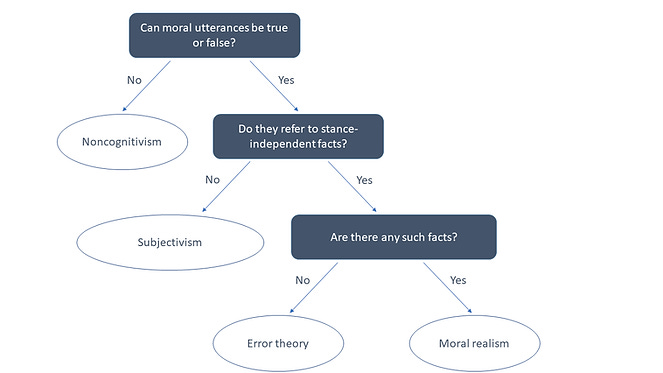
Notice that they all share the presumption that all moral utterances must mean the same thing as one another. That is, all moral utterances are or are not capable of being true, that they do or do not refer to stance-independent facts, and so on. In other words, all traditional accounts presuppose uniformity. Gill (2009) refers to this as the “uniformity assumption.”
Gill suggests that perhaps this assumption is simply mistaken. What if, instead, moral claims are sometimes used in a way that fits one of these analyses, and sometimes in a way that fits with its traditional rival position?
For comparison, think about how strange it would be to presume uniformity for a domain where there is clearly no uniform way to answer yes/no questions:
How are you supposed to answer these questions? The answer may be “yes” for some fruits, and “no” for other fruits. It would be absurd to think that all fruits or no fruits are tasty, or red, or high in vitamin C. It depends on the fruit. Just the same, it may be that moral utterances may sometimes mean one thing, and at other times mean something else.
Gill is not pointing to the mundane and trivial fact that some philosophers, or people who may have adopted idiosyncratic linguistic practices may use moral claims differently than everyone else. This is trivially true. And some people may be confused or make a mistake or use language sarcastically or dishonestly. Even the most ardent proponents of traditional theories can acknowledge a little variation, but such variation can be set aside as an acceptable degree of error, confusion, or unconventionality. That is not what is at issue.
Rather, elements both cognitivism and noncognitivism, realism and subjectivism, and so on may all be robust, ineliminable, central features of ordinary moral thought and discourse.
It may be that moral utterances express propositional claims some of the time, and don’t at other times, that people sometimes use them to refer to stance-independent moral facts, and sometimes don’t. Why should we suppose that all moral claims share the same set of metaethical presuppositions?
There are a few reasons to suppose that they would. Sinnott-Armstrong (2009) points to standard tests of ambiguity, such as counting. If we use the same terms to count two or more things, but the term we use has a different meaning across usages, this should stand out to us, and seem improper. For instance, suppose Alex has a baseball bat and a pet bat (i.e., the animal). It would seem strange for Alex to say, “there are two bats in my house.” However, if Alex lied to a family member, and then stole something at work, nothing seems strange about saying that Alex “committed two immoral acts.” It seems, then, that we can count up moral actions from one situation to the next, which suggests that our moral language does not vary (at least in this way).
Note, however, that such tests rely on armchair analysis of toy sentences and hypothetical utterances. It does seem to me that it would be odd for someone to say “there are two bats in my house,” when referring to a baseball bat and an animal, but it does not seem odd for someone to say that Alex “committed two immoral acts.” Fair enough. Let us add that to the pile of evidence against pluralism.
But such evidence doesn’t count for much. This is because the meaning of moral utterances - actual moral utterances, not toy sentences - is an empirical question. All the confidence in our armchair analysis is irrelevant if the empirical evidence suggests we’re just wrong about what people are actually doing when they engage in moral discourse.
One of the odd things about descriptive metaethics is that philosophers have been discussing the meaning of moral claims for decades, if not centuries, yet almost none have gone out to empirically evaluate what people are doing when they engage in moral discourse. Consider how strange the conventional methods of analytic philosophers are.
Imagine you were visiting a friend and you wanted to know what was in their office. So you begin speculating: well, most people have a desk in their office. Maybe a mini fridge to store drinks, a printer, a bookshelf…
You may be right. In fact, if you know your friend well, there’s a good chance you would be right about some or all of your hypotheses.
But why would you engage in armchair theorizing about what’s in their office when you can ask them or, even better, go look?
Philosophers may protest that there are significant differences between this scenario and descriptive metaethics. Most people have a pretty good idea of what’s in their office, and it’s easy enough to go look. But perhaps most people lack introspective access to what they really mean, and there (admittedly) isn’t any way to directly look and see the meaning of a moral claim, the way we can look in an office and seek a desk and an office chair.
It’s true that they are different in this way. But such differences don’t obviously warrant appealing to armchair methods. They just highlight how conventional linguistic and psychological questions can be difficult to answer, compared to discovering what’s in someone’s office. Merely because the empirical task of figuring out what people mean is hard doesn’t mean that an empirical approach is the wrong method.
Philosophers may also insist that the meaning of everyday moral utterances isn’t an empirical question, so empirical methods wouldn’t be appropriate. In that case, I’d be curious to hear what these accounts are supposed to be describing. If the study of descriptive metaethics isn’t an empirical enterprise, I’m at a loss as to what it’s supposed to be. I have my suspicions, though. I suspect some (perhaps most) analytic philosophers have strange notions about how language works, and that they may think that moral claims have a meaning that isn’t reducible to the intentions or other mental states of speakers. If so, it may be that the predominance of the uniformity assumption is due, in part, to specific conceptions of language and meaning.
I would have thought, though, that the final arbiter would be facts about actual usage, that is, what people are attempting to communicate when engaging in moral discourse. And if it turns out that, as a matter of empirical fact, traditionally competing metaethical positions frequently emerge in everyday moral discourse, then philosophers should consider the possibility that, insofar as all traditional descriptive metaethical theses presume the uniformity of the meaning of moral utterances, all such theories are mistaken.
References
Gill, M. B. (2009). Indeterminacy and variability in meta-ethics. Philosophical studies, 145, 215-234.
"moral claims have a meaning that isn’t reducible to the intentions or other mental states of speakers." - Unfortunately this is exactly what Sinnot-Armstrong (in his 2009 mixed-up metaethics paper) seems to think when he writes: “Speakers’ self-reports might reveal what those speakers mean, but speakers' self-reports do not show what their words mean unless those self-reports are shared by all standard speakers” (2009, pp. 243 – 244). So “the meaning” of moral *words* is constituted by how “standard speakers” use them.
I am yet to see someone make it clear how we can distinguish between standard and non-standard usages in a non-arbitrary way. Gill, using the example of Richard Hare, convincingly shows that we probably can’t.
Now, the ambiguity tests certainly DO NOT show that that it’s impossible to use moral language in a topic variantist (i.e. the view that we use moral terms with different meanings when discussing different moral topics) or a context variantist (e.g. when the meaning of our moral terms changes depending on the audience we’re speaking to) way.
Take this version of topic variantism: when I say “abortion is wrong” I mean “abortion is disgusting!” and when I say “murder is wrong” I mean “murder is inconsistent with the moral standards of our society”. The “ambiguity test” challenges us to explain how it could then be meaningful or linguistically appropriate for me to say “Both abortion and murder are wrong” or “I’ve committed two immoral acts – abortion and murder”.
Suppose we’re both self-conscious topic variantists in this way, and I suddenly utter “both abortion and murder are wrong”. I don’t see how this would be inconsistent with variantism. Given our shared background knowledge, wouldn’t you, as a fellow variantist, understand that what I meant was “murder goes against what most people in our society take to be wrong and abortion is disgusting to me”? I think you would. And if the communicative goals were accomplished, could we really say that I had done something “inappropriate” there? I do not even necessarily think that it would be weird for a variantist to speak in this way. Perhaps, as Gill suggests, our concept of morality is a family-resemblance-style “hodge-podge” concept that includes very different commitments but can nevertheless be used - meaningfully and effectively. So I would be employing the same concept in all of the three utterances above. Yet it doesn’t imply that the meaning is exactly the same. Cf.: "Chess and hide-and-seek are both games" seems appropriate and it looks like we're talking about the same concept, but why should we conclude that "game" has literally the same meaning when applied to chess and to hide-and-seek?
Or consider context variantism. The fact that there is nothing linguistically inappropriate in saying “I told both Joe (an expressivist) and John (a realist) that murder is wrong” is supposed to show that the meaning of the word is the same in both contexts. But speaking in this way seems equally appropriate for me as a context variantist. Again, if our shared concept of morality is a rich family-resemblance concept, I could convey two different meanings with one word without changing the topic. And a fellow context variantist who knows that Joe is an expressivist and John is a realist would be able to perfectly discern what I meant there (i.e. I expressed my disapproval to Joe and reported a stance-independent moral fact to John). The act of communication is successful. What would be “linguistically inappropriate” about that?
In any case, it seems to me that (1) if the ambiguity tests fail to show the impossibility of variantism AND (2) if we are dropping the standard/non-standard usage distinction, then (3) the ambiguity tests FAIL to show that the uniformity assumption is true, i.e. that there is a single standard (central) meaning of moral terms.
So what are ambiguity tests supposed to show? There may still be facts about how most ordinary people use moral words. Maybe we can call this "the standard meaning" and it is this that the ambiguity tests can show us. But if that is the case, then it’s obvious that the ambiguity tests are nothing more than a poor a priori substitute for empirical methods. They surely don’t rule out incoherentism. They surely don’t rule out indeterminacy. They don’t seem to rule out variantism either. While at the same time they cannot reliabliy tell us what the hell is actually going on in our language.
I may be fundamentally confused about literally all of this but...I don't see how. ¯\_(ツ)_/¯