


I don’t know of anyone who is more of a vocal proponent of moral antirealism than me (if you do, please let me know!). I don’t just think antirealism is correct, I think it carries few if any shortcomings, and that moral realism has almost nothing going for it, intellectually, practically, or otherwise. Given this, you might expect me to be an enthusiastic fan of Walter Veit’s recent and seemingly popular article (as far as metaethics goes), “To Hell With Moral Realism.”
Regrettably, I am not. While there are features of the article that I sympathize with, I believe the remarks, overall, miss the mark, and do not advance moral antirealism.
1.0 Where I Sympathize
Let’s start with where I sympathize. I do believe there is often something dogmatic in advocacy for moral realism. I also share Veit’s perspective that many philosophers “love their intuitions,” in a way I personally regard as a strange and confused fetishization. Veit also says that:
[…] Some philosophers try to trap you in a kind of gotcha! Hah! You can’t hold values unless you’re a moral realist.
They do, as do apologists and laypeople.
Finally, I have no qualms with the article serving as a polemic rather than an intellectual piece intended to argue for moral antirealism and against moral realism. Not every article, especially a blog, must carefully lay out arguments or examine reasons for holding a particular view. There is a time and place for polemics, rants, screeds, proclamations, and denunciations, and blogs are an ideal home for them.
2.0 Friendly Fire
My sympathies end there. I believe the article exhibits a number of underspecified remarks, questionable claims, and dubious assumptions.
2.1 Weak Definition
Veit begins by defining moral realism:
the view that there are moral facts, that there are objective moral properties out there in the world.
This is okay. I don’t like beginning with the unqualified claim that there are “moral facts,” since many antirealist positions hold that there are moral facts as well. I see little need to state this in general terms, then qualify it. Why not just start by saying it’s the view that “there are objective moral facts”? “Objective” is also a term commonly associated with moral realism, but it is ambiguous and has a number of uses unrelated to moral realism. These days, contemporary metaethicists usually use terms like “stance-independent” to specify that realism holds that moral truth doesn’t depend on people’s stances. “Out there in the world” could also be confusing, especially for nonphilosophers, since it may be interpreted to imply that moral facts are physical or at least natural phenomena we could discover. Arguably these are nitpicks, but I teach this topic to students and a little upfront suboptimality can often lead to entrenched misunderstandings it takes extra work to remedy.
2.2 Conflating Moral Realism with Moral Language
Veit states bluntly, in response to the notion that there are moral properties “out there in the world” that “There are not.” That’s fine, but this is immediately followed by this remark:
Notions like ‘rights’, ‘wrongs’, and ‘duties’ are leftovers from a pre-scientific age in which dogma and myths ruled over evidence and reason. And much like unicorns, gods, and other fairy tales, they should be consigned to hell.
This strikes me as strange and very nearly a non sequitur. Moral realism is a metaethical position about the nature of morality. Realism typically features a semantic thesis about the meaning of ordinary moral claims: that such claims are propositional, meaning that they are statements about what is true or false, and that these statements purport to refer to stance-independent moral truths. These are second-order features of moral language; moral language includes first-order, or normative (or evaluative) content as well. For instance, when a person says “Stealing is wrong,” this includes a first-order, normative notion about the nature of stealing: that it is wrong; and it may carry an implicit commitment to a metaethical position, such as moral realism, in which case stealing would be stance-independently wrong.
Regardless of whether moral notions are “leftovers from a pre-scientific age”, the notions of rights, wrongs, and duties are first-order/normative notions; they are not in themselves metaethical notions at all. It’s puzzling that Veit would immediately pivot from a rejection of moral realism to a rejection of normative moral notions altogether. Does Veit not draw a distinction between first-order and second-order moral concepts? Or is Veit assuming (without stating so) that normative moral concepts are conceptually linked to realist presuppositions in some way?
If the former, this is either a conflation or a contestable philosophical stance I’d reject, while if the latter I’d contest this as well. It is not the case that ordinary moral notions presuppose realism. While many realists (and some antirealists) believe this, there are few good arguments for this claim, and almost all of them rely on armchair theorizing based on the personal intuitions of philosophers about how contemporary English works. The presumption that moral realism is implicit in ordinary moral language is itself a dogma among philosophers, and it is probably false. It would be ironic, then, for Veit to object to realism on the grounds of dogmatism while surreptitiously buying into one of those dogmas himself.
Rejecting moral realism does not entail or even have much to do with rejecting moral terms and concepts, yet for some reason Veit immediately advocates doing so with little preamble and no apparent distinction between moral realism and the practical use of moral terms and concepts in everyday life. Such concepts could have considerable practical value regardless of whether realism is true or not, and Veit simply does not make the connection between moral realism and the use of these concepts clear.
2.3 Lots of Good Things Are Prescientific
Another issue with these remarks is that Veit’s phrasing suggests that moral concepts are among the “dogma and myths” of this prescientific age, rather than notions grounded in “evidence and reason.” But merely because concepts arose in the prescientific past, it does not follow that they are a form of myth or dogma. Money arose prior to modern science. Does that make it a product of dogma and myth? No; money is a social construction of immense practical value. Rights, duties, and so on similarly serve practical functions.
First, perhaps morality is myth or dogma, but this has little directly to do with moral realism. Even if realism were some sort of myth or dogma, that does not mean moral concepts are.
Second, normative language can and probably did arise for practical purposes, perhaps as a means of referring to norms and standards that facilitate cooperation and social coordination within communities. Even if we abandoned a distinctively Manichean conception of morality in the narrower sense of a metaphysically robust conception of a dichotomy between religious conceptions of good and evil, we don’t need such notions to make sense of or employ the language of morality for everyday, practical purposes. I assume Veit would agree parents should take care of their children. One might say they have a duty to do so. And I assume we need some term for distinguishing people who kick puppies for fun from people who give their lives to save others. Terms like “right” and “wrong” are suitable for these purposes. Given the practical value of these notions, one might argue that they did arise in a way at least partially grounded in evidence and reason.
Third, it’s not obvious extirpating moral concepts from a society would have good consequences. It may seem appealing to propose radical changes to a society’s norms, standards, concepts, and language, especially when they have apparent downsides, but abrupt changes can result in unforeseen consequences. We simply don’t know what would happen if society dropped moral terms and concepts altogether. If the abandonment were merely superficial, we’d quickly replace them with some other set of terms that filled the same functions. The question, then, is what practical functions we’d want to eliminate. And while there may be a morality-adjacent alternative that functioned better than morality proper, it’s somewhat irresponsible not to be clear about these distinctions so that readers are able to understand what Veit is proposing we abandon versus what he’s proposing we retain. It’s not clear to me, and I study this topic for a living. I very much doubt it’d be clear to many readers, especially lay audiences. Even with a polemic authors have a responsibility to be at least somewhat clear and careful, and I don’t think Veit is meeting this duty here.
2.4 Vague and Ahistorical
Veit goes on to say:
Despite the pride we take from human scientific and technological advancements, our minds, our brains are as much obstacles to these achievements as they are its cause. Humans are largely irrational and addicted to their own intuitions, which we had to overcome in order to develop modern science.
Much of this is vague and potentially ahistorical. It may also fail to draw a clear or accurate distinction between how nonphilosophers think now or in the past, and how philosophers think. Contemporary obsession with the use of “intuitions” or at least intuition talk only picked up in the past few decades within analytic philosophy, even if intuition has played an important role throughout the history of Western philosophy. But the notion of intuition at play within philosophy is not the colloquial notion at use among ordinary people, nor is it the same as the notion of intuition among psychologists. Which intuitions does Veit think people are obsessed with? Which people? There’s an implied continuity and overlap between the ordinary nonphilosopher’s conventional modes of cognition, which purportedly include intuitions, and the methods employed by philosophers in support of their philosophical theses. Yet it is not at all clear, nor is there especially good evidence, that philosophical intuitions are a part of ordinary thought now or in the past, much less that an addiction to them played a role in the rise of morality or anything else.
In short, while it may be the case that contemporary analytic philosophers are obsessed with intuitions, and appeal to intuitions as their primary basis for endorsing moral realism, it is far less clear that historical populations of nonphilosophers endorsed moral realism on the basis of intuitions, or that intuitions of the sort analytic philosophers appeal to play any significant role in implicit or explicit support for moral realism among nonphilosophers (which is itself highly questionable). Veit isn’t clear on what conception of intuition he has in mind, so it’s hard to know what he’s referring to.
There’s also some indication that a reliance on intuitions is associated with irrationality, though Veit provides little support for this. Yet Veit only reinforces these questionable assumptions about the relation between ordinary moral thinking and the way contemporary analytic philosophers think:
But when it comes to morals, our thinking has barely changed from our ancestors. The dogma of moral realism firmly remains part of much of our modern culture. This is emphasised perhaps nowhere more strongly than in today’s culture wars, which have turned differences in subjective values into the death of reason itself. For we now know quite well that participation in political causes tends to diminish your capacities as a reasoner. Much like rooting for a particular team in sports can turn one into an irrational hooligan.
Veit never presented any good reasons to believe moral realism was a part of the way our ancestors thought in the first place. The connection to contemporary culture wars is also obscure. Do people engaged in contemporary culture wars presuppose or appeal to moral realism, much less as a dogma? How does Veit know? And why is it a problem if they do?
2.5 Realism and Intuition
Veit then turns to why philosophers endorse moral realism. Before considering this, note that only about a quarter of philosophers accept or lean towards non-naturalist moral realism. About a third endorse naturalist realism, and it’s not clear Veit is objecting to that, while another quarter accept or lean towards antirealism. The proportion of non-naturalist realists (26.6%) is about the same as the proportion antirealists (26.1%). Depending on what position Veit is criticizing, it’s not that popular of a view. If Veit is targeting all realists, then the number jumps up to 62%. A majority, but not an overwhelming one. In any case, Veit thinks the reason philosophers “cling” to moral realism “is simple”:
Philosophers, much like the common science denier, love their intuitions. Where science conflicts with common sense it is science that looks suspect. So much so that philosophers have historically continuously embarrassed themselves by defending prejudices, myths, and a great many blunders that we now look upon in shame — and make the hostility of many scientists against philosophy hardly unjustified.
Whereas scientists teach their students that intuitions are unreliable garbage when it comes to understanding the world, many philosophers venerate their intuitions. Those that don’t are naturalists, as I’ve argued in my most popular blog posts here:
The claim that “Those that don’t are naturalists” is a puzzling one. Is Veit not aware that there are more proponents of naturalist moral realism than non-naturalist moral realism? See the survey results for yourself:
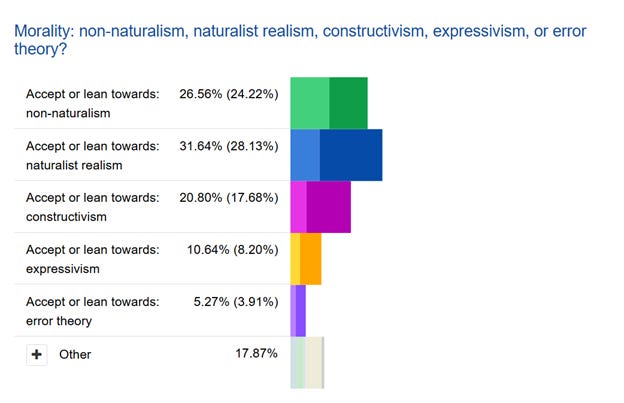
There are more philosophers who regard moral realism as consistent with the natural sciences than there are philosophers who reject this notion. Is Veit only talking about the non-naturalists? If so, why not say so? The wording Veit uses gives the impression realism is itself a prescientific or anti-scientific view. At best only certain forms of moral realism could fit this description.
Furthermore, Veit claims that scientists “teach their students that intuitions are unreliable garbage,” which resurfaces the same problem as before. The kinds of intuitions scientists are skeptical towards may or may not be the kinds of intuitions philosophers claim to employ when doing philosophy. Scientists don’t typically study or know much about philosophical methods or what philosophers have in mind when they invoke intuitions, and philosophers don’t typically employ intuitions to explore scientific questions in the first place; they typically use them for addressing non-empirical questions. In other words, philosophers employ intuitions to address non-empirical questions, and often endorse or use empirical methods to explore empirical questions.
This isn’t always true, but even when it isn’t, the use of intuitions is typically circumscribed to a subset of questions typically considered the province of philosophy, rather than science. Given this, and given that scientists don’t typically address these questions in their work, it’s unclear why scientists would be teaching people not to rely on a tool, presumably for addressing scientific questions, that not even philosophers use to do so! Given this, I suspect Veit may be a bit mixed up on the matter of “intuition.” There is probably only a bit of overlap between the kinds of intuitions scientists would encourage people to eschew and the kinds of intuitions philosophers invoke when doing philosophy.
Furthermore, the 2020 PhilPapers data suggests that about half of philosophers endorse intuition-based methods, and, as you can see here, Veit’s suggestion of a clean break between non-naturalists employing intuitions and naturalists rejecting intuition is not accurate:
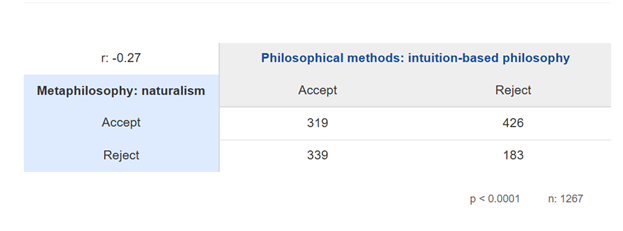
About 43% of naturalists (in the general sense, “naturalism” can refer to a broad naturalism, while “naturalist” in metaethical contexts sometimes only refers to naturalists about morality itself; one can be a non-naturalist in general but a naturalist about realism) endorse intuition-based methods in philosophy, while 65% of those who reject naturalism do so. This is hardly a sharp dichotomy in levels of endorsement.
Veit then claims:
And no intuition is stronger in people than the strong conviction that their own deeply held values are the objectively right ones.
Which people? Is Veit referring to nonphilosophers? What proportion have this conviction, and how did Veit determine this was the case?
Veit continues:
But how would we even live in a world that ‘abandons’ morality? Greene and I hold the same view:
“The solution […] is to get rid of realist thinking and to start by getting rid of realist language. Speak only in terms that make the subjective nature of value plain.”
This is quite strange. It’s as if Veit makes no distinction between realism and moral language. Interestingly, Greene is more careful. Greene suggests we get rid of realist language; he is not suggesting (at least not here) that we get rid of moral language.
Veit then provides another quote from Greene:
Instead of saying that capital punishment is wrong say that you are opposed to it. Say that it is an ineffective deterrent, difficult to implement in a colorblind fashion, and likely to lead to irreversible mistakes. And then say no more. Instead of saying that eating animals is wrong and a form of murder, say that you are opposed to eating animals because you wish to alleviate suffering and you believe that this practice causes much unnecessary suffering.
This is unfortunate, since it does appear that Greene is treating normative moral terms as “realist language.” I’m a fan of Greene, but what is this based on? Greene suggests we eliminate realist language, then goes on to suggest that we get rid of terms like “wrong” or “murder.” How is this “realist language”? Sure, one can go out of their way to make it clear they are expressing subjective moral values, but nothing about this language necessarily entails that one isn’t already doing that. It’s as if they regard normative moral language as somehow “realist” language. It isn’t. Notice how Veit goes on to say:
It is, of course, strategically tempting to use the archaic language of moral realism to realize one’s preferred vision of the world. If you can convince people that factory farms are objectively wrong, it stands to reason that they’ll have no choice but to become vegans.
Note the use of “objectively” here. That wasn’t present in Greene’s remark, nor is it typically appended in everyday language to normative terms like “wrong.” Sure, sometimes it is, but it’s not even clear in these cases whether nonphilosophers are using the term “objectively wrong” in a way that suggests moral realism in the first place. The term “objective” is polysemous and is often used to refer to concepts other than stance-independence, especially in everyday language. My own research specifically addressing this question found that many nonphilosophers interpreted “objective,” even in the explicit context of morality to refer to something other than stance-independence, e.g., lack of bias or the availability of a shared standard of measurement. And is this language “archaic”? Did ancient people speak this way? Are there distinctive cognate terms for “stance-independent” in ancient Sumerian? Do we find clear endorsement of non-naturalist moral realism in Hammurabi’s code?
3.0 Conclusion
Veit ends with the following remarks:
And yet, I have little hope that moral realism will land in the dustbin of history. Our minds are just too hard-wired for dogmatism. If people don’t believe scientific results if they don’t align with their intuitions about reality or if they conflict with their values, what hope is there that our species can overcome the plight of moral realism?
Even if our minds were hardwired for dogmatism, there is little evidence they are specifically hardwired for moral realism. There isn’t even any good evidence most people are moral realists. Veit has also done next to nothing in this article to show that widespread endorsement of moral realism actually is a “plight.” Perhaps it is. I’m certainly no fan of moral realism. Unfortunately, Veit simply doesn’t do the work to convincingly show that it is harmful. Yes, this is a polemic, and yes, I understand that it isn’t the goal of a polemic to offer a rigorous and sustained argument. But we’re not given much at all to work with here.
I found this article disappointing. Veit’s goal appears not merely to convince people of antirealism on purely intellectual grounds, but to advocate against moral realism on practical grounds as well. I doubt this article will serve to advance that cause much, and hope Veit will consider a more careful and well-supported approach in the future.
Note: "Whereas scientists teach their students that intuitions are unreliable garbage" etc should also be part of the quote block.
Love the article. Your sober and exhaustive approach should be emulated by many.
Good post, as usual. I just came here to make the futile suggestion that metaethical discourse would be less polysemous if people generally dropped the natural vs non-natural distinction and, in its place, adopted the concrete vs abstract distinction from metaphysics.