


This article is a response to this blog post from Hilarius Bookbinder. I recommend reading that first.
1.0 Look at my magic beans!
I produced this dialog some time ago to illustrate a problem I sometimes see with critics of illusionism, but I think it generalizes to the way people conduct themselves in many other philosophical exchanges. For those who don’t want to follow a link, here’s a summary: A person carrying a handful of beans approaches another person. They inform this other person that they are holding magical beans. The other person agrees that they are holding beans but denies that the beans are magical. This results in an argument where the person claiming to have magical beans insists that to deny they are holding magical beans is to deny they are holding beans at all, but, since they are clearly holding beans, any denial that they are holding magical beans is absurd.
I call this the magic beans fallacy, and it illustrates a common mistake philosophers and people in online arguments fall victim to: they presume that their account of a phenomenon, or some property or feature they consider important to that phenomenon, is so constitutive of it that to deny their account or to deny that the phenomenon possesses the property in question is to deny the phenomenon outright. Moral realists do this when they insist that if you reject moral realism, then you must think morality “isn’t real.” Non-eliminativists about phenomenal consciousness do this when they insist that to deny phenomenal consciousness is to deny we are conscious or have experiences or perceptions. Proponents of libertarian free will do this when they insist compatibilists are changing the subject or don’t really believe in free will. This list could be expanded to include many other positions, and perhaps examples you are familiar with readily come to mind.
One of my goals in this post is to highlight a possible instance of the magic beans fallacy. However, this is a secondary goal. My primary goal is to critique the notion of “intuition” as it is used among academic philosophers. Roughly, I think philosophers have tended to land somewhere along a continuum with respect to use of the term “intuition”: on one end, “intuitions” are a type of mental state that are the output of a psychologically distinct faculty, though there is little evidence for such a faculty, while on the other, intuition is just another name for a mundane cluster of existing psychological processes the existence of which is uncontroversial. The former conception does a lot of philosophical work, but it is reasonable to question whether such intuitions exist, while the latter conception does little or no philosophical evidential work, yet the existence of such intuitions isn’t in question.
Mundane conceptions of intuition are not without legitimate uses in philosophy. Reporting one’s own psychological states and inviting one’s audience to proceed with an argument if they share them is an entirely reasonable thing to do. Mundane uses of intuition can also be helpful for identifying internal inconsistencies in one’s views to better achieve reflective equilibrium. What I am denying is that there is any special type of mental state that serves as a substantive source of evidence in the way some philosophers maintain. This is not because I think such mental states exist, but can’t play the epistemic role philosophers want them to; rather, I am denying intuitions of this kind are real at all. This notion of intuition is a pseudopsychological one invented by empirically uninformed philosophers that has little if any basis in contemporary cognitive psychology.
By equivocating along this continuum, philosophers have masked the dubious, pseudoscientific nature of many of their practices. The notion of an “intuition” is a psychological notion, and as such falls within the purview of science. And yet philosophers have mostly been reluctant to submit the notion to psychology for review. If you claim people have intuitions you’re making an empirical claim about human psychology. It is your responsibility to ensure such claims are clear and testable and that the phenomena in question actually exist.
There are some critics of the unfettered use of intuitions in philosophy, but they typically concede too much to philosophers, or are philosophers themselves that want to maintain many of the field’s conventional practices. They typically grant that intuitions are real, but question their epistemic status. While they are on the right track, they don’t go far enough.
The insularity of the field has fostered an uncritical and dogmatic acceptance of “intuition” that has little justification and even less basis in the reality of human cognition. “Intuition” is, at best, an unhelpful term for what would be better classified as judgments, hunches, heuristics, and dispositions, and at worst a confused, pseudoscientific notion invented by a field with inscrutable and dubious methods.
Philosophers don’t appear to agree on what intuitions are, how they work, what their epistemic status is, whether they share any distinct phenomenology and if so what it is, which psychological processes are involved in intuitive judgments, which issues are matters of intuition or not, how many kinds of intuitions there are and what distinguishes these kinds from one another, whether they only concern the a priori, which kinds of intuitions philosophers are interested in or should care about (e.g., pretheoretical, reflective, and so on), how intuitions relate to dispositions and belief (some accounts hold that they are dispositions or beliefs, though it’s unclear what distinguishes these dispositions/beliefs from others), and so on.
This isn’t a case of a handful of conflicting accounts. There are numerous, distinct dimensions along which accounts of intuitions could vary from one another, these differences are often qualitatively significant (pretheoretical and reflective intuitions are very different), and for which there is little if any consensus. There are so many combinations of these potential qualities that there may be about as many accounts of intuitions as there are philosophers who’ve considered the matter. At the same time, few of these conceptions of intuition have been subjected to sustained empirical investigation to determine whether the relevant kinds of mental states are real, much less what psychological and neural processes are involved in them.
When “intuition” is investigated, the notion in question is often a somewhat orthogonal, psychological conception of “intuition” that doesn’t capture the distinct features attributed to philosophical intuitions. Conversely, such research often presumes that whatever outputs the researcher is obtaining from participants is an “intuition” of the relevant kind, with little or no effort to operationalize the notion of an intuition itself, much less doing so on the basis of any well-established psychological theory. As such, even research on philosophical “intuitions” is often presumptuous. Far from establishing that intuitions are a distinct type of psychological state, such research misleadingly reinforces the impression philosophical intuitions are a real and distinct phenomenon by recapitulating the same unsubstantiated assumptions found in non-empirical philosophy.
2.0 Bookbinder’s Defense of Intuitions
In spite of this, philosophers are quick to defend the centrality of intuition to philosophical method. Hilarius Bookbinder exemplifies this trend in an aptly titled post, “A defense of philosophical intuitions” which you can find here. I recommend reading that before proceeding, since this article is a response.
The main problem is that Bookbinder doesn’t offer much of a defense. Instead, Bookbinder begins by listing a bunch of psychological processes which have been established via empirical inquiry, e.g., memory and perception, then simply asserting that in addition to sensations, emotions, and so on, we also have a faculty of intuition. This is a bit like arguing that Bigfoot exists by listing off animals that do exist, like bears and goats and ostriches, then simply saying “and Bigfoot is another of these animals.” It is no exaggeration to say that this is about the level of evidence Bookbinder provides for the psychological reality of “intuitions.” I call this the Trojan List Fallacy.

The Trojan List works by presenting a claim or position alongside a host of other claims or positions an audience is expected to accept or find credible, thereby leeching credibility from the association. Here’s how this fallacy works:
Provide a list of uncontroversial claims or examples that an audience is expected to accept
Include the notion you want people to accept (typically at or near the end of the list) then claim or imply that it is just another example of things in the same category
Acceptance of the preceding items on the list may lull readers into a state of acceptance, and allow the acceptance of previous items on the list to bleed over into acceptance of your proposed idea
I think Bookbinder does that in this article. We’re treated to a menagerie of mental faculties and their associated dysfunctions, then we arrive at intuition, whereupon Bookbinder simply declares that it’s another mental faculty we have. For instance, Bookbinder first mentions memory and pairs it with Alzheimer’s, then mentions emotions and alexithymia, mental imagery and aphantasia, and so on. Yet, whereas every other faculty mentioned along with the dysfunctions associated with it has been established by empirical evidence, no similar evidence demonstrates the existence of any particular mental faculty of intuition, much less a subpopulation that suffers from an impairment in this faculty. It appears that we’re just supposed to grant that this faculty exists. It is also worth flagging, now, that for Bookbinder’s analogy to work, intuition must be a single faculty, since otherwise his eventual accusation that I lack the faculty in question wouldn’t make much sense, but we’ll get to that.
Rather than provide empirical evidence for a faculty of intuition he simply asserts:
Intuitions are another kind of mental faculty.
Bookbinder later suggests that we evolved to have intuitions and speculates on how moral intuitions could have evolved, though he oddly focuses on distinct mechanisms associated with a subset of intuitions, which is in tension with his suggestion that I lack the faculty of intuition (more on this later). However, explaining how something evolved presupposes its existence. What Bookbinder doesn’t do is present any evidence that intuitions are a real psychological phenomenon. It’s simply taken for granted.
Presumably, then, Bookbinder’s defense isn’t intended to defend the existence of intuitions, but to instead defend their philosophical importance. But Bookbinder also doesn’t do much to defend the importance of intuitions. Either way, a defense is moot if the sort of intuitions Bookbinder believes in aren’t real.
But the situation is worse than this. Bookbinder doesn’t offer a sufficiently clear account of what an intuition is such that the concept can be operationalized and tested in the first place. This, coupled with a direct, misguided, and condescending critique of me personally, results in an article that is in many ways confused and mistaken.
Bookbinder claims that his defense of intuitions is about metaphilosophy. It is, but it is also psychology. He is, after all, defending a mental faculty, and it would make no sense to claim his conception of intuition isn’t deeply embedded in considerations about human psychology given the close association between the “faculty” of intuition and all the psychological faculties Bookbinder associates it with. If claims about the existence and operation of a putative mental faculty aren’t the subject matter of psychology, it’s not clear what would be.
That metaphilosophy so readily blurs into psychology should give philosophers critical of approaches like mine pause; opposition to psychological entanglement with the field is bizarre and a little ironic, given that their supposed primary tool is a psychological faculty. It’s a bit like carpenters sneering at saws and screwdrivers. And just like carpentry, psychology has standards. Bookbinder’s account of intuitions is very far from meeting those standards.
3.0 Blind from Birth
Let’s start with the possible instance of the magic beans fallacy. Bookbinder quotes me, and sandwiches this quote between a handful of critical remarks:
Intuitions are another kind of mental faculty. Evidently some people do not have them, like Lance S. Bush, who writes,
“The use of the term “intuition” serves only to obscure matters in philosophy. Philosophers should collectively agree to stop using the term. I haven’t been the best at explaining what the problem is, but I don’t think I’ve butchered it, either. Nevertheless I’ve been discouraged and annoyed at the resistance. Why are people so fucking taken in by talk of intuitions? It’s like everyone slapped on one of those brain slugs from Futurama.”
Bush is a man, blind from birth, angrily denying that others have a power he lacks and cannot imagine.
(The remark he is quoting can be found here).
For some reason Bookbinder takes the quoted remarks to indicate that I don’t have intuitions. I never claim in the quote to not have intuitions, and nothing I say in that passage suggests that I’d agree that I “don’t have intuitions.” Presumably Bookbinder takes my skepticism about intuition-talk to suggest I personally don’t have them. This is not my position. I think use of the term intuition is so varied and inconsistent that we are better off not using the term and that we should instead employ more precise terminology to more carefully delineate which concepts we are employing in the appropriate contexts. I am also skeptical of certain conceptions of intuitions, and that insofar as one believes we have intuitions that fit these mistaken accounts, I believe nobody has intuitions of that kind. In that respect, there are conceptions of intuitions I think I don’t have, but I also think they’re intuitions nobody has. I just didn’t say that in this quote.
It’s ironic that the particular remark Bookbinder quotes doesn’t even include any denial there are intuitions. It just objects to talk of intuitions. Suggesting we not use a particular term in no way entails that one doesn’t think the phenomena to which the term may refer don’t exist, so my remark is even consistent with thinking we have exactly the kind of mental faculty Bookbinder claims we have but simply objecting to calling that faculty “intuition.” I think we probably don’t have such a faculty, but that’s a separate matter from whether I think we should continue using the term “intuition” or treat intuitions as an important source of evidence in philosophy (even if we had them).
My remark is also orthogonal to whether I’d agree with the statement “I have intuitions.” The only way to answer this question is to know what a person has in mind by “intuition.” And I do think we have some of the things that philosophers describe as “intuitions.” It’s just that, even if we had sui generis faculties, dispositions to believe, and so on, we’re not obligated to refer to any of these in particular (or all of them, collectively) as “intuitions.” At least part of my objection to how we use the term is that it is used in too many inconsistent and underspecified ways, making it unclear what anyone is even saying they have when they report having an intuition. For comparison, if people used the term “papple” to refer to apples and pears, and people were constantly mixing them up, you could object to use of the term “papple” without thereby denying that apples or pears exist.
It’s not as though we ever had any obligation to use the term intuition in any of the ways philosophers use it. The term “intuition” was already coopted from ordinary language, where many if not all of its typical usages don’t even correspond (at least in any very clean and unambiguous way) to various philosophical conceptions of intuitions. Philosophers could have just opted for some other term or terms to refer to the various phenomena they posited. Sui generis intuitions could’ve been called something distinctive, like verinoesis or veriception while they could have referred to dispositions to believe as “dispositions to believe.” Then, when philosophers reported having intuitions, they could very clearly say things like:
I am disposed to believe that the external world exists.
I vericeive that the external world exists.
Such disambiguation would make what philosophers were doing clearer, entirely independent of whether or not we do or don’t have any particular mental faculty like veriception. Given this, Bookbinder’s choice of that particular quote is a poor one, because it doesn’t even support the accusation directed at me, and there are other instances where I have expressed skepticism about intuitions in a seemingly general sense (though I have always only denied specific, narrow conceptions of what intuitions are). I also don’t deny that I have “intuitions” in many of the ways such terms are used in ordinary language, e.g., hunches or system one processes. I only deny a narrow, distinctive conception of intuitions such as those outlined here.
Some philosophical accounts of intuition might map onto ordinary usages, but much of ordinary usage construes intuition as “gut feelings,” subconscious pattern recognition, or even a kind of quasi-paranormal capacity to pick up on certain truths on the basis of the vibes given off in a particular situation. Philosophical use of the term thus either doesn’t even comport with its ordinary uses or, at best, picks out and refines one or another narrow, distinctive usages featured in ordinary discourse. Some philosophers even explicitly acknowledge that they aren’t using the term in its ordinary senses:
When philosophers talk of intuition — especially on the subject of justified beliefs — they seldom mean anything like the common usages of the term. If you look up synonyms for intuition on the internet you’ll find words like hunch, instinct, and natural inclination. But this is a far cry from what philosophers are referring to — they’re not suggesting that hunches, instinct and/or natural inclinations can be an adequate basis for the forming of beliefs. (Talis Per Se, 2025)
Instead, they are characterized as:
[...] an intellectual striking or intellectual presentation-a type of mental experience.
This is one of the conceptions of intuitions that I deny, not because I think nothing psychologically in the vicinity of what’s reported as an intuition is going on, but because I disagree with the characteristics attributed to these experiences. For instance, as Stan and I argue here, Bengson (2015) characterizes intuitions as having the property of being:
Rationally assenting — in that they make the forming of such beliefs fitting, justifiable, and reasonable. (this is our quote, which summarizes p. 723)
Am I somehow obligated to consider the judgments philosophers call intuitions “Rationally assenting” and thereby justified, reasonable, or fitting by definition? That would be absurd. It would mean that intuitions are granted a particular degree of epistemic status by definitional fiat and not by any arguments or evidence establishing that they had this characteristic. Justification cannot be obtained via stipulation or definition.
Does Bookbinder think I’m required to regard intuitions as justified or reasonable on purely analytic grounds (to be clear: Bookbinder doesn’t attribute this quality to me; I’m making a more general point about the appropriateness of rejecting phenomena when one bakes objectionable features into its definition)? I should hope not. Yet this is among the few characterizations of intuitions I’m actually denying anyone has. What I am not denying, necessarily, is that anyone has what Stan and I call “ambituitions”: mental states that exhibit many of the characteristics of the sorts of intuitions Bengson describes but without the additional feature of being “rationally assenting.” I think something like ambituitions may be real, however as I’ll outline later I believe they are a learned behavior rather than a natural feature of human cognition, and they lack the qualities that would make them a substantive source of evidence. In short, I deny that there are intuitions when intuitions are characterized in particular ways but I do not deny them when they are characterized in other ways.
Bookbinder doesn’t appear to distinguish the underdeveloped and poorly described “mental faculty” characterized in his own article from a panoply of other potential characterizations of intuitions, at least some of which I would not deny having. Note that if Bookbinder were to suggest that I, in virtue of denying some particular account of intuition such as Bookbinder’s own, thereby lack the faculty, he would presumably be implying that everyone that rejected Bookbinder’s distinctive conception of intuitions somehow doesn’t have intuitions. This would be ridiculous, and it would be as ridiculous as, e.g., a compatibilist insisting that a libertarian doesn’t believe in free will because their account differs from the compatibilist. What makes this more absurd is that it doesn’t follow from skepticism that one has intuitions that one therefore doesn’t have them. Why not suppose I do have intuitions, but mistakenly believe I don’t? Once again, none of my remarks provide any good evidence that I specifically and personally lack intuitions, while other people supposedly have them.
This also isn’t a claim about my personal phenomenology or lack thereof. If by “intuition” you mean a sui generis faculty for discerning a priori truths via a quasi-sensory capacity to “see” the truth, then I deny we have that ability. But I’m not merely claiming that I, personally, don’t have such an ability; I’m claiming that nobody has this ability. It’s a claim about what human psychology is generally capable of. I deny intuitions of this kind for much the same reason I deny people have telepathy. Imagine this exchange:
Lance: I don’t believe in psychic powers.
Alleged psychic: I see. So, you admit you lack the special power to read minds and see the future like the rest of us! How unfortunate for you.
Lance: No, I’m claiming nobody has psychic powers.
Alleged psychic: Again, it’s unfortunate you don’t have them, but the rest of us know that we have such powers because we use them all the time.

This is roughly equivalent to what I take Bookbinder to be doing. Bookbinder’s inability to distinguish what I reject from what I don’t suggests more about Bookbinder’s own lack of imagination and inability to conceive of other philosophical points of view than it suggests psychological deficiencies on my part.
Neither Bookbinder nor the entire field of philosophy has offered much in the way of empirical evidence that they “have intuitions.” In fact, it’s much worse than this: there’s no clear way to operationalize the term such that it could even be subject to the kind of empirical work that could reveal whether we have or don’t have intuitions, because philosophers can’t even agree on what intuitions are supposed to be, and are typically too disinterested or oblivious to what it would take to demonstrate that a particular type of psychological phenomenon is real to even make any serious attempt to corroborate such claims.
Instead, they seem to take the existence of intuitions for granted. The presumption that we have intuitions is based almost entirely off appeals to the personal phenomenology of philosophers and to established practice, i.e., intuition-talk is so prevalent among philosophers that of course we have intuitions. Tradition and private, subjective experiences are not great ways to determine that a particular type of psychological faculty exists. If they were, we’d have to acknowledge a faculty of prophecy, a faculty of clairvoyance, a divine reception faculty for hearing God, and a host of other faculties associated with religion and the paranormal to accommodate the many traditions and private experiences people around the world have reported. Incidentally, claims of these kinds are far more widespread and historically prevalent than appeals to philosophical intuitions, which you can readily confirm here, here or for international data in Hoogeveen et al. (2024). Millions of people have reported paranormal experiences since as long as recorded history has existed. Conversely, philosophical intuitions have been reported by a comparatively tiny fraction of the world’s population. In fact, contemporary descriptions of intuitions are recent, so projecting them onto historical descriptions of intuition may be anachronistic. We can readily distinguish between the belief that one is having a telepathic or clairvoyant experience without having to acknowledge that such mental states are real. Why, then, is it such a stretch to suppose that a small, relatively homogenous handful of academics who are all inducted into reading the same books, taking the same courses, and engaging in the same dialectical norms and practices might be confused or mistaken about certain features of their psychology?
While appeals to intuition or something intuition-like have been around in (at least Western) philosophy for a while now, it’s worth noting that philosophers have always been extremely small, insular minorities whose thinking and interests are unrepresentative of the populations they come from, that intuition-talk of the sort characteristic of contemporary analytic philosophy is culturally parochial, confined as it is to a narrow and unrepresentative bandwidth of professions, cultures, and languages, and that its explicit centrality and frequency of the explicit use of the notion of an intuition is an extremely recent phenomenon that only arose in analytic philosophy (an even more narrowly Anglophone practice, in particular) in the past few decades. And yet somehow Bookbinder thinks this faculty evolved. If it did, then presumably we should see ubiquitous, rudimentary use of philosophical intuition outside analytic philosophy. I await evidence of this, and am curious what studies confirming such intuitions would look like (this is sarcasm; I predict no evidence will be forthcoming because philosophical intuitions are not a feature of our evolved psychology).
In the meantime, why not propose that precognition or the ability to see ghosts, evolved, too? Perhaps the mental faculty of “spectroception” evolved to allow us to see and interact with ghosts. After all, Pew found that 18% of Americans claim to have seen a ghost and 29% claim to have interacted with the dead (perhaps the latter is a second mental faculty, necrophony). I’d expect seeing ghosts to be even more prominent historically and in less secular societies, so this is likely an underestimate of the global human average. The true amount is likely a very large proportion of people and is probably far more than the number of people who are remotely familiar with philosophical intuitions. Why not take these abilities as serious candidates for mental faculties? Is it because of the total lack of empirical evidence that such faculties exist? Funny, then: there’s a similar lack of evidence for the existence of philosophical intuitions, the content of which are even less clear than paranormal powers.
Maybe Bookbinder and analytic philosophers in general are satisfied with such low standards, but I am not. Once philosophers posit the existence of psychological faculties they have stepped into the realm of psychology, where claims should meet standards of scientific rigor. Bookbinder’s claim that we have a faculty of intuition follows a long list of other psychological faculties, all of which have been confirmed by substantial amounts of empirical evidence. Is there a similarly robust body of empirical evidence supporting the existence of Bookbinder’s proposed faculty?
No. There are more serious attempts to establish the existence of paranormal powers than there are serious attempts to establish the existence of “intuition” as a distinct psychological faculty. If we’re to take intuition seriously, its proponents are going to have to put more effort into grounding their claims in contemporary cognitive science than proponents of literal paranormal abilities.
Of course, if “intuition” is just a careless term for the mundane psychological faculties we already have, then “intuitions” immediately graduate from pseudoscience to mundane reality. As I said, whether we have “intuitions” or not depends on one’s account of intuitions. Some accounts may put forward dubious theses about human psychology or claim to transcend empirical claims about human cognition altogether. Others may make testable claims we could confirm that establish intuitions as a distinct phenomenon. Still others may reduce intuition-talk to mundane, preexisting psychological states which everyone, including myself, could readily accept as real.
For instance, in contrast to intuition as a sui generis “power” to “see” truth, if “intuition” is instead construed as a disposition to believe propositions that results from introspectively unavailable processes such that one cannot articulate any explicit inferential path by which one formed the disposition then I do have intuitions, and suspect virtually everyone else does, too. “Intuition” also has various mundane and acceptable uses outside philosophy. For instance, it is commonly used in the context of dual-process models of cognition that emphasize a distinction between fast, non-inferential, heuristic judgments and slower, deliberative judgments (see Evans, 2008 for review). I do think we make fast, heuristic judgments, so in that sense I endorse the existence of intuition without any issue.
If Bookbinder was inclined to say that anyone who reports not having the kinds of intuitions Bookbinder thinks there are “doesn’t have intuitions”, then I’m in good company. Even if most philosophers believe we have intuitions, they don’t agree about what intuitions are. This is because there are many conceptions of what intuitions are. If anyone believes there are intuitions that fit some other description but not Bookbinder’s, then any my-definition-or-nothing framing of the dispute would mean anyone who didn’t think of intuitions the way Bookbinder does “doesn’t have intuitions.” I don’t know if Bookbinder is making this mistake (the magic beans fallacy) or just making some other mistake instead (such as not understanding what my position is).
There’s a good chance many, perhaps even most philosophers would not endorse the kinds of intuitions I claim don’t exist. There is a whole metaphilosophical literature concerning what intuitions are and what (if any) role they play or should play in philosophy (e.g., Bealer, 1998; Bengson, 2013; 2015; Cappelen, 2012; Cohnitz & Häggqvist, 2009; Moffett, 2025; Nado, 2016; Williamson, 2004). Philosophers take a variety of different stances on these issues (if they think about them enough to take a stance), and it’s not at all clear they all think of intuitions in the way Bookbinder does. Does Bookbinder think anyone who characterizes intuitions in ways that differ from the conception of intuitions I reject is likewise “blind from birth”? If anyone suggests intuitions are something else are they likewise victims of congenital cognitive deficits? If so, it would apparently be impossible to even disagree about what intuitions are without thereby revealing one’s mental deficiencies.
I’m skeptical Bookbinder would insist on something like this, so this may be a case of just not understanding my position. But if Bookbinder thinks that denying his specific conception of intuitions is an outright denial of intuitions, then Bookbinder is making a significant error. If Bookbinder doesn’t think this, then it’s probably not accurate to say I don’t have intuitions. It’s lose-lose then, for Bookbinder: a serious error has occurred, it’s just a matter of what that error was.
Nothing in my remark suggests I can’t imagine what having a faculty of intuition would be like, either. Yet Bookbinder takes a couple other swipes at me: that I’m “angrily” denying others have something I “can’t imagine.” Note that these remarks are completely made up. Bookbinder is in no position to judge whether I’m angry about this particular issue, nor that I can’t imagine it. These are just personal digs at me, made without provocation or justification. There certainly are things that anger me in philosophy, but my personal lack of intuitions isn’t among them, any more than I am angry that I don’t have telepathy.
What role could such remarks serve? One possibility is that it is a way to try to discredit me by depicting my skepticism as rooted in emotion rather than sober reasoning. This is then coupled with my alleged inability to even imagine having this power, suggesting a kind of slack-jawed incredulity. How would Bookbinder know whether I could imagine such a thing? I read a lot of fiction and play a lot of fantasy video games. If I can imagine magic missiles, dragons, and psionics, I think I could imagine a scholarly discipline whose practitioners believe they have a mysterious power to “see” truth and have some rough idea what that would be like. The claim that I can’t imagine having intuitions is baseless. It’s just an insult. Of the two of us, I’d wager that it’s considerably more likely Bookbinder struggles to imagine other points of view such as mine, given how badly Bookbinder has mangled my views.
If you’re going to make a directed personal attack, at least make it accurate, and at least use a quote that does a better job supporting the accusation. I have stated that I don’t have intuitions on several occasions, where this should be understood to mean I don’t have the kind of sui generis notion philosophers such as Bealer (1998) endorse, not that I don’t have “intuitions” under one of many other descriptions, but I didn’t say anything like that here. Why not use one of those remarks? It would still be misleading, but at least it would appear to support Bookbinder’s insults.
There is also a question of the context in which I made the argument, which further illustrates how poor of a choice that remark was. Here is a link to the remark I made, and what it was a response to:
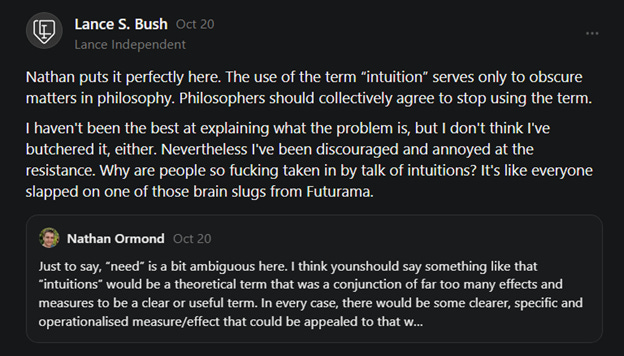
Note what Nathan was starting to say (the quote cuts off and isn’t available anymore), and what I was responding to: use of the term “intuition.” Even if we had “intuitions” that fit Bookbinder’s description, this is entirely consistent with objecting to use of the term. At least part of the problem with the use of the term is that philosophers don’t use it consistently within the discipline, it has a number of technical uses outside the discipline (see e.g., here), and it has a variety of colloquial or non-technical uses that philosophers are at pains to explicitly distance themselves from.
In “How ‘intuition’ exploded,” Andow (2015) shows that use of the term “intuition” exploded, not just within philosophy, but outside of it as well, where presumably many of its uses differ from those used by philosophers. Unless the practices of every discipline have radically changed in the past few decades, this suggests part of what’s going on is a linguistic phenomenon (though it’s worth noting Andow believes use of the term may have pragmatic benefits and that we should be hesitant to abandon its use; see Andow, 2017).
All this is to say that the term is used inconsistently across numerous disciplines and in everyday discourse to such an extent that it’s hard to know what anyone means when they use the term. This varied usage justifies concerns about using the term “intuition” in a way that is entirely independent of whether there are any phenomena that fit specific accounts of intuition. This objection didn’t originate with me. Nado (2016) calls it the “argument from unclear application”, and explains why people are drawn to this position:
Doubts about the very concept of intuition are rather easy to sympathize with— one merely needs to consider the bewildering variety of attempts to define it. For some, an intuition is a sui generis propositional attitude with a distinctive phenomenology; for others it is an inclination to assent to a proposition on the basis of understanding or competence; for yet others it is an empirical and theory laden judgment which occurs in the absence of conscious reflection (see for instance Bealer 1998; Sosa 1998; Devitt 2006). These examples could be greatly multiplied. It’s difficult to isolate a single feature of intuition that elicits unanimous agreement—some philosophers deny that intuition has a special phenomenology, some deny that the justification it generates is a priori, and some even deny that it is immediate or unreflective. (p. 783)
Note the point of such an objection: that the term “intuition” fails to reliably refer to anything in particular. Such an objection is not the claim that no phenomena meet any particular description, but instead the objection centers on the failure to isolate any particular account as privileged in its use of the term over others, such that we can confidently maintain that “intuitions” are such-and-such.
It is, first and foremost, a critique of our use of the term, and whether it reliably captures any particular phenomenon, which is consistent with there being a whole host of phenomena that are real but that aren’t the exclusive reference of the term and are sufficiently different from one another that use of the term would be ambiguous, unclear, and reliably mislead people.
Declaring that a term’s usages are so varied and inconsistent that it’s defective and shouldn’t be used is a practical question about how we use words, not a question of what does or doesn’t exist independent of our usage of the term. Now consider that in light of what I said:
Nathan puts it perfectly here. The use of the term “intuition” serves only to obscure matters in philosophy. Philosophers should collectively agree to stop using the term.
I am explicitly objecting to use of the term, not to the existence of any particular phenomenon. If Bookbinder isn’t committing the magic beans fallacy, my next best guess is that Bookbinder is mistaken or confused about my views. Maybe it’s a bit of both. Either way, my skepticism about intuition talk is not without precedent. Timothy Williamson (2004) characterizes intuitions as mundane and continuous with our ordinary psychological practices in a way I find unobjectionable:
What are called ‘intuitions’ in philosophy are just applications of our ordinary capacities for judgement. (p. 109)
If Williamson is right, then we don’t have any distinctive faculty of intuition; we just have ordinary judgments and some people have started to call some of them “intuitions.” Nado (2016) also references Williamson’s view of intuitions when discussing the argument from unclear application:
The term ‘intuition’, he claims, can apparently be applied to nearly any kind of judgment— Williamson argues that states we’re willing to term ‘intuitions’ need not be a priori, need not have special phenomenology, need not even be non-inferential. He concludes that ‘‘philosophers might be better off not using the word ‘intuition’ and its cognates. Their main current function is not to answer questions about the nature of the evidence but to fudge them, by appearing to provide answers without really doing so[.]” (Williamson, 2007, p. 220, as quoted in Nado, p. 783)
Is Williamson tacitly conceding that he doesn’t have “real” intuitions? Is he a victim of whatever neurological disorder I supposedly have, that renders us both blind to a priori truth? If so, this “blindness” doesn’t appear to be much of an impediment to being a successful philosopher.
These are rhetorical questions. Pending compelling evidence to the contrary, there’s no good reason to think Williamson is “blind from birth” any more than I allegedly am. Williamson and I simply don’t buy into particular accounts of what intuitions are. This does not entail that we have congenital cognitive disorders that deprive us of a “power” that Bookbinder has. But perhaps only a few philosophers possess the power of intuition. I don’t know about you, but I wonder whether it’s a mighty morphin power or just a regular one.

Any other philosophers who endorse some other conception of intuition than Bookbinder or who are skeptical of the use of the term would also be potential victims of intuition-blindness. If so, then this “blindness” may be an epidemic. For instance, Van Inwagen is another eminent philosopher who apparently wasn’t chosen by Zordon, since he proposes that intuitions could simply be:
[…] in some cases, the tendencies that make certain beliefs attractive to us, that ‘move’ us in the direction of accepting certain propositions without taking us all the way to acceptance. (1997, p. 309, as quoted in Pust, 2024)
If this is what Bookbinder means by “intuition,” then of course I have intuitions. I do think we have ordinary capacities for judgment, and I do think we have dispositions to believe things. Notably, neither of these abilities requires spandex or helmets. But what does Bookbinder mean by “intuition”?
4.0 Bookbinder’s underdescribed definition
Bookbinder characterizes intuitions as follows:
Rational intuitions are a spontaneous, rapid psychological assessment of truth and prompting to judgment about a priori propositions.
He also provides several examples of intuitions:
5+7=12
It is wrong to torture puppies for fun.
If you know something, then you believe it.
Nothing can be both true and false at the same time in the same way.
Cycling implies cyclists.
Everything obligatory is also permissible.
Impossible things never happen.
Bookbinder further describes intuition as a “mental faculty” and claims that we “evolved to have them.” Allegedly, I don’t have intuitions. But do I have the faculty Bookbinder describes? I don’t know, because I don’t think the description is sufficiently clear for me to judge one way or another. Whether anyone has intuitions of the sort Bookbinder describes will turn on details that Bookbinder doesn’t specify. For instance, if Bookbinder maintains that a non-negotiable feature of the faculty is that it is a single, functionally specialized system for dealing with all and only a priori issues, but it turns out the cognitive organization of human minds isn’t structured this way, but instead handles different judgments via different processes, then nobody has “intuitions” of the relevant sort, including Bookbinder. His use of the term “mental faculty” is singular, which suggests a single dedicated faculty. But Bookbinder simply isn’t clear about this, since later speculation about the evolution of moral intuitions points to two different mechanisms, each of which appears related only to moral intuitions. If Bookbinder maintains that intuition is facilitated by a single, dedicated faculty, then his account is on extremely shaky footing, as there’s little evidence to suggest such a thing. If, instead, “intuition” captures a range of processes, this exposes it to being a superfluous and unhelpful term that doesn’t pick out anything in particular. Worse, the brief description Bookbinder gives is likely to obscure underlying differences between the various processes that fall under the umbrella of “intuition.” If so, this raises questions about the suitability of the term, and, in any case, whether it makes sense to refer to a disparate array of processes as “intuitions” in the first place. Either way, the situation isn’t going to look hopeful for Bookbinder.
This underspecificity is one of the main reasons I am so critical of philosophical talk of intuition in the first place. Bookbinder’s own article is a Dark Specter of precisely what the problem is: philosophers engage in a kind of naïve armchair psychology but do not appear to take the challenges of identifying the actual functions and processes involved in human judgment, the importance of doing so, and how they might be relevant to philosophical methods and theorizing, anywhere near as seriously as they should. Before presenting a more general critique of Bookbinder’s account of intuition, I want to first provide my own reaction to each of the examples of intuitions that Bookbinder provides.
5.0 A case of the mundane
After presenting these examples Bookbinder adds:
Once you understood the meanings of those sentences, did you say to yourself, “I dunno… I’m going to need an argument here”? Edgelords aside, I’m going to say no. You didn’t. You read those sentences and immediately agreed, or, minimally, were strongly tempted to agree. That’s rational intuition in action.
There is some mild poisoning the well here. Bookbinder poses a question, then, instead of considering that answers may vary, simply declares what people’s answers are. He also preemptively declares anyone who questions these arguments an “Edgelord.” This is not a great way to make your case, but that isn’t my main concern with this remark. My main concern is that Bookbinder doesn’t argue or present any reasons to believe that, even if one does respond to these statements by agreeing or being tempted to agree, that they are all the product of “rational intuition.” These are presumably prototypical examples of what Bookbinder considers “rational intuitions,” yet it’s not clear to me, at least, that they share much in common and, to the extent that they do, it’s unclear why I’d think my judgment about any of these statements requires anything I’d be inclined to think of as “intuition.” Another curious feature of Bookbinder’s account is the omission of any reference to distinct phenomenology. Philosophers often claim intuitions have a distinct phenomenology, so Bookbinder not mentioning this is either an omission or another way in which his account differs from other accounts of intuition.
I also think the set of examples Bookbinder provides can be readily accounted for by other means, so there is no need to posit a faculty of intuition to account for (at least my own, and, I suspect, most other people’s) reaction to any of them. To illustrate this point, I will report my own reaction to each of Bookbinder’s examples. Consider your own reaction as well. Our reactions may differ, and that shouldn’t be surprising, since I don’t think human cognition is that homogenous, despite its similarities.
Let’s begin with the math equation:
5+7=12
I don’t have any distinct phenomenology in response to this that feels similar to my reaction to the other scenarios. Instead, my reaction to this is that it seems like something I remember in virtue of understanding basic math rules. It’s a bit like recalling the rules of a game. Granted, in this case, the game corresponds to features of everyday life: I can picture five and seven apples, putting them all in a bag, and know that there’d be twelve apples in the bag. Does this require a faculty of intuition? I don’t see why we should think it would. What if this is just an instance of recall or unconscious inference? If we can explain all the relevant psychological details by pointing to established psychological phenomena, there may be no good reason to propose intuition as an explanation. Furthermore, it’s not clear why whatever faculty I use to make this judgment is the same as the faculty used to make the rest of the judgments on the list. It very likely isn’t. Existing evidence on the cognitive processes involved in mathematical cognition already shows that they involve a range of different faculties, many of which do not overlap with linguistic and other forms of judgment that appear on Bookbinder’s list (Gaber & Schlimm, 2015). These dissociations are linked to distinct neurophysiological processes that have been explicitly recognized as distinct from those associated with language cognition:
How does the brain represent and manipulate abstract mathematical concepts? Recent evidence suggests that mathematical processing relies on specific brain areas and dissociates from language.
[…] the mere presence, within a sentence, of elementary logical operators such as quantifiers or negation did not suffice to activate math-responsive areas. Instead, quantifiers and negation impacted on activity in right angular gyrus and left inferior frontal gyrus, respectively. Overall, these results support the existence of a distinct, non-linguistic cortical network for mathematical knowledge in the human brain. (Amalric & Dehaene, 2019, p. 19)
Findings like these put constraints on the respects in which there could be a “faculty of intuition” associated with both mathematical and non-mathematical judgment, since it suggests that this “faculty” would, at the very least, involve dissociable cognitive systems with distinct neurophysiological and likely functional profiles that operate semi-independently of one another.
Next, we have a moral claim:
It is wrong to torture puppies for fun.
Due to my familiarity with moral philosophy and its overuse of recycled over-the-top moral violations, at least part of my reaction to this is to recognize its role in philosophical contexts. But were I to assess this, it expresses a remark I’d readily agree with on largely expressive or subjective grounds. It doesn’t strike me as “true,” in any further sense, and is not at all like my reaction to 5+7=12. And were I in particular philosophical contexts (e.g., arguing with moral realists), I certainly would expect an argument for this, if they were to suggest this should be interpreted as a claim about what is stance-independently true.
If you know something, then you believe it.
This looks like it’s asking me to think about the relation between use of the term “know” and “believe.” This seems a bit like linguistic recall, though it might involve a bit of theorizing about what I predict people would say or think. For the most part, though, my reaction to this is, again, recall: I just remember that “knowledge” is standardly used to refer to a certain subset of beliefs that meet higher epistemic standards than many other beliefs at the very least (and would be called “justified” in philosophical parlance). So again, not much of a “rational intuition” here so much as a cautious recognition that remarks like this play a certain role in philosophy where “knowledge” is conventionally defined to entail belief. There’s no special phenomenology, and I see no particular reason to call these judgments “intuitions.”
Nothing can be both true and false at the same time in the same way.
This isn’t a phrase people typically use in everyday conversations. Instead, I’ve only seen it arise in philosophical contexts as a somewhat clumsy way of asserting that contradictions aren’t possible with a canned phrase “at the same time in the same way” to suppress pedants who come up with annoying pseudo-exceptions that describe different situations, concepts, or uses of a term. It’s a kind of anticipatory dialectical prophylactic to ensure one’s interlocutor that they mean a genuinely conflicting set of truth claims. This is just something one learns is an implication of certain standard forms of logic. No particular intuitions from me. This doesn’t feel any more intuitive (if intuition is supposed to feel a certain way) than someone saying “bishops move diagonally.” And I don’t think I need special faculties for learning rules.
Cycling implies cyclists.
This just seems to be prompting me to think about associated word meanings. If cycling is taking place this does imply the existence of someone or something doing the cycling. Why think of this as an intuition? Why do I need intuitions to understand the relations between words? For comparison, if I hear a knock at the door, this implies the existence of a knocker. Does this inference require a special mental faculty? Or is the faculty only applicable to relations between words?
Everything obligatory is also permissible.
This is a funny one: I don’t necessarily agree with this. This statement would be true in the context of specific, rigid ways of defining these terms that one might find in normative ethics: the class of actions that is “obligatory” is that set of actions one must perform, while permissible actions are actions one may perform and are not prohibited. Thus, one might maintain that, by definition, the class of actions one must perform certainly includes those actions one is permitted to perform, though this doesn’t apply in reverse: not all permissible actions are obligatory.
Again, though, all judging this to be true requires is knowing that we are speaking of these terms in a philosophical context where these meanings are stipulated, and one simply needs to know how the terms are standardly used in these contexts. This doesn’t require “rational intuition” any more than recalling the rules in Magic: The Gathering. For example, consider this statement
If one player attacks another player with a creature, and the defending player controls only tapped creatures, the defending player is unable to block the attacking creature.
Is this statement true? Yes, it is. But judging that it’s true simply involves knowing the rules of MTG. Remembering things gets the job done just fine. Just so, I remember that the terms “obligatory” and “permissible” are used in this restrictive sense in certain discourses. In ordinary language, I don’t even think this is true. Why? Because in ordinary language, “permissible” may mean that the action is allowed but not required, which would mean that all obligations aren’t permissible, since “permissible” would carry the pragmatic implication “not obligatory.” If you went and surveyed nonphilosophers about these terms, I bet you’d get mixed results. People wouldn’t have some special a priori intuition where they “figure out” or “recognize” that this statement is true. Instead, one learns that it is true given certain stipulations in specific contexts, and then one recalls this relation when speaking in those contexts. Once again, intuition is no more required for this than it would be required to know the rules of chess or bingo.
Impossible things never happen.
This is much the same as the previous sentence. If “impossible” is understood in a formal philosophical context to mean “something that cannot occur/be true,” then this is like saying “Things that cannot happen cannot happen” which is trivially true. Does it require “rational intuition” to judge this to be the case? It’s not clear to me that it does, nor is it clear how a judgment of this kind involves the same process, phenomenology, or any other features in common with the other sentences here, aside from them all involving, once one nails down what’s being asserted, something like knowledge, memory, or recognition of learned rules and patterns.
Incidentally, in ordinary discourse “impossible” is routinely used in contexts where the thing in question isn’t technically impossible at all, it’s just very hard. Think of a phrase like:
Mark did the impossible and overcame his fear.
Some of the sentences Bookbinder uses have fairly fixed meanings by design, such that there aren’t many plausible real-world contexts where their meaning would deviate (e.g., “5+7=12”), thereby allowing their truth to be fairly fixed in most contexts, whereas others derive their obvious truth from the phrase in question being understood in a distinctive, fairly narrow philosophical context where one distills the allegedly distinctive semantic content from the pragmatic features the utterance might have in everyday contexts. In both cases, whether the statement is true or not doesn’t turn on or require the use of a special faculty for “seeing” or “recognizing” the truth. It simply involves knowing the meanings of the terms in relation to one another in the relevant context.
I worry that Bookbinder and some other philosophers may think more is at play in our judgments in these cases. Perhaps, for instance, some philosophers believe there are certain logical relations between various concepts, and that we need a distinctive faculty or power for “seeing” these relations and making the appropriate inferences. But even if we had this ability, it’s not obvious to me that it would be operative in all the cases Bookbinder presents. Before reaching for the operation of such a faculty, we may wish to first rule out the role other processes may play in facilitating the appropriate judgment in a given context, such as memory and unconscious inference. In the examples Bookbinder provides, I suspect these probably do most or even all of the work for all of the examples provided. If nothing else, it is more parsimonious to rely on existing psychological processes to account for our judgment than positing new psychological phenomena.
And while the notion of “intuition” appears in ordinary language, the distinctive way Bookbinder and some other philosophers seem to use it may or may not be a feature of ordinary thought. I suspect, instead, that the use of the term “intuition” as Bookbinder employs it does not capture a natural way to speak or think. Instead, I believe that whatever phenomenology and psychological processes are involved in intuition are either an amalgamation of existing mundane processes or, at best, a novel but epistemically irrelevant learned behavior largely distinctive to academic philosophy.
In the examples Bookbinder provides, for instance, I believe these statements are only true in virtue of the meaning of the relations of the terms, which is either fairly straightforwardly presupposed in most contexts even for nonspecialists (e.g., 5+7=12), or involves a distinctive, learned process of recognizing certain rigid ways terms are used within a particular mode of discourse: namely, the discourse of contemporary analytic philosophy, where the meanings of the terms are by implication of their use in the relevant contexts intended to represent prototypical truth claims. But whereas Bookbinder or others may see one’s judgment of these statements as true to involve the substantive deployment of a faculty of “rational intuition,” what I see, instead, is a parochial, learned behavior among a highly idiosyncratic group of thinkers that is roughly similar to making grammaticality judgments or the rules of games.
I think philosophers more or less learn to engage in a kind of dialectical game, internalize the rules of that game, and then proceed to play the game. Once they’ve become accustomed to playing that game, they internalize the learned behavioral patterns associated with it, and the outputs of their judgments now feel special: distinctive to the game. As one becomes more and more accustomed to a certain routinized process, one gradually shunts explicit stepwise reasoning into the unconscious, where unconscious processes do the work. Speed chess players have learned the rules so well they don’t have to consciously think through everything to make a snap decision. Athletes don’t have to reason through how to move; they just move, going on autopilot and letting their mind and body work together to achieve their goals. Just so, the social conditioning, training, and iterative prompting within philosophical contexts makes judging philosophical topics in the appropriate contexts second nature. I believe philosophers have mistaken these experiences for a special faculty, intuition, when in reality all they’re doing is activating a learned schema.
Compare, for instance, to people who engage in glossolalia or who believe they are channeling spirits or communing with supernatural beings. One prompts the schema, then the associated body of distinctive experiences unfold. The people speaking in tongues or communing with spirits certainly believe their experiences are genuinely prompted by external forces, but they’re probably not. They’ve internalized a suite of learned processes that prompt them to react and to experience the world in the same way. I am proposing that similar processes have given rise to philosophical appeals to “intuition”: such appeals either refer to utterly mundane psychological phenomena like beliefs, judgments, or dispositions, or to learned, pseudopsychological states that will never be vindicated by a mature cognitive science any more than seeing auras will. This pseudopsychology is facilitated by the shared use of the term “intuition,” which allows these dubious practices to hide amidst mundane psychological phenomena like infected members of a herd huddling amongst their brethren in the hopes the lions won’t spot their weakness.
This underspecificity and obscurantism conceals the extent to which “intuitions” may be the output of different psychological processes. Recall the set of examples Bookbinder provides. How can we be sure judgments in all of these cases rely on the same psychological processes? And how do we know that the process in question is intuition as opposed to some other process, such as memory, mundane judgments of linguistic competence, or distinct psychological faculties associated with moral judgment (in the case of the example of torture)? What, exactly, do all of these judgments have in common? What makes them intuitions? Presumably, they’re all supposed to be a priori judgments. Well then, do we have a distinct psychological faculty specifically for dealing with a priori judgments? What if a person regards some or all of the judgments in question not to be a priori matters? What if they’re right? Is the content of human psychology to be settled by philosophical disputes? That seems odd.
What about cases where philosophers use “intuition” to refer to unambiguously empirical judgments? Are they using the term incorrectly? How was this established? And when they do make judgments on such matters, do they then draw on some other process or do they rely on the same process, anyway? Does the system address all a priori judgments, no matter how mundane? Are philosophical intuitions distinct from mundane a priori judgments about the conventional meanings of words or basic math?
To address these questions we’d need to have a clearer conception of what Bookbinder takes intuition to be so that it could be adequately subject to operationalization, then we’d need to gather the appropriate data. This simply hasn’t been done, and so, at best, Bookbinder’s account is speculative armchair psychology.
This is all too common for philosophers. They often make claims about human psychology: what we believe, how we think, what we experience, and so on, but appear disinterested or even hostile towards requests to deepen such claims with evidence about their scope, causes, and variability. Instead, they seem content to make declarations from the armchair with little to no substantive engagement with empirical data, or any appreciation for how much work it actually takes to make the sorts of claims that Bookbinder makes about vision, memory, proprioception. The number of publications on e.g., visual perception is so vast it may not be feasible to read articles at a rate faster than they’re produced. This is how the reality of human thinking actually is. Messy, unpredictable, complicated, and vast, where progress is challenging and made by fits and starts in the lab and under the microscope. What Bookbinder offers us in this article is vague, speculative, and underdeveloped. It’s not even half-baked. It’s just a pile of flour.
Perhaps Bookbinder has a wealth of empirical data supporting this account and just isn’t inclined to present it. I am betting this isn’t the case. Bookbinder appears to me to both eschew empirical approaches and to have a degree of misguided contempt for people like me who are often seen as empirically demanding. Consider the skeptic described at the outset of the article:
Skepticus: Do you have a full psychological analysis of each of these concepts along with the truth conditions for their correct application? No? Well, I guess they are just made-up armchair fantasies invented by empirically-resistant philosophers. Get back to me when you learn some social science and how to run SPSS. Until then I don’t want to hear this nonsense about you reading sentences and understanding them.
This is a caricature. What is a “full psychological analysis” exactly? While I certainly demand a lot, why is it unreasonable to do so? Did researchers content themselves with armchair descriptions of perception or memory and stop there, mocking anyone who asked questions about how these processes worked? No, they did not. And we make new discoveries all the time. Discovering human anatomy, physiology, and behavior is what eventually yielded insights into and allows us to partition the distinct features of memory: working memory, episodic memory, semantic memory, and so on.
At the same time, I wouldn’t demand all this detail merely to establish the existence of a phenomenon. I don’t think it takes much empirical evidence to show that visual perception or memory are real. It takes a lot of effort simply to document how exactly they work. It wouldn’t be hard to establish the mere existence of vision or hearing. So it shouldn’t be difficult to simply establish the existence of philosophical intuitions, if they are real. But neither Bookbinder nor anyone else has managed to do even that. They don’t even appear to be attempting to do so, or making any serious effort at all to treat psychological claims with the seriousness every other “mental faculty” Bookbinder lists has been treated by actual researchers who take their subject matters seriously.
For instance, the evidence for visual perception and memory is so vast that it’d be absurd to question whether they exist. The same cannot be said for “intuition.” Again: intuition is not defined by Bookbinder or anyone else in a way sufficiently clear to be sure what empirical data corroborating its existence or nonexistence would look like. And this is a serious problem. In the case of vision and memory, we can readily specify the counterfactuals in which these capacities did not exist; we can easily say that if they did exist, we’d expect one set of observations, and if they didn’t, we’d expect another set of observations.
Conversely, what would human psychology look like if someone did have intuitions vs. if they didn’t? It’s not at all clear, because the notion of an intuition is so woefully underspecified it’s not clear what would even constitute evidence of their existence. If, for instance, it would be a change only in phenomenology but not underlying process, then the absence of intuitions may have little functional difference. If it’s a change in process, great: which process or processes? Who knows! Because philosophers typically don’t bother to treat the subject matter the way psychologists have treated memory, visual perception, and other psychological phenomena. So, not only is the bar much lower than Bookbinder supposes, but the notion of an intuition is also so poorly developed among philosophers that it couldn’t even meet that very low bar of minimal clear operationalization.
And it’s difficult to stress just how low of a bar it is. I and any reasonable skeptic don’t demand the same level of evidence to establish that something exists as we do to establish the precise details of how, exactly, it works. Some minimal evidence of the functional role it plays in such a way that it is demonstrably distinct from other phenomena is all we’d really need. For comparison: evidence of a previously undocumented organism requires a far lower bar than comprehensive evidence of its biology, reproductive process, metabolism, behaviors, and so on. Confirmation that it isn’t some other animal will require enough detail to distinguish it from others, but we wouldn’t need to know everything about it merely to know it is a new species.
All we want of Bookbinder is the comparatively far lower bar of simply providing adequate evidence that intuitions of the relevant kind exist at all, and yet I don’t think Bookbinder can meet even this modest and reasonable request, and certainly doesn’t in this article.
This skeptic is also depicted as demanding “the truth conditions for their correct application.” I’m an empiricist and my view of concepts is heavily influenced both by contemporary views of language and cognition and by Wittgenstein. Many of us would be the least likely to demand the “correct application” of the “truth conditions” of a concept. This sounds like conceptual analysis, which skeptics like myself tend to regard as yet more of the misguided notions characteristic of analytic philosophy that we reject. Unless Bookbinder means this in a very modest sense, in which case it’s not clear why this would be unreasonable for a skeptic to request.
Some of what Bookbinder says is accurate enough, though.
Well, I guess they are just made-up armchair fantasies invented by empirically-resistant philosophers.
Yes. That’s exactly what it is. I think what Bookbinder articulates here is probably a “made-up armchair fantasy invented by empirically-resistant philosophers.” This, at least, is spot-on. I don’t know how much Bookbinder knows about social science, though, but this:
Get back to me when you learn some social science and how to run SPSS.
…is starting to look a bit dated. I’d bet some people are still using SPSS but not anyone I know. Most of the researchers I know use R. The last part of the remark is interesting, too:
Until then I don’t want to hear this nonsense about you reading sentences and understanding them.
What I find strange about this is the suggestion that opposition to intuition somehow involves opposition to the notion that someone can read sentences and understand them. And that just isn’t the case. Of course I think people can read sentences and understand them. It’s just that I would never describe this ability as something involving “intuition.” Instead, it involves an existing array of cognitive processes, such as orthographic processing and more generally memory, attention, perception, cognitive control, the ability to make inferences and predict what will come next, and so on. At no point in a description of how people understand written language do we ever need “intuitions” to make sense of anything. It might help, but that’s something you’d need to make a case for and isn’t something you’re entitled to just help yourself to without any substantive engagement with the actual empirical study of language cognition. And again, if such use overlaps with existing terminology, then the notion of “intuition” is redundant.
If it doesn’t, and some special process is involved that would be usefully labeled as an intuition, then great: then it’s going to take just as much empirical work to establish this as it has for researchers to establish all the other aspects of language cognition… which is to say, it would require actual evidence, and not made-up armchair fantasies invented by empirically-resistant philosophers. Ham-fistedly jamming your own pseudopsychological terminology into the mix when it is explanatorily superfluous and doesn’t yield any special insights or predictions or figure into any defensible model of human cognition isn’t going to fly.
Granted, people began using the term “intuition” to refer to speaker judgments about grammaticality and other aspects of language, but it’s not clear this represents a distinct faculty or feature of cognition, or that its historical usage matches Bookbinder’s use, nor is it clear that whatever is involved in such judgments is the same faculty used to make judgments in mathematics, moral philosophy, metaphysics, or modality. It’s also not clear the emergence of and use of this term in linguistics or psychology is identical to use of the term among philosophers. Nothing is clear, because Bookbinder’s characterization of intuition is obscure and underdeveloped and exhibits none of the features we’d expect of a well-developed psychological concept. It looks exactly like what one would expect non-psychologists to do if they didn’t care about clarity, rigor, or precision, and just wanted to make things up from the armchair.
But philosophers are not entitled to simply make up features of human psychology and then insist they’re real without doing any of the actual work psychologists put into distinguishing the various processes involved in human cognition. Note the hypocrisy and inconsistency that characterizes the way philosophers have handled the notion of intuition: philosophers pride themselves on drawing conceptual distinctions that people outside philosophy often dismiss as pedantic or irrelevant, yet when philosophers enter the realm of psychology with the notion of “intuitions” and “mental faculties,” they exhibit none of the same concern for rigor or conceptual clarity. Instead, we get weak, underdeveloped definitions, handwaving dismissals of concerns, and in Bookbinder’s case openly contemptuous well-poisoning against skeptics. Much of what Bookbinder is doing in this “metaphilosophical” defense of intuitions arguably isn’t even philosophy, it’s just very bad psychology, posturing, and rhetoric.
Regarding this latter point, the “skepticus” presented by Bookbinder also serves to poison the well against posts like this one. If Bookbinder can preemptively caricature us as demanding, as if this were a bad thing and as if such demands were excessive or unreasonable, it can give the impression that anyone who then raises such concerns fits the established stereotype of a grumpy skeptical grinch who’s just an overly-demanding stick in the mud. But that’s not at all what I or other skeptics are actually doing.
We’re not making unfair and asymmetrically excessive demands for Bookbinder’s notion of intuition. Quite the contrary: we’re asking Bookbinder to meet the minimum standards for establishing that the phenomenon in question is real at all. Which, again, is a far lower bar than demanding a “complete” psychological analysis. I think memory exists. Do you think I believe we have a “complete” analysis of it? Because I don’t, and even if one existed (it doesn’t), I’m not a specialist and wouldn’t know what it was. I’m not skeptical of memory in spite of this. Why? Because I’m not such a moron that I think we need a “complete” account of something merely to believe it exists. Alzheimer’s exists, and we can’t even figure out what causes it or how to get rid of it. The same could be said for many aspects of human psychology. But the evidential demands for establishing the mere existence of a phenomenon are far lower than those for establishing a “complete” understanding of it.
No, it isn’t a complete understanding that we want. Instead, we want two things. First, we want the concept to be sufficiently clear that it can be operationalized. This is the process of identifying those measures and observations that would serve as evidence of or against the hypothesized phenomenon. In other words, we first want the claim to be testable. Second, we want sufficient empirical evidence to establish that the phenomenon exists. If the conception is defined in terms of its functions or processes, then we need evidence of them. If it is hypothesized as distinct from other, existing processes, then we need a description of how it is distinct, and what empirical evidence would serve as evidence of the hypothesized phenomenon but not alternative hypotheses that involve different processes.
If it is defined in terms of its phenomenology, that may do to establish people have intuitions that at least fit that description, but it won’t tell us much about their nature, and much of the relevant work would still need to be done. After all, people report having phenomenology associated with clairvoyance and telepathy, but this fact alone is insufficient to establish that either phenomenon is real. If intuitions were merely a kind of subjective experience, independent of the processes or functions that gave rise to them, that’d be fine: I’d readily acknowledge at least some people (philosophers and people exposed to philosophy, if nobody else) have intuitions, but then we won’t know whether intuitions can do any of the philosophical work they’re put to. And that’s an important point: it’s one thing to show intuitions exist in some form; it’s another to show that the form in which they exist sustains their particular uses among philosophers. The latter would require more work than establishing mere existence. And, of course, few people are actually working to address such questions and those who do are largely ignored by academic philosophers, who apparently don’t care very much about the tools they use to do philosophy.
To put all of this in simple terms, all skeptics are demanding is that your concept be testable and then pass those tests. This is a very low bar relative to a “complete” psychological analysis. But it is still a bar many philosophers seem reluctant to even attempt to meet. Why? Because it’s still, all things considered, a high bar to meet for at least some phenomena. Take Bookbinder’s proposed notion of intuitions. Along with the many questions I’ve already posed, there are many more that we could pose:
What exactly is a “mental faculty”? Is it a single psychological system with a distinct functional and neurological profile, or does the “faculty” encompass a heterogeneous range of distinct processes? This is a bit like asking whether the outputs of a person’s smartphone are produced by one app, or multiple apps.
If this “faculty” evolved, how did it evolve? If it’s heterogeneous (i.e., if “intuitions” involve two or more distinct psychological processes), then each of the distinct processes involved would’ve been subject to unique selective pressures, would play a unique adaptive role, and may function differently than other processes. Conversely, if it’s a single system, what selective pressures gave rise to the system, what is it an adaptation for, and how do we know? Evolutionary psychological explanations are notoriously hard to support with evidence (which isn’t to say it can’t be done, but has Bookbinder or anyone else done the work? I’d be happy to take bets that the answer is “No.”) If it’s a heterogeneous set of processes, which adaptive pressures gave rise to each of the relevant subsystems that comprise intuition? And how do we know which one is in operation at any given time? And for the faculty as a whole or for each of the individual faculties, is it currently being employed for the purposes of meeting that adaptive challenge or is it operating for some other purpose? Do all of the different processes have the same epistemic status? How can claims that intuitions are reliable or ought to be trusted be sustained if different processes prompting a given intuition have a different epistemic/evidential status than other processes?
Is there compelling evidence that this faculty is universal or emerges early in development? Is there evidence that it is innate? Does it require enculturation or training to use? If so, what kind of cultural input or training is required, and how did we determine this? Which studies have established when and how it arises, how it develops, and what inputs are needed for it to operate normally?
What does it mean for the intuitions to be “rational”? Does Bookbinder mean this in the sense that Bealer (1999) does, i.e., an a priori intuition? If so, is the point to distinguish such intuitions from non-a priori intuitions like “When you remove the bricks from the foundation of a building, it will collapse”? If so, then are rational intuitions the product of one mental faculty, while non-rational intuitions are the product of one or more other mental faculties? How do we know they’re the product of different mental faculties rather than the same one?
Must they only be about a priori propositions? Does this include both synthetic and analytic claims? If so, and if this distinction is upheld, then are they both produced by the same faculty or different faculties? Does intuition presuppose a stance on the analytic-synthetic distinction (or the lack thereof)? If not, then does this conception of intuitions presuppose synthetic a priori truths or the legitimacy of the distinction? If so, then do all the philosophers who deny the distinction or take skeptical stances towards certain strains of the a priori also not have intuitions? Or do they have intuitions but just mistakenly think they don’t? How do our metaphilosophical commitments interact with whether we have intuitions and what kinds of intuitions we have? And if such beliefs do suggest one lacks intuitions, then given the prevalence of such skepticism among philosophers, why am I being singled out as some kind of mentally deficient person?
Must intuitions be spontaneous? What does that mean, exactly? This doesn’t seem consistent with how much philosophy is done, since people are often prompted to respond to cases and this often doesn’t involve a spontaneous response. And if intuitions must be spontaneous, then are responses to e.g., Mary’s Room or the trolley problem not intuitions if they aren’t spontaneous? In other words, suppose you posed the trolley problem to two people. One responds right away. Another pauses a bit before responding, suggesting some type of cognition has gone on, thereby rendering their response non-spontaneous. Is the first response an intuition but the second one isn’t? Is the second person permanently barred from having an intuition if they stick to this non-intuitive judgment when responding to the case? If these non-spontaneous judgments aren’t intuitions, what are they, and what is their evidential status compared to intuitions? Do people only have intuitions the first time they respond to a thought experiment or case? Once they know how they responded the first time, are subsequent reactions still intuitions or are they a new type of psychological state? If they’re still intuitions, then how can they be since they’re not spontaneous anymore? If they aren’t intuitions, then are philosophers supposed to catalog and track their initial response to every philosophical question prompting an intuitive reaction? What if they forget what their initial reaction was? I don’t recall how I responded to Mary’s Room the first time; that was decades ago. Whatever response I give is no longer spontaneous, so is self-knowledge of our intuitions beholden to the efficacy of our memory? Should we trust older philosophers less given how long it’s been since their initial exposure to a thought experiment? If you have an intuitive response to a certain category of cases, but become habituated to them, can you still have an intuition about similar cases, or does exposure to similar cases undermine the spontaneity of judgments in other cases? For instance, if you are already familiar with many instances of the trolley problem, can you still have an intuitive response to the organ harvest thought experiment, or is your familiarity with related sacrificial dilemmas and your internalized responses to them sufficient to render similar scenarios ones in which the cognitive processes involved no longer involve spontaneity and are thus not intuitions? And if so, does this mean philosophers are barred from having intuitions about variants of cases they’re familiar with? If not, why not? If so, this raises questions about whether and when philosophers are actually having intuitions when presented with new scenarios. If these scenarios are very similar to familiar cases, then the cognitive mechanisms involved may draw on those associations, leading them to make inferences motivated by e.g., consistency or recall. This may not even be introspectively accessible. Which brings up another worry:
Can a philosopher know when they’re having an intuition vs. when some other type of non-intuitive process has prompted a judgment? If not, this is a problem. If it is, how can they know? Based on what standards or criteria? In other words, if one is presented with variants of familiar thought experiments, such that one’s familiarity likely plays a role in their response, is their response still “spontaneous” or does it not count as spontaneous? After all, it may draw on mechanisms associated with memory and familiarity. If so, do people only have intuitions when presented with sufficiently novel scenarios or questions? If not, why not? If so, how do we know when a scenario is sufficiently different from one’s past encounters with similar questions? Note, too, that while semantic memory may be quite robust, episodic memory that tracks one’s prior experiences with e.g., thought experiments will often be extremely limited, such that one won’t recall, so we may lack much of the knowledge needed to know how familiar we ourselves are. In this case, how do we know whether our reactions are intuitions or non-intuitive responses drawing on unconscious familiarity? Note that the latter won’t be introspectively accessible, and so the processes may differ even if the phenomenology remains largely the same (or at least, it’s unclear why this isn’t a possibility). If so, this may make phenomenology an unreliable guide in determining whether one is having an intuition.
Do intuitions have to be rapid? If someone takes a while to respond to the trolley problem, is their judgment no longer an intuition? Do people who struggle or hesitate before giving a response to Mary’s Room or a Gettier case not have an intuition about it, but instead have something else? What are these non-rapid judgments if they aren’t intuitions? How rapid do they have to be? How do we determine how rapid they have to be?
What is a “psychological assessment” of truth? Does this imply non-psychological assessments? What are those, and how do they differ from psychological assessments?
Do intuitions have to be judgments about whether something is true or not? Must they in all cases be direct assessments of the truth of propositions or can intuitions be direct judgments of whether something is e.g., good, more likely, different, and so on?
Must intuitions prompt judgments? If so, why? Can you have an intuition but not follow this with a judgment? What exactly is “prompting” a judgment? Does this mean causing a judgment?
Is any judgment of the relevant kind an intuition? Is knowing the definition of a word an instance of an intuition? If so, does linguistic competence in general employ intuition? Are all mathematical judgments intuitions? What delineates what is and isn’t an intuition?
Do these intuitions share any distinct phenomenology? Philosophers often indicate that intuitions have a distinct phenomenology, yet this is missing from Bookbinder’s account. For instance, are they associated with a “Eureka!” or “Aha!” experience? Is this a requirement? It’s puzzling Bookbinder doesn’t mention phenomenology, given how common a feature this is. Was this an oversight and Bookbinder does think distinct phenomenology is characteristic of intuitions? If so, then one may ask whether most people in fact have such phenomenology. If not, then is Bookbinder offering an idiosyncratic account of intuitions? If so, what are the implications of this idiosyncrasy?
How, for any given judgment, do we know when it is the output of the mental faculty of intuition instead of the output of some other faculty, such as memory? This is especially problematic if intuition doesn’t have any particular phenomenology. And if it does, what is that phenomenology and how did we determine that most people have it (aside from people with congenital cognitive deficits like me)?
Bookbinder’s definition is not good. It leaves many questions open and he does little to address any of these questions. Some of the proposed characteristics seem inconsistent with standard characterizations of intuitions (e.g., that intuitions must be rapid), take contestable stances on the nature of intuition (e.g., that they must concern the a priori), omit characteristics often taken to be central (e.g., shared phenomenology), or are simply unclear (“psychological”).
Note that for many of the other faculties Bookbinder lists in the article, most of these questions could be answered. We know memory doesn’t involve a single system or process but a set of interacting and somewhat distinct processes that serve different functions and operate differently from one another. We’ve catalogued these processes and have a decent understanding of how they work. We have an innate capacity for memory, it does emerge early in human development, it does appear in all cultures and populations, it is unambiguously present in nonhuman organisms and shows all the hallmarks of an old and well-established aspect of cognition, and its evolutionary origins are (for the most part) fairly reasonably well understood. It can be divided into various subtypes and these are, in turn, reasonably well-understood, such that there is no legitimate controversy about whether memory is real and whether there are different kinds of memory. Memory doesn’t suffer problems related to analytic/synthetic distinctions, it doesn’t have to be spontaneous or rapid, it doesn’t require any distinct phenomenology, it doesn’t draw on an ambiguous distinction between psychological/non-psychological forms, it doesn’t have to prompt judgments, it doesn’t have to be about whether something is true or not, and we can study the physiological factors associated with and that are indicative of memory using e.g., fMRI.
Thus, unlike Bookbinder’s account of “intuition,” memory suffers little if any of the vagueness or underspecificity of Bookbinder’s account, and our understanding of it settles virtually all of the questions I posed and that aren’t answered by Bookbinder’s account. The quality, breadth, and robustness of the evidence that constitutes our understanding of memory is orders of magnitude greater than our understanding of philosophical “intuition,” and the same could be said for many of the other mental faculties Bookbinder outlines.
5.1 “Mental faculties” and the single-capacity reading
By “mental faculty” does Bookbinder mean a single, distinct psychological system? The claim that it “evolved” suggests this, since this implies it is an adaptation that resulted from specific selection pressures our ancestors faced. This would be quite a surprise, since I wasn’t aware that, in addition to avoiding predators, venomous snakes, and extreme weather, our Pleistocene predecessors also faced challenges like assessing Gettier cases and evaluating the validity of syllogisms. I’m being a bit glib here, but there’s a serious question behind this: what selective pressures gave rise to this faculty of intuition? I don’t think evolutionary psychological hypotheses are necessarily untestable or that we can’t say anything about their plausibility, but it’s a tall order to show that the faculty of intuition evolved in response to a distinctive set of selective pressures despite its extreme generality.
If this “mental faculty” is a product of evolution, then is Bookbinder presupposing a degree of modularity? If we go, for instance, with a classical conception of a modular mind, we may wonder whether the “mental faculty” in question exhibits e.g., most or all of the characteristics outlined by Fodor (1983):
Domain specificity
Mandatory operation
Limited central accessibility
Fast processing
Informational encapsulation
‘Shallow’ outputs
Fixed neural architecture
Characteristic and specific breakdown patterns
Characteristic ontogenetic pace and sequencing (Robbins & Drayson, 2025)
Which of these characteristics does Bookbinder’s “faculty” exhibit? Some of them? All of them? How do we know? How was this determined? What studies support these conclusions? Presumably, given the breadth of philosophical topics we make judgments about, the faculty is supposed to be relatively domain general (but perhaps its domain is a priori judgment as a whole?). If so, does it exhibit any other of these characteristics? Or is Bookbinder thinking of the faculty in some other way? If so, what way is that? What does Bookbinder even mean by a mental faculty? I don’t know if Bookbinder takes the faculty in question to be modular or not because there just isn’t any serious engagement with what an actual psychological profile of the putative account of a faculty of intuition would even look like for anyone to meaningfully evaluate the claim being made. However, Bookbinder references another article where he discusses the evolution of moral intuitions. In this article, Bookbinder proposes that moral intuitions are a product of at least two distinct selective pressures that give rise to conflicting moral intuitions. This suggests at least two distinct, conflicting processes involved in moral intuition, and these processes are presumably distinct from the processes involved in nonmoral intuitions. This implies either that there are multiple faculties of intuition or that “the” faculty of intuition somehow receives inputs from various distinct psychological processes, each with their own adaptive origins. This makes Bookbinder’s account murkier: in what sense is intuition a “mental faculty” if it’s the product of at least three (and probably more) distinct and conflicting psychological processes?
My concern about whether intuitions are the product of one or multiple capacities is reflected in the literature. Nado likewise draws attention to what she calls the “single-capacity” account, and contrasts it with more heterogeneous accounts. According to Nado (2016):
Perhaps the clearest example of the single-capacity characterization of intuition is found in the work of George Bealer. Bealer claims that intuition forms something like a natural mental kind—that it is a “sui generis, irreducible, natural (i.e., non-Cambridge-like) propositional attitude” (Bealer 1998, 213). Specifically, Bealer holds the view that intuition is a certain sort of intellectual seeming—a conscious episode in which, upon considering some proposition P, P simply seems as though it must be true. (p. 17)
Nado points out that such intuitions are typically unified at least in terms of shared phenomenology. As Nado continues: “[…] these intellectual seemings are generally identified by reference to their possession of some distinctive sort of phenomenology” (p. 798). Given this, it is interesting that Bookbinder makes no explicit mention of phenomenology. Is Bookbinder using an idiosyncratic account of intuition? Or is this a regrettable omission? Pust likewise claims that intuitions reflect “a distinct kind of mental state with their own ‘intellectual’ phenomenology” (Pust, 2000, p. 31, as quoted in Nado, 2014, p. 18). It’s worth noting that if Bookbinder is making such a claim, then it is an open empirical question whether such a phenomenon exists and whether it is generally present among nonphilosophers. There are still other seemingly single-capacity accounts discussed in Nado (2016), so see that for reference. The general point here is that philosophers have routinely spoken as if intuition was a natural kind, or the product of a single capacity or faculty, or similarly treat philosophical intuitions as fairly homogenous. As Nado concludes:
It does appear that many philosophers, either explicitly or implicitly, consistently or inconsistently, portray intuition as a fairly natural, unified type of mental state—and treat it as such during methodological debate. (p. 20)
I quote Nado here to substantiate the impression that philosophers often speak of intuition at the very least as if it were a single capacity, and Bookbinder is no exception to this. This exposes such accounts to a dilemma: If they do think of it as a single capacity, they shoulder a considerable empirical burden to demonstrate that such a capacity exists; it isn’t something they are entitled to presume exists in the absence of adequate evidence. If, instead, they acknowledge this way of speaking was sloppy and imprecise, then they can be challenged on two grounds. First, they will have conceded that they have, in fact, been sloppy and imprecise, and are thus not in a good position to express such contempt for critics like myself for drawing attention to their sloppiness. And second, if the category of intuition truly is heterogeneous, this opens the door to it being heterogeneous in a way that exposes it to precisely the kinds of challenges raised here, not the least of which is that what can be said of one subset of intuitions or the processes involved in those intuitions may or may not generalize to others, and this puts philosophers in a poor position to make bold and sweeping claims about the reliability or evidential status of intuitions as a general category. They will instead have to handle intuitions on a case-by-case basis, and, insofar as this holds true, teasing apart the empirical underpinnings of the processes that produce different intuitive outputs will become necessary…which is to say that it will be necessary for philosophers to actually take psychology seriously, which, if nothing else, is the main lesson I want to push in contrast to Bookbinder, who seems dismissive of and impatient with the notion that the empirical details matter.
The single-capacity account has very little going for it, and Bookbinder’s other article talking about the evolution of moral intuitions suggests a heterogeneous conception of intuition, so it’s likely that language suggesting a single faculty is just an imprecise and misleading way of speaking about intuition. If it’s not, anyone who does consider intuitions the product of a single faculty would be committed to a dubious and unsubstantiated view of human psychology. If they opt instead for heterogeneity, then they face another set of problems. I’ve already alluded to this problem but the same output (an “intuition”) may result from different processes for different people or in different circumstances, or the outputs on the list Bookbinder provides may be the result of different mental faculties with different evolutionary histories. Recall Bookbinder’s examples of intuitions:
5+7=12
It is wrong to torture puppies for fun.
If you know something, then you believe it.
Nothing can be both true and false at the same time in the same way.
Cycling implies cyclists.
Everything obligatory is also permissible.
Impossible things never happen.
Do all of these employ the same “mental faculty” in the way other cognitive processes, such as memory and visual perception do? Or are “rational” intuitions the output of different processes? Do we know, for instance, whether the same mental faculty is involved in judging that 5+7=12 and in moral judgments, modal judgments, and semantic judgments? If so, how do we know this? This isn’t something we could readily determine through introspection. Consider, for instance, these remarks from Siegler, Adolph, and Lemaire (1996):
One of the most striking characteristics of human cognition is its variability. Both children and adults often possess multiple strategies, rules, concepts, and theories that they use to think about a given phenomenon or solve a given type of problem. For example, in such diverse domains as arithmetic, spelling, serial recall, and moral reasoning, children know and use multiple strategies. Recent trial-by-trial analyses have shown that the variability is present even in domains that have given rise to classic stage theories. Thus, when 5-year-olds are presented number conservation problems, they not only judge on the basis of the relative lengths of the rows, as stated in Piaget’s theory and virtually all developmental psychology textbooks, but also sometimes rely on the type of transformation and other times rely on the results of counting […] (p. 79).
Mathematical “intuition” alone may involve a host of distinct psychological processes, and it’s not at all clear which (if any) would be appropriately considered an “intuition.” Has Bookbinder read about or engaged with the literature on math cognition at all? I don’t know, but it doesn’t come up in the article. At best, Bookbinder is oversimplifying the cognition of intuition. At worst, Bookbinder is unaware of actual efforts to understand how judgments in these domains work.
We’ve known for decades that people employ a variety of different strategies and concepts for making judgments on a variety of topics. Whether we use any particular strategy when making a judgment about math or morality or whatever else is an open empirical question; not one that can be established by introspection or declarative fiat. And these different strategies plausibly arise from different processes; there is no good reason to presume that the exact same mental faculty is involved in judgment across all the various domains of philosophy (i.e., that the same faculty is involved in the list of examples Bookbinder provides), that this faculty is involved in related nonmoral judgments in e.g., mathematics, and that the various strategies and concepts people employ can all be subsumed by a single system.
At the same time, insofar as we could potentially obtain evidence that some of the outputs of some of our judgments are the result of well-established and distinctive “mental faculties,” such as memory, this may raise serious questions about the plausibility of Bookbinder’s proposed mental faculty of intuition from the very outset. If, for instance, semantic judgments or simple mathematical judgments are often the result of recall, then the outputs in those cases would be associated with semantic memory (Kumar, 2021). It’s not plausible that the mental faculty of intuition is identical to the faculty of semantic memory. And this is just one example; there are other processes that could be involved in math judgments that wouldn’t reasonably be called “intuition.” Do we know in any particular case in which a philosopher makes a judgment about e.g., a Gettier case or a simple application of transitivity whether they are employing semantic memory or instead relying on a distinct mental faculty of “intuition”? How would we know this? At least one common feature of intuitions is that they are non-inferential. More generally, the processes that give rise to them occur outside conscious awareness. If anything unifies intuitions, it’s that their etiology isn’t introspectively available to us. As such, they are, practically by definition, the sorts of things for which we wouldn’t know which cognitive processes produce them merely by introspecting. We’d have to do actual cognitive scientific research. And if the outputs of our judgments may or may not be intuitions depending on the processes involved, this may make it impossible to tell via introspection whether one is having an intuition or not. At the very least, it may be difficult. Unless intuitions are unified by their phenomenology and not the processes that give rise to them; but this simply trades one problem for another and, notably, Bookbinder never emphasized unity on the basis of phenomenology anyway. Simply put, proponents of intuitions face a number of dilemmas that all result in problems: if they’re arguing for a single faculty, they need to present evidence for that.
If they’re not, they need to show what processes are or are not constitutive of “intuition” and to offer criteria for how we know when an intuition is or isn’t occurring. If their basis is phenomenology alone, they’ll have to provide evidence that this phenomenology is shared by themselves and others engaging in philosophy, and there will still be relevant empirical questions about the etiology of this phenomenology: is it an innate capacity that is present among laypeople? Or is it something one must learn by studying philosophy? If so, how is it learned? And do we know the learning process instills an epistemically legitimate practice in those who subsequently develop a capacity for having or recognizing their intuitions? If not, then the capacity to have intuitions may be real only in the epistemically useless and misguided sense that people can learn to do something when they claim to see auras or communicate with God, even though what they’re doing isn’t actually seeing auras or communicating with God, but is some sort of culturally acquired hallucination or self-imposed delusion.
5.2 The evolution of intuitions
One problem closely related to the notion of intuitions being a “mental faculty” is their alleged evolutionary origins. Bookbinder claims that moral intuitions are a product of evolution and links to an article he wrote where he discusses the evolutionary origins of moral intuitions. Here is the article. Bookbinder claims that we have two distinct and conflicting sets of moral intuitions that correspond to competing moral theories. On the one hand, agent-neutral moral theories maintain that all people have the same duties and aims, regardless of their personal priorities or relationships with other people. Conversely, agent-relative theories deny this, and instead hold that obligations can vary depending on one’s relationship towards others (e.g., if I make a promise to someone, this confers a unique obligation on me, but nobody else, to fulfil that promise).
According to Bookbinder, agent-relative moral intuitions are driven by kin selection, while agent-neutral moral intuitions are driven by reciprocal altruism. Bookbinder goes on to say:
How can we resolve this conflict between agent-neutral and agent-relative theories? There’s a good reason to think that in fact we can’t, and that the dispute is irresolvable. We have fundamentally competing instincts to (1) treat everyone equally and impartially, and (2) treat our family and tribe preferentially. These instincts arise from distinct evolutionary forces.
This is puzzling for a number of reasons. Recall that Bookbinder claims that we have a faculty of intuition. Bookbinder’s remarks here suggest that moral intuitions are the product of at least two distinct and even conflicting “instincts.” Recall that we’re supposed to have a “mental faculty” that enables us to engage in a “spontaneous, rapid psychological assessment of truth and prompting to judgment about a priori propositions.” What is the connection between kin selection, reciprocal altruism, and this alleged faculty?
Kin selection and reciprocal altruism are both present in nonhuman animals. Do these animals have moral intuitions? That seems unlikely, since it would mean animals engage in a process of spontaneous, rapid “psychological” assessment of truth that prompts judgment about a priori propositions. I don’t recall Steve Irwin ever describing an animal engaging in such behavior, but perhaps naturalists have just overlooked Pyrrhonian porpoises and skeptical skunks.
In any case, kin selection and reciprocal altruism both motivate altruistic behavior without the need for prompting “spontaneous, rapid psychological assessment of truth and prompting to judgment about a priori propositions.” Such an event is not needed for animals to feed their young, or protect their nest, or to develop symbiotic relationships, unless I’m to believe moral intuitions play an integral role in the symbiotic relationship between cleaner shrimp and fish or the tendency for bears to protect their cubs. This suggests that the evolutionary processes in question aren’t adequate to account, on their own, for “moral intuition.” More must be at work psychologically than “instincts” that cause certain types of adaptive behavior under certain conditions, since such phenomena don’t require moral intuitions to function. In other words, these processes simply don’t yield moral intuitions as their output, unless we think animals have moral intuitions (they don’t), or kin selection and reciprocal altruism are sufficient to cause moral intuitions, but only in humans (but there’s no reason to think this is the case). So how, exactly, does the output of the psychological processes associated with kin selection and reciprocal altruism prompt people to have moral intuitions? And what else is involved in causing people to have moral intuitions, since these processes are not sufficient by themselves for such intuitions to occur (since, again, if they were, then animals would have moral intuitions, which they don’t).
At best, then, Bookbinder has given us an inadequate account of moral intuition, even setting aside questions of whether this account is correct or accurately accounts for how moral cognition works in the first place. I couldn’t even judge whether it’s inaccurate or not because it’s so underdeveloped that there isn’t enough substance to evaluate in the first place.
Another problem is that the outputs of these processes yield at least two subcategories of moral intuition, which suggests that intuition is facilitated by at least three processes: whatever processes are involved in nonmoral intuitions, and the two sources of moral intuition described by Bookbinder. This would suggest that the “faculty” of intuition is not the result of a distinct psychological process with a single evolutionary history, but is instead a term that operates over a number of different processes with distinct evolutionary histories. If so, why call it a “faculty”? Most of the other faculties Bookbinder describes aren’t like this. And that’s fine, as far as it goes: the faculty in question need not be served by a single psychological process, but this then raises legitimate questions about what does warrant describing it as a “faculty.” What is it that makes intuition a “mental faculty” if it isn’t the use of a distinctive psychological process? Shared function? Phenomenology? Take the case of memory. All forms of memory have a similar function: the storage and retrieval of information for later use. What unifies the various processes that comprise “the” faculty of intuition?
It’s also worth noting how Bookbinder phrases this evolutionary commentary:
Where do these intuitions come from? That’s like asking “where do these perceptions come from?” Or “where do these emotions come from?” The obvious answer is that we evolved to have them. I give a thumbnail sketch of how moral intuitions could arise here.
It’s not clear intuition is like either of these. Both perception and emotion are well-integrated into identifiable features of our bodies (eyes, ears, etc.), nervous systems, and localized brain regions (e.g., the amygdala). They have clear and complete or close analogs in nonhuman animals. None of this can be said of intuitions. There are no distinct organs associated with them (e.g., eyes, ears), and no well-established brain regions associated with them (e.g., the occipital lobe in the case of vision). Note that one might argue certain regions of the brain have been associated with system 1/system 2 processing, but the characterization of intuition prominent within psychology is not identical to the one Bookbinder is using or that is in general use among philosophers, and in any case system 2 has been associated with “intuitions” as well; see e.g., Greene’s work on “utilitarian” responses to the footbridge dilemma, which I discuss in the next section.
Furthermore, while evolution can explain kin selection and reciprocal altruism, it is unclear what specific selective pressures led to the emergence of faculties of moral intuition associated with whatever psychological processes facilitate behavior linked to kin selection and reciprocal altruism. For comparison, empirical evidence that perception evolved would not, in and of itself, be sufficient to provide evidence of a special faculty of perceptual intuition. Whatever moral intuition is, it is something in addition to the mere “instinct” to engage in altruistic behavior prompted by kin selective or reciprocally altruistic forces, once again, because animals which don’t have moral intuitions engage in these behaviors.
In addition, even if we grant that both kin selection and reciprocal altruism played some role in the development of moral “intuitions,” Bookbinder offers nothing by way of concrete and specific explanation that moves us from the vague role both selective pressures may have played in prompting certain kinds of dispositions towards certain behaviors and judgments and the specific propensity to have spontaneous, rapid evaluation of the truth of certain moral claims.
Furthermore, such an account is so far from approaching anything like an adequate account of the nature of moral psychology that it is the empirical equivalent of saying illness is caused by “bacteria and viruses.” That’s a good start. But it tells us nothing about how or why they cause illness, and, of course, not all illnesses are caused by bacteria and viruses. Just so, much of moral psychology involves, e.g., the role of controlled vs. heuristic processing, the integration of affect, reputational and social concerns and navigating social hierarchies, the role of culture in shaping and refining intuitions, the role of rationalizing, argumentation, and persuasion, the process of moralization, the role both culture and innate features of cognition play in constraints in the process of moralization, the role distinct emotions play (e.g., disgust, outrage, anger, shame, guilt, etc.), and so on. Moral psychology is replete with a vast host of considerations which would likely interact with moral “intuitions,” if there were such things.
In short, Bookbinder’s claims are armchair hypotheses for which there is little compelling evidence in the first place. It’s unclear how kin selection or reciprocal altruism could produce a priori judgments as outputs, how either process did so exclusively in humans despite their presence in nonhuman animals, that kin selection and reciprocal altruism are proposed mechanisms of natural selection that tell us little directly about the cognitive architecture that they give rise to, that these processes can produce conflicting outputs so it’s not clear how they’re supposed to form the basis of a reliable mechanism of judgment, and that both, together, would at best only account for some but not other philosophical intuitions, which would make no sense if intuition were a single mental faculty.
While Bookbinder purports to offer us a thumbnail sketch, all we’ve really received is nail clippings. Again, if you want to understand the psychology of, e.g., moral judgment, along with any ostensible moral “intuitions” we might have, this will require real work, not lazy, handwavy remarks about kin selection. And once again, I draw attention to Bookbinder preemptively describing the “skepticus” as being overly-demanding as a way of anticipating objections like this and dismissing them. It is empirically resistant, it is handwaving, and it is exactly what I’d expect of a field that talks a big game about rigor and precision, but when it engages with other fields, its proponents often show little willingness for taking the topic as seriously as is called for. Again, I am not demanding that any claims about the evolution of moral intuitions be accompanied by a “complete” account of moral psychology. I don’t think what moral psychology as a subfield has produced is remotely close to “complete.” And that’s exactly the point: despite thousands of papers and decades of research, we’re not even close to a complete account. We’re barely scratching the surface. Bookbinder’s misguided, scoffing demand for a complete account is itself an indication of his own lack of awareness of just how far his and other philosophers’ accounts come: we’re not demanding a complete account. We’re demanding something far less grandiose than that, and Bookbinder and other philosophers still don’t even come close to that incredibly low bar. What I am demanding is that if you want to claim that it’s so “obvious” that moral intuitions are a product of evolution, that sustaining such a claim requires analogous standards of precision, clarity, rigor, and comprehensiveness for psychological claims that philosophers demand of philosophy. We’d need a good operationalization of what a moral intuition is, evidence that people have them, and evidence that the content of moral intuitions, in general, was shaped by the hypothesized selection pressures.
We’d need to operationalize what a moral intuition is, and then show that they’re not the product of other selective pressures. Note, too, that evolutionary explanations only explain why a particular behavior evolved; it does not directly tell us what specific, proximal mechanisms are associated with the behavior in question. As such, an evolutionary explanation will never, by itself, be adequate to account for some aspect of human cognition such as a so-called “moral intuition.” Evolutionary explanations only explain phenomena at a particular level of explanation: they account for the selective pressures that gave rise to a behavior. They do not explain the cognitive processes that produce the behavior. And, as noted above, the evolutionary origins of a mental process alone are insufficient to evaluate its epistemic status; we’d need to know more about the proximal mechanisms involved in a given output. If, for instance, intuitions associated with kin selection are, on reflection, influenced by what we ourselves would regard as biasing factors, but intuitions associated with reciprocal altruism aren’t, what we’d have is a selective epistemic debunking of some moral intuitions but not others.
Without knowing about the proximal details, we’d be unable to know which specific processes are involved in producing the “moral intuition” that it’s permissible to save one’s child at the expense of a hundred unrelated children and the “moral intuition” involved in judging that you should abide by a contract signed with strangers. Kin selection may be involved in a disposition to have the former “intuition” and reciprocal altruism the latter, but it also matters what is actually involved in having these “intuitions.” This is almost identical to the point Greene makes regarding deontological and utilitarian judgment: processes potentially matter. Lastly, the two pressures Bookbinder mentions actually produce conflicting intuitive outputs. Why would we call systems that produce conflicting outputs the same faculty rather than two different faculties?
In short, Bookbinder’s account barely scratches the surface of the nature of moral psychology. More generally, even if we could somehow tie kin selection and reciprocal altruism to moral intuitions, a task which Bookbinder hasn’t actually done, this would still leave much of what constitutes the alleged faculty of intuition underdescribed. Many philosophical intuitions have nothing to do with morality, and we’d be very far from an account of the evolutionary history of all the other matters we allegedly have intuitions about, the cognitive processes involved, and how all of what are likely highly disparate processes constitute a single “faculty” of intuition.
5.3 Must intuitions be spontaneous?
This is a rare case where the answer may be, for the most part, “yes.” But we should still pause for a moment to consider just what to make of the notion that intuitions are spontaneous. First, there is the question of what exactly this means. Roughly, this might be taken to capture the notion that intuitions aren’t the result of conscious reasoning or explicit inference and are not the result of some external stimulus prompting the response. One might think of an intuition as spontaneous insofar as there’s a degree of immediacy not in the sense of rapidity, but in the sense of an absence of an extended causal chain between the presentation of e.g., a thought experiment, question, or proposition, and one’s reaction to it. For instance, one might present the footbridge dilemma to a student, and the student may react without taking notes, pondering the matter, or proffering reasons, but instead with a reflexive “Absolutely not!” with little to no conscious thought in the interval between processing the question and reacting to it. Of course, I’m assuming that this is roughly what Bookbinder has in mind. If we were to treat “spontaneity” as a characteristic of the way a particular mental faculty operated, we’d need to offer an operational account of what did and didn’t count as a spontaneous response.
So, must intuitions be spontaneous? Let’s grant that they must be. This nevertheless puts some constraints on what does or doesn’t count as an intuition, and it is worth noting what it doesn’t tell us. That an intuition is spontaneous doesn’t necessarily tell us that it is e.g., noninferential, since inferential processes may happen outside conscious awareness. This is, instead, a component of the phenomenology or surface presentation of intuitions. This tells us something about the processes likely to be involved; namely, that intuitions don’t involve conscious, deliberate inferential processes. But it doesn’t tell us much about what is involved in the processes that produce intuitions aside from this.
Regarding constraints, consider the standard presentation of a case or thought experiment. If you’ve never presented the trolley problem, experience machine, or other scenario to a class, you may not have encountered many people who react this way, but one common reaction is to question elements of the thought experiment:
“Can I warn the people on the track?”
“How can we be sure the machine would actually work? Can my friends or family join me in the simulated world?”
Instructors presenting thought experiments are often barraged with clarificatory questions. However they opt to handle those questions, suppose students are mollified and then respond. Are their responses still spontaneous? How much reasoning has to go on, and what kinds of reasoning, to preserve the right kind of spontaneity for a response to be a proper intuition? If these responses aren’t spontaneous, then is the student’s response not an intuition? Apparently it wouldn’t be, by definition. So what is it, then? And if we’re to exclude as intuitions any response that was preceded by a question, then does this permanently bar any philosophers who, as an undergraduate, posed a question about the trolley problem from having an intuition on the matter? And what if one reads material about the trolley problem in advance, or listens to a lecture or presentation that prompts reflection or thought? Are their reactions no longer spontaneous?
Note that this is a problem regardless of what the answer is. If the answer is that, at that point, no, their responses are not intuitions, then this creates quite the conundrum for philosophers: it would mean that many common reactions to thought experiments or cases are not proper intuitions but some other, non-intuitive state. What is the epistemic status of these states, relative to intuitions? And once a person has questioned a thought experiment or sought clarification, are they forever barred from having an intuition on the matter? Can they have intuitions later? What about their reaction to similar cases for which they’re not familiar? These are all questions philosophers should be addressing if they want to take their own accounts of intuitions seriously. And while there are papers scattered about that address some of these questions, it is small, obscure literature that is not part of standardized education in analytic philosophy and not something most philosophers are familiar with.
Take, for instance, trolley problems. Many students encounter them years before they opt to become philosophers. How do we compare all the people that have genuine intuitions about trolley problems versus those who have pseudointuitions (or whatever we want to call non-spontaneous responses)? Is one more epistemically relevant than the other? If so, why? And how did we determine this? On the basis of our intuitions? But if we’ve thought about the matter and our responses aren’t spontaneous, then we don’t even have intuitions to appeal to in order to adjudicate whether intuitions or non-spontaneous pseudointuitions are the better of the two! Perhaps at this point the only way to settle the matter is to consult people who are still naïve enough to have actual intuitions. But as Kauppinen (2007) points out, untrained laypeople are likely to commit a host of errors such as sensitivity to pragmatic features of the question such that we can’t trust their responses, either! If philosophers really took all the features they attribute to intuitions seriously, they’d recognize they face serious problems with discerning which outputs are and are not actually the product of intuitions, and further face the problem that they themselves increasingly lose touch with intuitions the more they study philosophy. Are we to instead base much of philosophy on the foggy memories philosophers have of the intuitions they once had? If not, why not? If so, then I have some bad news for philosophers about what the data says about the efficacy of memory. Whereas memory is generally reliable, this is not always the case for all kinds of memory. When a person adheres to a political ideology, their views often change in accord with changes among those who share that ideology. Yet rather than having an accurate recollection of the changes in their past political positions, people tend to distort their memory of the past, such that they are convinced they held their current political attitudes all along (Grady et al., 2023). It’s an open empirical question whether and to what extent persuasion results in a change in belief or (instead or in addition) a change in memory (Nash et al., 2015). When one’s intellectual integrity, reputation, competence, and self-identity are involved, memory distortions may be more likely to occur. All of these factors are present in the philosophical positions philosophers take. Given this, I hypothesize that philosophical positions work in much the same way as political views: philosophers, I propose, distort their recollection of their past ways of thinking to better comport with their current philosophical positions, in a sort of “That’s what I thought all along!” effect.
Returning to just the matter of intuitions about cases similar to ones a person has already been exposed to, for instance, we face a serious problem. Consider this exercise where one reacts to increasingly absurd variants of the trolley problem, such as this one:
Once you’ve reacted to a dozen or more variants of the trolley problem, is your reaction to the next variant still spontaneous? If so, why? If not, why not? How similar would it have to be to familiar thought experiments to not be spontaneous? If judgments about similar cases are still spontaneous, this has some very weird and implausible implications about human psychology. If it isn’t, and if conscious reflection, theorizing, and so on strips one of a capacity for spontaneity in reaction to new cases that are similar to previous cases, then this would mean that professional philosophers are almost incapable of having new intuitions, unless and only unless the cases they were presented with were sufficiently novel. And yet philosophers routinely speak of their intuitive reactions to e.g., new variants of Gettier cases or trolley problems. Why should we take them at their word? Are their responses not heavily informed by prior theorizing and thus not spontaneous at all?
If one’s reactions to such cases would, at that point, not be spontaneous, it’s worth noting that senior philosophers have encountered so many thought experiments, cases, and propositions that solicited intuitive reactions that perhaps none of their reactions are especially spontaneous. This would suggest that more experienced philosophers put further and further temporal distance between themselves and any direct experience of having an intuition with time. Quite a strange state of affairs if the primary tool of philosophy is intuition. If, on the other hand, philosophers can continue to have intuitions in their dotage, one has to wonder: in what sense are any of their reactions genuinely spontaneous?
There’s a phenomenon in psychology known as practice effects. Here is a standard definition:
Practice effects are characteristic of serial neurocognitive assessments, including those used in clinical trials. They refer to changes in test performance attributed to increasing familiarity with and exposure to test instruments, paradigms, and items. (Goldberg et al., 2015)
As the authors in this and many other articles note, practice effects can have a significant effect on efforts to obtain robust data about participants in psychological research. This is because repeated exposure to stimuli, and the resulting familiarity that accompanies such exposure, alters the psychological processes associated with one’s engagement with the same stimuli. Think about, for instance, the experience of watching a movie with a plot twist a second time as opposed to the first time: does your way of experiencing and engaging with the movie differ? It absolutely does. Now imagine how you’d react to a movie on viewing it a dozen times, or a hundred times. It would be remarkable if you reacted the same way as the first time.
Philosophers are exposed to countless prompts for intuitions. It is incredibly unlikely that the psychological processes involved in a moral philosopher’s engagement with the trolley problem after thirty years are identical to the psychological processes involved in their initial exposure to that same problem. And yet philosophers still routinely speak of their intuitions about these cases. It is unlikely, if intuitions are spontaneous, that they actually still have intuitions about these cases. Instead, they have…what? A memory of what their intuitions once were? And as I alluded to earlier, memory is not necessarily very reliable.
If philosophers still believe they are having intuitive responses to these cases, this challenges the notion that intuitions are necessarily spontaneous. But perhaps philosophers are instead engaged in reporting a kind of pseudointuition, some sort of roleplaying where they speak as if they were experiencing the case prompting a reaction for the first time.
Philosophers may still find themselves disposed to react the same way to the footbridge dilemma or Mary’s Room as they did when they were an undergraduate, but the psychological processes involved in reporting their stance on the case for the thousandth time couldn’t plausibly be spontaneous unless Bookbinder and philosophers generally mean something profoundly idiosyncratic by “spontaneous” or if philosophers reliably suffer from an acute case of localized amnesia. Neither of these is very likely, so I suspect that philosophers continue to report having “intuitions” about cases long after they actually have intuitions about them, and instead treat the ossified recollection of their initial reactions as “intuitions” even when the genuine intuitions are mere ghosts located in a distant, faded past.
Might practice effects undermine the reliability of philosophical judgment? Might the psychological processes or faculties involved in latter-day reactions to what one once had intuitions about have a different epistemic status than one’s initial intuitions? We don’t know, because we have no substantive data on these questions, and we don’t have such data because academic philosophy tends to foster so much complacency, dismissiveness, and ignorance about its overlaps with psychology that few people are asking such questions and even fewer are bothering to try to answer them.
Despite its alleged reliance on intuition, philosophers generally don’t seem keen on exploring the implications of which faculties (whatever a “faculty” is) are involved in which judgments, under what circumstances, given this or that type of training or familiarity, and what the epistemic relevance of those changes and variations might be. It’s ridiculous. Imagine if carpenters had little interest in what wood was or how saws and nails worked. Imagine if astronomers had little interest in how to use telescopes. Imagine if doctors were bored and disinterested in anatomy and biology and were dismissive towards colleagues who suggested maybe if they wanted to cure illness, they should figure out how it worked. This is the equivalent of where contemporary analytic philosophy broadly stands in relation to intuitions. The general treatment of the very tool on which the entire discipline allegedly rests is utterly facile. It is treated as an afterthought to be dealt with in a grudging and cursory manner so they can get back to the real work of carving out yet another pointless position in a saturated landscape of empty formalization masquerading as serious contributions to human knowledge.
5.4 Must intuitions be rapid?
Another problem is that it’s unlikely philosophers would generally agree that intuitions must be rapid, even though this is prominently featured in Bookbinder’s definition. Take, for instance, Josh Greene’s work on the dual process model of moral cognition (Greene, 2007). According to this account, there are two distinct systems for generating moral judgments: a fast, less reflective, more automatic, heuristic-based system and a slower, more deliberative system. Greene’s work purports to show that deontological judgment is often associated with the former, more “intuitive” system, while the latter system is involved in utilitarian judgment. Some findings suggest people take longer to arrive at moral judgments when they make utilitarian decisions and that people lean more on deontological judgment when under cognitive load (Greene et al., 2008). Greene also claims that these systems are associated with activity in different regions of the brain, which would likewise support the contention that distinct cognitive processes are involved in deontological and utilitarian moral judgments (Greene, 2008; 2009).
I don’t endorse Greene’s dual process model. It might be correct in some or even all respects, but Greene’s account has faced heavy criticism (e.g., Berker, 2009; Bluhm, 2014; Kahane, 2012). It’s not clear utilitarian judgment is slower (Baron & Gürçay, 2017), there are questions about the neuroscientific data Greene presents (Kahane et al., 2012), and, perhaps most devastatingly, it’s not even clear people who choose the “utilitarian” response in sacrificial dilemmas are motivated by utilitarianism (Kahane et al., 2015). My point in highlighting this example is not because I think it’s correct, but because it shows what a serious effort to examine the processes involved in traditionally “philosophical” judgments looks like. At the same time, even if it’s incorrect, it shows that at least some prominent philosophers regard what are, by definition, slower and more deliberative processes as intuitions. After all, Greene and others presumably consider utilitarians to have contrary intuitions when they conclude that we should maximize utility, despite apparently relying on a system that isn’t rapid. It would be quite a surprise for philosophers to object to utilitarianism on the ground that the output of utilitarian judgments carry less epistemic weight because they’re the product of a cognitive system that isn’t rapid, and thus fails to meet the criteria for being an intuition in the first place.
Furthermore, if Greene’s model were correct, it would suggest at least some traditionally philosophical judgments central to the discipline, i.e., utilitarian judgments, are not the result of intuitions, since such judgments are not spontaneous or rapid. If philosophers take intuitions as evidence, then, we’d need to do additional work to figure out which cognitive systems any given judgment is an output of, so we can determine whether the judgment is an intuition and therefore enjoys the evidential status of intuitions, or not, in which case it doesn’t (even if it enjoys greater evidential status for being some other kind of mental state, whatever that might be). In other words, this is lose-lose. Either these judgments are treated as intuitions, in which case intuitions aren’t rapid and Bookbinder has given us a bad definition. Or they aren’t intuitions, in which case much of what philosophers say is confused, misguided, or inconsistent, and large swaths of what philosophers take to be intuitions aren’t. And somehow, nobody noticed this for decades. At the same time, it would also mean that philosophers would have to do empirical work to figure out whether a given philosophical judgment was the result of a rapid cognitive system or not, so they could determine whether it was an intuition, and thereby confer on it the appropriate epistemic standing that it has. And is all of this supposed to not be available via introspection? How is it, if utilitarian judgments aren’t intuitions, that no utilitarians ever noticed they weren’t having intuitions for the past few centuries? Why would it require Greene’s fMRI data to reveal that what we all thought were intuitions weren’t? This is a problem. If utilitarian judgments aren’t intuitions, then philosophy is dependent on psychology to determine which philosophical judgments are intuitions. If they are intuitions, then intuitions aren’t rapid and Bookbinder will have to revise the definition.
Mainstream analytic philosophers don’t seem quick to do this, and I doubt they’d ever get on board with doing so, even if this would make sense given the rest of their stated commitments. I suspect, instead, they prefer to just sloppily refer to a whole range of judgments and psychological states as “intuitions” and just be uncharacteristically imprecise about the cognitive processes associated with these “intuitions.” Philosophers, by and large, just don’t want to do the legwork of actually getting clear on the psychology behind what they do. I don’t think they have any obligation to do so (and the rest of us are likewise not obliged to take them very seriously when they don’t), but if they want to make claims about psychology, why not do so with the same rigor, care, and caution they take when it comes to doing philosophy itself?
Another important feature of Greene’s account is that if two types of moral judgments are the result of two different psychological systems (or “faculties”), then their epistemic status may differ. Greene also endeavors to show that the fast, intuitive “system 1” processes associated with deontological judgment are more vulnerable to biases than the slower, deliberative “system 2” processes associated with utilitarian judgment. If this were the case, it may asymmetrically undermine some moral judgments but not others (Greene, 2014). This would provide some indirect support for utilitarianism over deontology, in that the latter was largely the product of a distinctively compromised “mental faculty.” If we just blithely ignore the processes involved and declare every judgment in the vicinity of philosophy an “intuition” without concerning ourselves with the processes involved, we may potentially overlook possibilities like this.
This is why it’s important to get clear on what we’re talking about: knowing which judgments are the outputs of which process is relevant to their epistemic status. More generally, we’re just not able to simply declare that the various judgments on the list Bookbinder provides are the result of the same mental faculty, and that this mental faculty operates in the same way across all these distinct outputs.
As an analogy, consider your phone. Does every app on your phone do the same thing? No. Each operates in its own distinct way, can perform specific functions, and can’t perform others. Apps are specialized. It would make no sense to ignore these differences. Likewise, we can’t just know via introspection or by declaring it to be the case that all of our so-called philosophical intuitions are the result of the same faculty; after all, at least part of the reason we even construe such judgments as intuitions is that they’re non-inferential and the internal processes that give rise to them are inaccessible to us; that we don’t know what’s causing them is one of the few characteristics intuitions do convincingly share with one another. Instead, any given intuition involving, e.g., modal judgments, moral judgments, mathematical judgments, and so on may be the product of different faculties, which may have different evolutionary histories, be more or less influenced by distinct shared, innate mechanisms, more or less influenced by enculturation and individual experience, more or less vulnerable to biases, and so on.
It’s ridiculous to just declare that intuitions are all the output of the same faculty. Whether this is true is an empirical question, and neither Bookbinder nor anyone else has done anywhere near enough research to convincingly establish that philosophical judgments all fall within the scope of the same faculty, unless “faculty” is being used so loosely as to not be an especially meaningful descriptor in the first place, which would introduce its own set of problems for the account, not the least of which being that it renders the claim that I lack this “faculty” a lot more dubious: after all, claims about congenital blindness are far less plausible if the “faculty” in question isn’t innate, isn’t relatively autonomous or encapsulated in any way, and is instead a feature of general psychological processes, since I obviously possess those.
In other words, if intuitions are the product of a distinct faculty, then the claim that I have some congenital deficit whereby I lack such a faculty enjoys at least some modicum of plausibility; conversely, if it isn’t even a distinct faculty but is instead an umbrella term that operates over a host of existing faculties, then it isn’t even remotely plausible that such a “faculty” is itself innate or a product of evolution (it’s not even clear what that would mean; its components may be products of evolution but that’s not the same thing as saying the faculty itself is a product of evolution), and under such circumstances it would no longer make much sense to say I was born without “the” faculty. Which faculty? In other words, suppose philosophical “intuitions” are just a description of the outputs of judgment and reasoning that include a wide range of existing, conventional features of human psychology. If this is the case, then it makes little sense to suggest I lack such a “faculty,” since this would require me to have widespread, catastrophic cognitive deficits that would go far beyond a distinctive rejection of philosophical intuitions. I’d be profoundly brain damaged and probably unable to function normally in most contexts, much less academic contexts. I clearly don’t have such extensive deficits. While not quite a dilemma, the two most viable ways of characterizing a faculty of intuition are in tension: if it’s a single distinct faculty or draws on a narrow handful of systems or processes, then there’s little empirical evidence to suggest people possess such a thing, while if “intuitions” are instead the output of a range of existing, general processes then it’s extremely unlikely that I was born with deficits in all of these processes. This highlights a very serious problem for Bookbinder. The single faculty account isn’t plausible, but it’s the only account on which it would be defensible to claim I exhibited a deficit.
In other words, if the conception of a faculty is that of a specific cognitive module or system, it is vulnerable to the many problems of underdescription I’ve outlined, while if it isn’t, it is vulnerable to a different problem of underdescription and at the same time no longer describes a sufficiently autonomous and distinctive faculty for it to be plausible that I lack the “faculty” in question (after all, I explicitly maintain that I do have “intuitions” if they are understood to be continuous with our ordinary psychological capacities of judging and reasoning, in accord with Williamson’s description of intuitions). At the very least, either Bookbinder’s account is subject to my objections of underdescription, or Bookbinder is wrong that I don’t have a faculty of intuition, though it’s more likely that the real answer is “all of the above” and that Bookbinder has made just about every mistake I’ve proposed.
5.5 What is a psychological assessment?
Recall that Bookbinder also claims intuitions involve a “psychological assessment” of truth. What work is the term “psychological” doing here? I have no idea. My best guess is that this term is superfluous and that its inclusion is an oversight. If “psychological” is omitted from Bookbinder’s characterization it’s not clear to me that this makes a difference.
5.6 Must intuitions be judgments about what’s true or false?
Bookbinder also claims that intuitions involve assessment of truth. Must intuitions involve assessments of the truth of propositions? This seems like an oddly restrictive way of construing intuitions. Is it impossible to have the intuition that A would be better than B? Must the intuition be the intuition that the proposition “A is better than B” is true? People’s intuitions are often solicited in response to questions like these:
If a person committed a crime at exactly 3:02 PM yesterday, could they have done otherwise?
Does Smith have knowledge in this case?
Would it be wrong to push the man off the bridge?
What principles of justice would we devise behind a veil of ignorance?
In all of these cases, one can convert the question into an assessment of the truth or falsehood of one or more propositions (e.g., “Most people would endorse the difference principle”). But this isn’t typically how intuitions are presented to people. Instead, they’re presented in ways that don’t explicitly and specifically solicit judgments about the truth of propositions. When a person responds with:
“Yes”
Or
“We’d all endorse utilitarianism”
…note that these are not assessments of truth, or at least they’re not direct assessments of truth. Most of these cases could be presented as assessments of truth; my point is simply that they’re often not presented that way. So are they therefore not intuitions? If so, “intuition” is an extremely narrow and strange category, and we’d still need to account for what reactions to these cases are, if they’re not intuitions. If, instead, these are intuitions, then Bookbinder has mistakenly offered an overly narrow characterization of intuitions.
5.7 Must intuitions prompt judgments?
Bookbinder also claims that intuitions prompt “judgment about a priori propositions.” Must intuitions prompt judgment? What exactly does that mean? That intuitions cause judgments? If so…well, must they? Can one have an intuition and nevertheless not judge something to be true or false? Intuitions are often associated with or characterized as dispositions to believe propositions. A disposition may or may not entail the formation of a belief. Likewise, when intuitions are characterized as seemings, or are otherwise cashed out in terms of their experiential qualities, they likewise may not entail a judgment. But it’s not clear whether Bookbinder is implying that intuitions are causally linked to and often cause judgments, or whether they invariably cause judgments. I think the former is the more charitable and plausible interpretation, in which case this seems like a reasonable thing to say about intuitions: that they are not judgments but are causally linked to the formation of a judgment. This would be similar to how, e.g., the experience of seeing a tree tends to cause (but doesn’t necessarily cause) a belief that there is a tree.
It’s worth noting this characterization has the added implication of implying that intuitions are not, themselves, judgments. On the one hand, this adds greater specificity to the account. On the other, it distinguishes the account from any accounts which hold that intuitions are a kind of judgment.
5.8 Is Bookbinder’s definition too broad?
Bookbinder’s characterization of intuition is so broad that it seems to include just about any judgment about the meaning, concepts, or the relation between words. Maybe that isn’t a problem, but it may begin to stretch credulity that the “faculty” involved in a child recognizing and implementing grammatical rules is the same faculty involved in judging that it would still be wrong to torture people if everyone in society approved of torture, which is part of the same faculty that recognizes that 2+2=4 or that 7 is a prime number, which is in turn the output of the same faculty involved in judging that Mary learns something when she sees red. “Intuition,” as described, operates over a wide range of outputs, from mundane and simple judgments about the meanings of words to judgments about highly abstract and sophisticated counterfactuals. In what respect are all of these mental states the outputs of the same “mental faculty”? No other faculty on Bookbinder’s list is like this. Vision, nociception, memory, and so on are all functionally specialized and relatively narrow in their operative bandwidths. I’m not alone in raising such concerns. Note what Nado (2014) says about the way the term “intuition” is used among philosophers:
In this paper I will argue that this entire dialectic is somewhat misguided. The mental states which are generally assumed to fall under the category of ‘intuition’ likely comprise a highly heterogeneous group; from the point of view of psychology or of neuroscience, in fact, ‘intuitions’ appear to be generated by several fundamentally different sorts of mental processes. If this is correct, then the term ‘intuition’ may simply carve things too broadly. I will argue that it is a mistake to focus on the ‘reliability of intuition’; empirical evidence suggests that the reliability of one type of intuition may tell us next to nothing about the reliability of other types. Rather than debating the evidential status of intuition as a whole, philosophers interested in methodology would do well to focus their investigations much more narrowly. (p. 15, emphasis mine)
This does not mean Nado and I agree on the particulars. I favor a wholesale purge of the term from philosophy, while Nado adopts a more moderate perspective on the notion of intuitions. Nevertheless, while we part ways down the line, I enthusiastically endorse Nado’s efforts to draw attention to the (at least) somewhat misguided dialectic (we’d also differ in that I regard the dialectic as hopelessly and severely misguided).
5.9 Is Bookbinder’s definition too narrow?
Conversely, Bookbinder’s account of intuition may be too narrow for many of the reasons raised in other sections. Accounts of intuition often construe intuition as judgment or belief. However, one of the main limitations of Bookbinder’s account is that intuitions are characterized exclusively in terms of their role in a priori judgments. This is not how at least some other philosophers construe them. As Nado (2016) points out, Williamson (2007) claims that much of what philosophers treat as intuitions are “straightforwardly empirical,” or even “straightforwardly perceptual.” In fact, Nado continues, Williamson goes so far as to claim that intuition
[…] can apparently be applied to nearly any kind of judgment— Williamson argues that states we’re willing to term ‘intuitions’ need not be a priori, need not have special phenomenology, need not even be non-inferential. He concludes that ‘‘philosophers might be better off not using the word ‘intuition’ and its cognates. Their main current function is not to answer questions about the nature of the evidence but to fudge them, by appearing to provide answers without really doing so” (Nado, 2016, p. 783, Williamson, 2007, p. 220, as quoted in Nado, 2016)
We might dismiss Williamson’s characterization as simply mistaken (though it would be an empirical matter whether and to what extent Williamson is right about actual use of the term “intuition”), or Bookbinder or other proponents of narrower conceptions of intuitions may simply stipulate that what they mean by an intuition doesn’t include empirical judgments. However, this raises questions about the normative considerations relevant to such claims. We might be inclined to regard the actual way philosophers use the term ‘intuition’ to be relevant to making judgment calls about appropriate and inappropriate (on the grounds of being misleading) claims about what an “intuition” is. One can, of course, always declare that what one means by a term is such-and-such. I could, for instance, stipulate that what I mean by an “intuition” is a bowl of spaghetti. But that’s clearly not how anyone else uses the term and were I to adopt such idiosyncratic usage I would be rightly criticized.
Likewise, if Bookbinder’s account of intuitions is out of accord with use of the term among academic philosophers, then while Bookbinder may defensibly claim to have picked out a distinct and narrow use of the term that falls within the scope of standard (even if a minority) uses in the field, even while not representing many usages common to the field (which would put Bookbinder’s account on much firmer footing than intuitions-as-spaghetti), this would still play well into my objections. After all, if Bookbinder and some of Bookbinder’s colleagues opt to use the term in the narrow sense Bookbinder does, but many other philosophers don’t do so, and instead use “intuition” in a panoply of non-overlapping and even conflicting ways, as suggested by Williamson, this supports my objection to the use of the term on precisely those grounds that prompted the very quote from me that Bookbinder used as an example in the first place.
Recall that my objection was to use of the term intuition. If the term’s usage is so inconsistent among philosophers, what would it even mean to say one doesn’t have intuitions? What is it, exactly, that one doesn’t have? What I don’t think anyone has is a sui generis quasi-sensory capacity for “seeing” truth. What I certainly don’t think we lack is the ability to make empirical or sensory judgments, which explicitly falls within the scope of the use of the term “intuition,” according to Williamson. The sui generis capacity is magic. Empirical judgments are beans. I’m only skeptical about magic, not beans.
5.10 Do intuitions involve any distinct phenomenology?
One oddity with Bookbinder’s characterization is that there is no mention of any distinct phenomenology associated with intuitions. Some philosophers characterize intuitions as “intellectual seemings” or “appearances,” or otherwise allude to intuitions having a distinct phenomenological profile. Insofar as others might insist intuitions do have distinct phenomenology, Bookbinder’s account may be inconsistent with other conventional characteristics, or at least omit an important feature. This once again raises questions about the degree of overlap and non-overlap between Bookbinder’s and other characterizations of intuitions, and is yet further indication that characterizations vary to such an extent that it’s unclear if “intuitions” capture any distinct phenomenon and if so, what that phenomenon is.
If intuitions don’t have a distinct phenomenology, this raises another question. Bookbinder and those who offer similar accounts of “intuition” do not appear to base these claims on e.g., systematic, third-personal cognitive scientific evidence. Instead, such claims appear to be based primarily on armchair considerations. However, if intuitions don’t have a distinct phenomenology, how is one to know when one’s experiences are or are not intuitions? Their phenomenology would typically be one of the strongest signals, and in any case is often presented as one of the unifying features of intuition. If intuitions aren’t unified in this way, this raises questions about what does unify intuitions, and how people know when they’re having an intuition rather than some other mental state.
6.0 Insults & Accusations
In addition to a weak defense of intuition, Bookbinder’s insults also leave something to be desired. Recall what Bookbinder initially said about me: namely, that I don’t have intuitions and that I am:
a man, blind from birth, angrily denying that others have a power he lacks and cannot imagine.
Earlier in the article Bookbinder mentions various deficits associated with the dysfunction of the mental faculties in question. People can become blind or suffer from anosmia (the inability to smell). Their memory can be eroded by the advance of Alzheimer’s. They can have aphantasia and thereby suffer deficits or the total inability to employ mental imagery.
What’s notable about all of these examples is that we have empirical evidence of what the deficits are. We can empirically demonstrate their existence among individuals with the relevant conditions and in most cases, we can identify the etiologies of the various deficits, tracing their origins to their distinct physiological causes, including brain damage, developmental disorders, neuronal dysfunction, genetic abnormalities, and so on. No comparable body of evidence has established that I or anyone else suffers from a deficit in any analogous mental faculty for “intuition.”
With respect to the cognitive capacities we do have, there are various public means of corroborating the efficacy of the capacity in question. We can test people’s memory, visual perception, and so on. This is crucial in discerning when a person has a deficit: there is some functional ability they lack. And we can often (if not usually) identify distinct physiological differences between people who have the “power” in question and those who lack that power, or whose power is constrained or functioning abnormally. If someone is “blind from birth,” with respect to visual perception, we can demonstrate this. What demonstrations or evidence has Bookbinder offered to suggest that I, or anyone else, lack a “power” Bookbinder has? None.
What external methods do we have to corroborate the efficacy of philosophical intuitions? Yet again: none whatsoever. As such, intuitions are disanalogous to every one of the other mental faculties or “powers” Bookbinder describes in an extremely important way: we can confirm the existence and efficacy of these other faculties by means other than merely claiming to have the abilities in question.
If I lacked veriception or some other distinct “mental faculty,” great: there ought to be some physiologically detectable indicators of this. So what are they? Which parts of my brain aren’t working? What developmental abnormality do I and others who lack veriception suffer from? This is nothing like a demand for application conditions or a “full” analysis (whatever that is). No reasonable person would accept that we had proprioception or mental imagery without actual evidence that these are abilities we had, and part of that evidence comes from the deficits associated with those who lack these abilities. Evidence of visual perception is so overwhelming I don’t even need to bother providing evidence of it. If you’re reading this, there’s your evidence. Another compelling source of evidence is that we have these:

There is even a wealth of evidence confirming phenomena as comparatively obscure as aphantasia (lack of mental imagery), which was only named in 2015. See, for instance, Keogh and Pearson (2024) who report that:
In 2018 we published research showing that fifteen individuals who self-identified as having aphantasia also demonstrated a lack of sensory visual imagery when undergoing the binocular rivalry imagery paradigm, suggesting more than just a metacognitive difference. Here we update these findings with over fifty participants with aphantasia and show that there is evidence for a lack of sensory imagery in aphantasia. How the binocular rivalry paradigm scores relate to the vividness of visual imagery questionnaire (VVIQ) and how aphantasia can be confirmed is discussed.
Notably, this research is in its early days, but researchers don’t just sit on their hands complaining that a “skepticus” is demanding a “full” psychological analysis. They speculate about how else one might provide evidence that, e.g., some of those who self-report aphantasia may differ from others:
It could be interesting for future research to investigate whether these individuals who report having aphantasia, but prime binocular rivalry above 60%, likewise might also show evidence of visual imagery using other objective measures (e.g. pupillometry, skin conductance or even decoding in neuroimaging).
This is what identifying mental faculties looks like. One gives a clear account of what the faculty is, then devises methods of determining its function, in part by determining when the faculty isn’t functioning, and how we can confirm that this is the case. Note that in this case, some of the people who report aphantasia may lack conscious mental imagery yet still exhibit some of the functional indicators of having mental imagery, leading researchers to speculate that:
One interesting finding however is that approximately 12% of self-identified individuals with aphantasia had scores above 60% on the binocular rivalry priming paradigm, so it may be possible that these individuals have some form of ‘unconscious visual imagery’ that leads to priming or perhaps the differences reside in the metacognitive process of self-evaluation of imagery vividness.
Just as philosophers carve up the conceptual space into categories and subcategories, and take pride in drawing distinctions, however nitpicky, so, too, do psychologists reveal the contours of human thought by identifying potential distinctions and then presenting actual evidence for them. Is this too demanding? Would a person expecting empirical corroboration of the reality of aphantasia be making an unreasonable and excessive demand for a “full psychological analysis”? No. Researchers have expressed doubt about the reality of aphantasia precisely because it relies (like the alleged mental faculty of “intuition”) on self-report:
The field of aphantasia is still in its infancy and the veracity of self-reported aphantasia is still questioned by some due to the personal nature of visual imagery and heavy reliance on introspection and subjective reports (de Vito and Bartolomeo, 2016), although it is worth pointing out that this argument can apply to any internal experience that relies on self-report. With the rapid increase of online studies and a renewed interest in aphantasia, an important question keeps surfacing, how can we best identify or confirm aphantasia?
What the authors of this study offer is not a “full psychological analysis” of aphantasia, but enough evidence to significantly increase our confidence in the reality of the phenomenon. This is accompanied by the simultaneous acknowledgement that there’s a lot we don’t currently know, along with discussion about what we don’t know, and how we might find out about it. This is the kind of intellectual humility one might expect, or hope, from philosophers like Bookbinder, but that is notably absent. And it is also how responsible and serious people studying mental faculties approach the question. What they don’t do is:
Assert without adequate evidence that the mental faculty in question exists
Scoff at skeptics and caricature their perspectives
Single out specific skeptics and insult them for doubting the existence of the faculty by suggesting (again, without evidence) that they suffer from cognitive deficits while dismissively describing them as angry, blind men flailing in futile fury at what they cannot imagine
Deny in their comment section that they’re insulting the person in question and put them in timeout with a temporary ban when they raise objections, as Bookbinder did (and which resulted in deleting all of my comments)
Regarding this last point, Bookbinder was also clearly insulting me, and yet he denies this. When I commented on the post, Bookbinder eventually said:
If someone told me that I have aphantasia and I was unaware of it, I would not find it insulting, even if I might be astonished. You, however, relentlessly call everything you disagree with bullshit while insisting that others are bullies. This does not contribute to the conversation in a productive way. So I am banning you for a week to cool off.
Bookbinder presents himself as simply proposing the hypothesis that I have a philosophical analogue to aphantasia and indicates that I should not find the remark to be an insult but should instead find it “astonishing.” I’ve heard similar remarks from philosophers before. I’ve addressed them years ago (here) and of course acknowledge the possibility. It’s just that there’s no good reason for supposing I suffer from any sort of cognitive deficit of this kind. The kinds of cognitive deficits Bookbinder compares my alleged anoesia to involve localized and specific impairments, often associated with identifiable lesions or developmental abnormalities, or distinct functional impairments rather than global deficits. Since there’s no good evidence of a single faculty of intuition that is functionally distinct from other processes or localized in distinct regions of the brain, there’s no good reason to think one could exhibit a specific deficit of the relevant kind. Conversely, if intuitions are the product of a heterogeneous set of processes, there’d be no viable means by which one could exhibit a specific, localized deficit. As such, the accusation faces a dilemma: insofar as it is even remotely plausible as a serious hypothesis, it would saddle Bookbinder with a burden he’d be unlikely to meet, since it would heavily favor a single faculty account of intuition. Conversely, if intuition isn’t the result of one faculty but a heterogeneous range of processes that serve many distinct and non-overlapping functions, then the proposed analog to aphantasia is no longer plausible.
7.0 Conclusion
At the start of his essay, Bookbinder presents a cartoon skeptic that makes unreasonable demands. What I’ve shown is that reasonable skeptics don’t make excessive demands. We simply want claims of an alleged faculty of intuition to meet the same standard of evidence as everything else on Bookbinder’s list. Neither Bookbinder nor anyone else has yet to meet these modest standards. They don’t need to answer every question I posed in this essay; they only need to establish that the phenomenon in question exists. Yet they haven’t even managed to do that.
When confronted with these challenges, some philosophers decide to insult and denigrate their opposition, but others at least typically acknowledge doing so. Bookbinder denied this, claiming that he wouldn’t be insulted by his remarks but would instead be astonished at the suggestion that he might have the philosophical equivalent of agnosia. If Bookbinder merely intended to put forward a neutral hypothesis, there’d be no need to accompany this suggestion with antagonistic remarks. As Stan Patton put it:
The words were intended to be personally provocative & condescending, and he knew what he was doing.
I agree. It was just sneering and dismissive contempt masquerading as a psychological hypothesis. There was nothing astonishing about the suggestion. The only thing that astonishes me is how Bookbinder could fail so badly in two fields at once. Bookbinder’s defense of intuitions isn’t just bad philosophy, it’s bad psychology.
References
Amalric, M., & Dehaene, S. (2019). A distinct cortical network for mathematical knowledge in the human brain. NeuroImage, 189, 19-31.
Andow, J. (2015). How “intuition” exploded. Metaphilosophy, 46(2), 189-212.
Andow, J. (2017). Intuition-talk: virus or virtue?. Philosophia, 45(2), 523-531.
Baron, J., & Gürçay, B. (2017). A meta-analysis of response-time tests of the sequential two-systems model of moral judgment. Memory & Cognition, 45(4), 566-575.
Bealer, G. (1998). Intuition and the Autonomy of Philosophy. In M. DePaul & W. Ramsey (Eds.), Rethinking Intuition: The Psychology of Intuition and Its Role in Philosophical Inquiry (pp. 201-239). Lanham, MD: Rowman & Littlefield.
Bealer, G. (1999). A Theory of the A Priori. Philosophical perspectives, 13, 29-55.
Bengson, J. (2013). Experimental attacks on intuitions and answers. Philosophy and Phenomenological Research, 86(3), 495-532.
Bengson, J. (2014). How philosophers use intuition and ‘intuition’. Philosophical Studies, 171(3), 555-576.
Bengson, J. (2015). The intellectual given. Mind, 124(495), 707-760.
Berker, S. (2009). The normative insignificance of neuroscience. Philosophy & Public Affairs, 37(4), 293-329.
Bluhm, R. (2014). No need for alarm: A critical analysis of Greene’s dual-process theory of moral decision-making. Neuroethics, 7(3), 299-316.
Cappelen, H. (2012). Philosophy without intuitions. Oxford, UK: Oxford University Press.
Cohnitz, D., & Häggqvist, S. (2009). The role of intuitions in philosophy. Studia Philosophica Estonica, 1-14.
Evans, J. S. B. (2008). Dual-processing accounts of reasoning, judgment, and social cognition. Annu. Rev. Psychol., 59(1), 255-278.
Fodor, J. A. (1983). The Modularity of Mind. Cambridge, MA: MIT Press.
Gaber, D., & Schlimm, D. (2015). Basic mathematical cognition. Wiley Interdisciplinary Reviews: Cognitive Science, 6(4), 355-369.
Goldberg, T. E., Harvey, P. D., Wesnes, K. A., Snyder, P. J., & Schneider, L. S. (2015). Practice effects due to serial cognitive assessment: implications for preclinical Alzheimer’s disease randomized controlled trials. Alzheimer’s & Dementia: Diagnosis, Assessment & Disease Monitoring, 1(1), 103-111.
Grady, R. H., Ditto, P. H., Loftus, E. F., Levine, L. J., Greenspan, R. L., & Relihan, D. P. (2023). From primary to presidency: fake news, false memory, and changing attitudes in the 2016 election. Journal of Social and Political Psychology, 11(1), 6-24.
Greene, J. D. (2007). Why are VMPFC patients more utilitarian? A dual-process theory of moral judgment explains. Trends in cognitive sciences, 11(8), 322-323.
Greene, J. D. (2008). The secret joke of Kant’s soul. In W. Sinnott-Armstrong (Ed.), Moral psychology: The neuroscience of morality: Emotion, brain disorders, and development (Vol. 3, pp. 35–79). MIT Press.
Greene, J. D. (2009). The cognitive neuroscience of moral judgment. The cognitive neurosciences, 4, 1-48.
Greene, J. D. (2014). Beyond point-and-shoot morality: Why cognitive (neuro) science matters for ethics. Ethics, 124(4), 695-726.
Greene, J. D., Morelli, S. A., Lowenberg, K., Nystrom, L. E., & Cohen, J. D. (2008). Cognitive load selectively interferes with utilitarian moral judgment. Cognition, 107(3), 1144-1154.
Hoogeveen, S., Borsboom, D., Kucharský, Š., Marsman, M., Molenaar, D., de Ron, J., ... & Wagenmakers, E. J. (2024). Prevalence, patterns and predictors of paranormal beliefs in The Netherlands: a several-analysts approach. Royal Society Open Science, 11(9), 240049.
Hutcherson, C. A., Montaser-Kouhsari, L., Woodward, J., & Rangel, A. (2015). Emotional and utilitarian appraisals of moral dilemmas are encoded in separate areas and integrated in ventromedial prefrontal cortex. Journal of Neuroscience, 35(36), 12593-12605.
Kahane, G. (2012). On the wrong track: Process and content in moral psychology. Mind & language, 27(5), 519-545.
Kahane, G., Everett, J. A., Earp, B. D., Farias, M., & Savulescu, J. (2015). ‘Utilitarian’ judgments in sacrificial moral dilemmas do not reflect impartial concern for the greater good. Cognition, 134, 193-209.
Kahane, G., Wiech, K., Shackel, N., Farias, M., Savulescu, J., & Tracey, I. (2012). The neural basis of intuitive and counterintuitive moral judgment. Social cognitive and affective neuroscience, 7(4), 393-402.
Kauppinen, A. (2007). The rise and fall of experimental philosophy. Philosophical explorations, 10(2), 95-118.
Keogh, R., & Pearson, J. (2024). Revisiting the blind mind: Still no evidence for sensory visual imagery in individuals with aphantasia. Neuroscience Research, 201, 27-30.
Kumar, A. A. (2021). Semantic memory: A review of methods, models, and current challenges. Psychonomic bulletin & review, 28(1), 40-80.
Moffett, M. A. (2025). The indispensability of intuitions. Cambridge University Press.
Nado, J. (2014). Why intuition?. Philosophy and Phenomenological Research, 89(1), 15-41.
Nado, J. (2016). The intuition deniers. Philosophical Studies, 173(3), 781-800.
Nash, R. A., Wheeler, R. L., & Hope, L. (2015). On the persuadability of memory: Is changing people’s memories no more than changing their minds?. British Journal of Psychology, 106(2), 308-326.
Pust, J. (2000). Intuitions as evidence. New York, NY: Routledge.
Pust, J. (2024). Intuition. In E. N. Zalta & U. Nodelman (Eds.), The Stanford Encyclopedia of Philosophy (Fall 2024 ed.). https://plato.stanford.edu/archives/fall2024/entries/intuition/
Robbins, P., & Drayson, Z. (2025). Modularity of mind. In E. N. Zalta & U. Nodelman (Eds.), The Stanford Encyclopedia of Philosophy (Fall 2025 Edition). https://plato.stanford.edu/archives/fall2025/entries/modularity-mind/
Siegler, R. S., Adolph, K. E., & Lemaire, P. (1996). Strategy choices across the life span. In L. R. Reder (Ed.), Implicit memory and metacognition (pp. 79-121). Mahwah, NJ: Erlbaum.
Talis Per Se. (2025, January 20). Justification through intuition. Substack.

Van Inwagen, P. (1997). Materialism and the psychological-continuity account of personal identity. Philosophical Perspectives, 11, 305-319.
Williamson, T. (2004). Philosophical ‘intuitions’ and scepticism about judgement. dialectica, 58(1), 109-153.
Williamson, T. (2007). The philosophy of philosophy. Blackwell Publishing.
I thought this was very interesting but MUCH too long. I hadn’t seen you be so clear about what you are objecting too previously (not saying you hadn’t been, just that I hadn’t seen it) so it was quite helpful in that respect. I think a concise statement would be very useful (again, perhaps you have one I haven’t seen).
In my experience philosophers defend intuitions most usually through a kind of argument from despair: ‘well, if intuitions aren’t good evidence, we can’t know _anything_.’ Which is a TERRIBLE argument.
Instead of "intuition" how about "prajna," "gnosis" or "vijnana buddhi"?