


1.0 Selection effects & directional shift
Josh Rasmussen posed an excellent question on Twitter a few weeks ago:
Unlike in phil religion, where specializing affects the majority view about God's existence, the majority view about moral realism is independent of specialization.
I wonder why.


This remark refers to the 2020 PhilPapers survey. What Josh is drawing attention to is that if you look at the responses from all of the philosophers surveyed, a substantial majority accept or lean towards atheism. However, if you filter by those who specialize in philosophy of religion, this trend flips: a substantial majority favor theism.
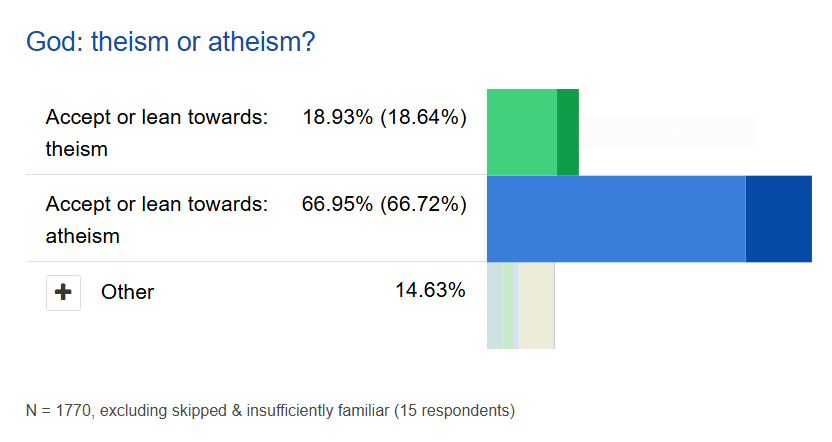
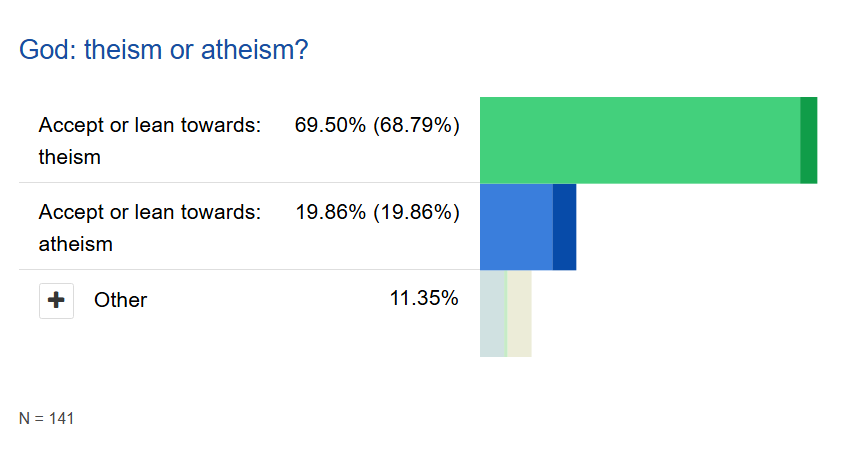
Yet when it comes to moral realism, this flip doesn’t occur when you compare philosophers in general to specialists in metaethics.
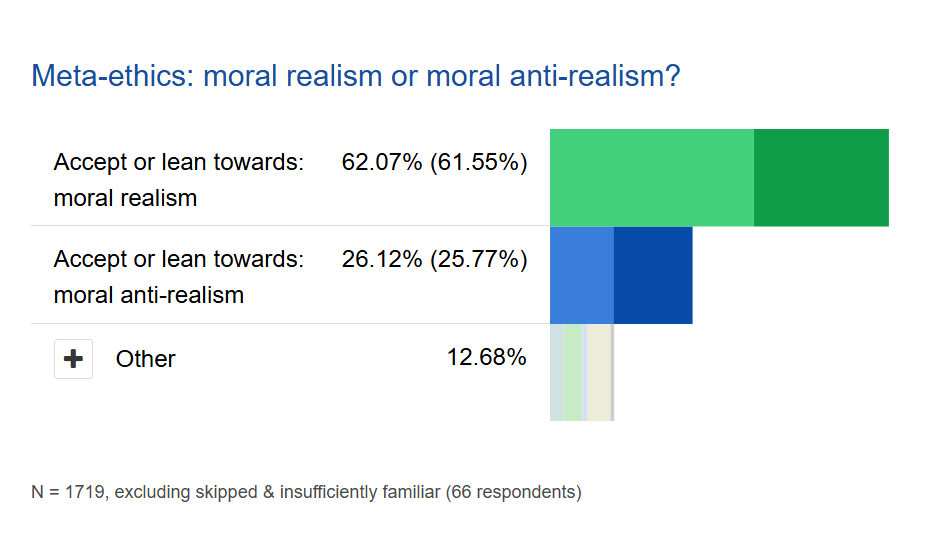
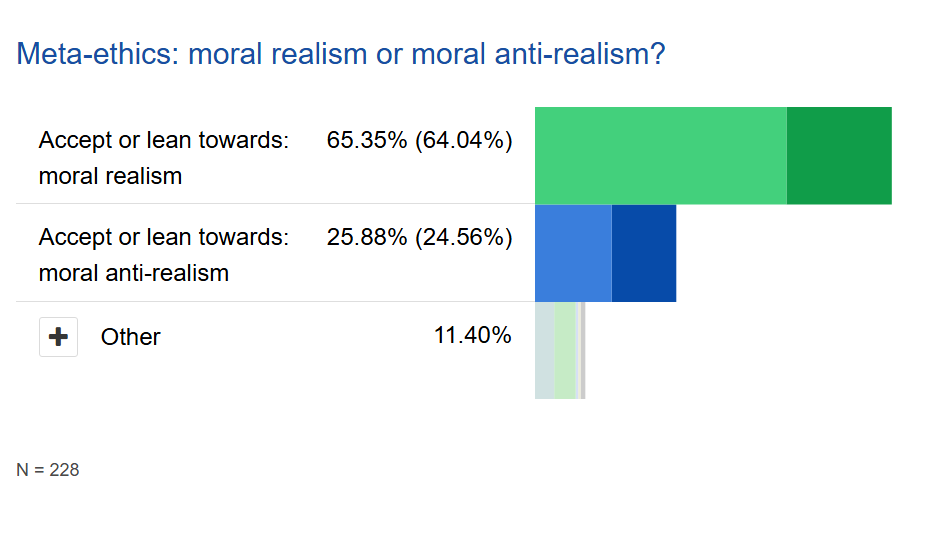
Josh wonders why this flip occurs for theism, but not moral realism. While I can speculate, I don’t know why. I think this is a genuine and peculiar puzzle and I don’t have a good explanation for it.
A key consideration is selection effects. Selection effects occur whenever an observed measure or difference between measures intended to represent a given population is a result of a systematic tendency for members of the sample to consist of an unrepresentative subset of that population. For instance, if you were conducting a study on criminal behavior, people who have committed crimes may be less likely to volunteer to participate in the study. As a result, your sample may consist of a disproportionate number of law-abiding citizens relative to the population. And, of course, if you’re recruiting from the local population, some people may be unavailable because they are currently incarcerated. It seems intuitive to me that people in prison are more likely to be criminals than people who are not in prison.
One explanation for why philosophers of religion are more likely to be theists is that theists are more likely to study philosophy of religion. In fact, Adriano Mannino looked into the matter and found that selection effects not only accounted for the asymmetry in theism between specialists and non-specialists, but also that there is some indication that studying philosophy of religion actually caused more theists to become atheists than vice versa. Mannino points to a study from Helen De Cruz that investigated how the beliefs of philosophers of religion changed over time. The rate of revision to atheism/agnosticism was greater (11.8%) than the rate of revision to theism (8.1%). These aren’t titanic numbers nor a titanic difference, and they hardly settle the matter definitively, but these findings illustrate an important point: the raw proportion of philosophers that endorse a given view can be highly misleading.
Suppose that 95% of the population is inclined towards moral realism. And suppose philosophers are recruited at random from the population. This would mean that about 95% of people who begin studying philosophy are inclined towards moral realism. We then discover that the proportion of professional philosophers who endorse moral realism is about 62%. This would mean that the proportion who went from moral realists to moral antirealists must be much greater than the proportion who went from being antirealists to realists.
If this were the case, it would make very little sense to point to the fact that most philosophers are moral realists as evidence that moral realism is the most defensible view within academic philosophy. It would instead look like there’s a massive preexisting bias in favor of moral realism and that studying philosophy partially mitigates it. It would also be better evidence that the weight of philosophical argumentation favors antirealism over realism, at least insofar as many more people are won over by the case for antirealism from studying philosophy than vice versa.
This is why it’s important to stress the direction of belief change resulting from studying philosophy, and not just the raw numbers. Now, 95% is just a made up number. I don’t actually think 95% of nonphilosophers are moral realists. But ironically, it is moral realists themselves who routinely insist realism is extremely intuitive or obvious or the default position. What’s their explanation for why so many philosophers apparently reject realism and even become antirealists after studying philosophy in spite of this fact? 62% is hardly the ringing endorsement you’d expect of a position that’s so “obvious.” These considerations are worth noting in light of the post Josh was responding to:
If moral realism is clearly not true, why do over 60 percent of professional philosophers accept or lean towards it?
That’s not to say therefore the view is true, it could well be wrong, but if it were obviously false I don’t think it would be this big a divide.
The implication seems to be that the fact that over 60% of philosophers accept or lean towards moral reason poses a problem to those of us who think moral realism is clearly not true.
It doesn’t. Moral realism is clearly not true. And it is also clearly true that over 60% of philosophers got this one wrong. This says more about how wrong so many philosophers can be than it says about how confident we should be as antirealists.
People should not be intimidated by the proportion of philosophers that endorse a position. Philosophers don’t have a clear, well-developed set of methods, they remain divided on numerous issues, and ongoing contention in the field may have as much to do with current fashions and selection effects than with the quality of arguments.
2.0 More accessible
Others have weighed in on the question. Maverick Christian proposes:
I think because moral realism is (typically) more directly accessible by intuition; e.g., it just seems obvious to some people that it's wrong to torture infants. It's harder to come up with a good argument for moral realism for folks who don't already have such moral intuitions.
In contrast, God's existence isn't as immediately obvious and it's a subject matter that seems far more susceptible to arguments and evidence; e.g., psychophysical harmony and moral knowledge.
I think there’s some truth to this. The move to moral realism is more immediate than the case one typically makes for the existence of God or for other philosophical positions. I also agree that it’s hard to come up with a good argument for moral realism for people who don’t have moral intuitions. I part ways with Maverick, however, in that I don’t think anyone has moral intuitions because I don’t think philosophical intuitions are a genuine psychological phenomenon.
3.0 Lance is no expert!
Where things took an unfortunate turn is when I came up:
I doubt you and Lance Bush would agree about much but I believe he's dug into the numbers and argues that it's pretty split once one account non-natural moral realism, natural moral realism, and anti-realism.

I appreciate Gabriel referencing me and drawing attention to my previous remarks on the matter, but this remark is vulnerable to misinterpretation and, unfortunately, I think this is exactly what happened. Gabriel’s remark makes it seem like I was claiming that once you subdivide things the proportion of moral realists is no longer a majority and that it’s closer to a split. But I’ve never said this. You can see what I’ve written about this in an article titled “The moral realist/antirealist dispute is more like rock paper scissors than a dichotomy.” Here’s the relevant portion:
All major metaethical positions are “contentious,” and none commands a substantial majority of assent among philosophers. Even if you collapse naturalist and non-naturalist realists together, you only get 62% of philosophers. That’s nothing close to an established consensus. But I’m puzzled as to how Goff goes about deciding who “needs” to argue for their positions: Do you need to argue for a position if more than 50% of philosophers would disagree? If so, why?
And what level of abstraction is necessary? The arguments for non-naturalist realism and naturalist realism are not the same as one another, nor are the positions, themselves, the same. While 62% of philosophers endorse moral realism, this is an extremely misleading figure. The 2020 PhilPapers survey also includes a question that provides more specific information about the metaethical views of respondents:
As you can see, no position comes anywhere close to exceeding 50%. Non-naturalist realists make up 26.6%. The other survey question about realism vs. antirealism found that 26.1% of philosophers endorse moral antirealism. Then we have about 31.6% that endorse naturalism. Why lump naturalism and non-naturalism in together? Naturalists share many affinities with antirealists, in that naturalists tend to reject much of what antirealists find objectionable about realism, e.g., irreducible normativity and the like. 62% is a misleading and artificial figure. One could add up antirealists and naturalists, call the collective positions “Anti-Moorean,” and argue that non-naturalist views are “contentious,” noting, ironically, that there’s almost exactly as many non-naturalist realist respondents as there are antirealists. In light of this, perhaps we should insist that non-naturalist realism is a similarly contentious position and that people therefore need to argue for it!
For what it’s worth, if we consider constructivism, expressivism, and error theory to all technically be a form of antirealism, then even if some of the respondents to the direct realism/antirealism question may have eschewed the “antirealist” label, it may, in fact, be the case that some form of antirealism is the most common response if one divides responses into naturalist realism, non-naturalist realism, and some form of antirealism. The weird lumping together of naturalism and non-naturalism as some super-bloc is leveraged by realists to depict antirealism as some kind of weird minority position. It isn’t. The actual situation is far closer to rock paper scissors.
I don’t claim here that moral realists are not in the majority. I generally just collapse the accept/lean distinction in the data and acknowledge that moral realists are in the majority. What I am arguing isn’t that they aren’t the majority, but that the realism/antirealism divide isn’t the best way to carve up the position space of possible positions. There are other ways of dividing up the position space that are at least equally defensible. Here are two other possibilities:
1. Non-naturalist realists & antirealists vs. naturalist realists
Distinguish everyone who maintains that moral truths must have normative authority or force in a way that isn’t available to natural facts. As a non-negotiable requirement, some will hold that such facts exist, and others will hold that since no such facts exist, moral realism is false. This would place all non-naturalist realists and many antirealists on the same side, while naturalists and some antirealists would be on the other side. This would be similar to the incompatibilist/compatibilist dichotomy in free will, where free will skeptics and libertarians are on the same side, and compatibilists are on the other.
2. Naturalist realists & antirealists vs. non-naturalist realists
Distinguish everyone who maintains that whatever morality is, it can’t involve non-natural moral truths. This would place naturalists and moral antirealists on the same side, and non-naturalists on the other side.
The realism/antirealism divide is largely incidental and arguably an artifact of the fact that 20th century metaethics focused so much on semantics. Naturalist and non-naturalist realists share similar views about the semantics of moral claims. Both are cognitivists, and both hold that moral claims purport to describe stance-independent moral truths. But the kinds of truths they think exist are very different from one another.
Incidentally, Huemer favors something very similar to (2) above. In Ethical Intuitionism he explicitly argues that the dividing lines would make more sense if it were the non-naturalist moral realists vs. everyone else. I agree with Huemer.
Another point worth emphasizing is that the PhilPapers survey includes both those who accept a position and those who lean towards a position. This is typically collapsed, but they can be disaggregated. When you do this, this is what you get:
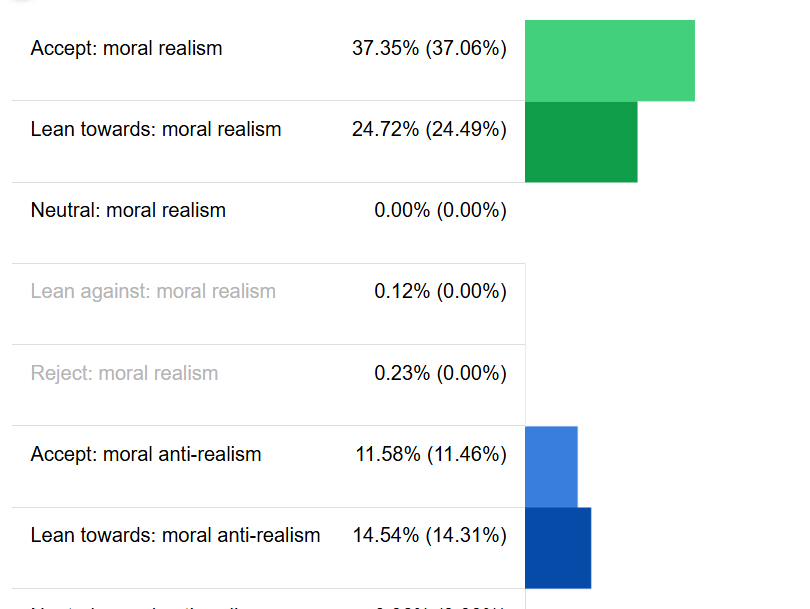
Only 37.35% of philosophers accept moral realism. Personally, I take this to be a bit of a technicality, but it’s still, well, technically true. Discourse covers this here, though it now appears to be behind a paywall.
Thomas Metcalf appears to have interpreted Gabriel to be saying that I claimed realists were not in the majority:
Nope. Among metaethicists, non-naturalist realism is comfortably ahead, at 36%. Naturalist realism is at 30% and the clearly anti-realist disjunction sums to 22%:
https://survey2020.philpeople.org/survey/results/5078?aos=28
Philosophers in general more-strongly reject anti-realism.

Everything Thomas Metcalf says here is true. The PhilPapers survey has two metaethics questions on moral realism. One distinguishes realists from antirealists. The other focuses on the specific position philosophers endorse. You can find results for that second question here. However, there’s a big problem with Thomas’s response. Thomas focuses specifically on the views of specialists in metaethics. Gabriel’s remark about it being split never clarified whether he was referring to philosophers in general or to specialists in metaethics. If you see my original article, you’ll see that I was discussing proportions among total respondents, not specialists. For instance, here’s the results I displayed there:

…as you can see at the bottom, the N = 1024 refers to all respondents, not specialists in metaethics. Thomas appears to have misunderstood Gabriel on two fronts: first, Gabriel’s remarks were interpreted such that I was taken to be denying realists comprise a majority of respondents. Second, Thomas focuses specifically on specialists, even though I wasn’t commenting on that proportion and Gabriel didn’t explicitly mention it. To be fair, neither of these mistakes is Thomas’s fault, for the most part. Gabriel’s remarks are unhelpfully vague, both with respect to what I was claiming and whether Gabriel was referring to philosophers in general or to specialists.
If you filter by specialists in metaethics, you get these results:
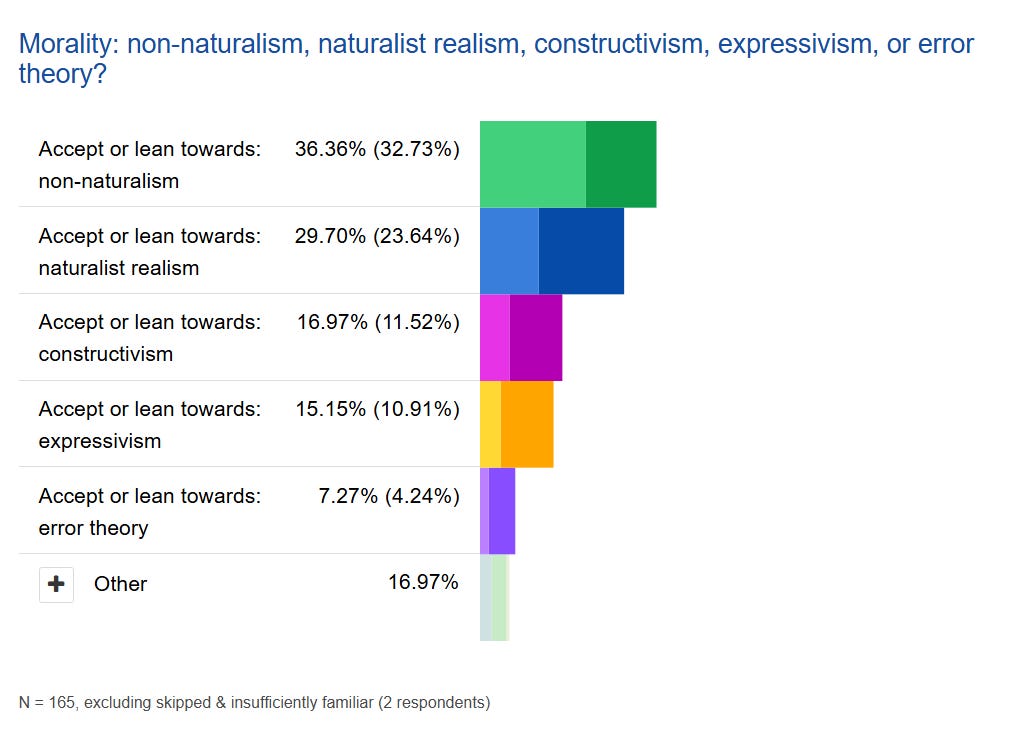
We’ll ignore the accept/lean distinction and simply add up everyone who is clearly a realist and everyone who is clearly an antirealist. “Clearly” here is important: it excludes constructivists, who are difficult to classify. We can then add up expressivists and error theorists as those who “clearly” endorse antirealism, and we get these results:
Non-naturalist realists: 36.4%
Naturalist realists: 29.7%
Antirealists: 22.4%
Realists are in the clear majority among specialists in metaethics, and both non-naturalist realists and naturalist realists by themselves have more proponents than antirealism. Even if we included all constructivists among antirealists, we’d get only 39.4%, which is higher than naturalist or non-naturalist realism alone, but not even close to being higher than both together. And it wouldn’t be reasonable to include all constructivists; 26.1% of philosophers chose “antirealist” to the question that focused on the realism/antirealism divide. Constructivists are likely to fall on both sides of that dividing line.
Gabriel responded to Thomas:
Less than a 1/3 buy into non-naturalist realism with it only being ahead of antirealism by only 8%. Naturalists have a lot of the same issues with non-naturalists as anti-realists. Bush argues a descriptive thesis is closer to their view with no serious metaphysical baggage.
I’m not quite sure what data Gabriel is referring to. Perhaps he’s referring to philosophers in general rather than specialists. Among philosophers in general we get:
Non-naturalist realists: 26.6%
Naturalist realists: 31.6%
Antirealists: 15.9%
I’m not sure where the 8% is coming from, though, so this may not be the divide Gabriel is referring to. All of this is unfortunate, because Thomas responds:
What survey results are you reading? I don’t know of any that present the findings you claim exist. More generally, in my experience, Bush doesn’t really understand metaethics very well compared to experts.
I can’t find the findings Gabriel is referring to either. But it’s the second comment that stands out to me:
More generally, in my experience, Bush doesn’t really understand metaethics very well compared to experts.
I doubt Thomas has much experience with me. This remark also implies I’m not an expert, which I’d dispute. Either way, in this case Thomas may be basing at least part of his assessment off of Gabriel’s remarks, rather than my own. This is ironic, given that as you can see above I agree with Thomas.
To my knowledge, I had one exchange with Thomas. I believe it was on Facebook. Thomas kept replying that I was “misinterpreting” him. I didn’t think I was, and if I was, I think it was probably his fault for not being very clear. Either way, I found him opaque, annoying, and difficult to speak to. I did not have a positive impression of Thomas. Apparently he didn’t have a positive impression of me.
That’s unfortunate, but perhaps we can try to reach an accord. I’ll be posting this and reaching out to Thomas to see if he’d like to have a conversation.
Someone else came to my defense with this remark:
If we're treating constructivism as antirealist (not sure what the language used in the survey was), it's 22.42% + 16.97% = 39.39%.
Lance *is* an expert, he is published in and teaches metaethics. He has written a series on the Philpapers survey here:

That’s a good series from me, so go check it out. Also, thanks Watchdominion!
As you can see above, these numbers do add up. Watchdominion is correct. If you treat constructivists as antirealists, that’s the number you get. You may also recall I make a similar remark in the longer quote from my earlier article:
For what it’s worth, if we consider constructivism, expressivism, and error theory to all technically be a form of antirealism, then even if some of the respondents to the direct realism/antirealism question may have eschewed the “antirealist” label, it may, in fact, be the case that some form of antirealism is the most common response if one divides responses into naturalist realism, non-naturalist realism, and some form of antirealism.
Note all the qualifications here: if we include constructivism, and if we split up naturalists and non-naturalists, then antirealism comes out on top. Which is true. But there’s a reason I excluded constructivism from the official antirealism tally, and presented this as a conditional: it’s not easy to classify as clearly realist or antirealist. I would generally exclude it…just like Thomas did. If my way of classifying things is an indication that I don’t have a good understanding of metaethics, this would apparently indicate Thomas doesn’t, either. Watchdominion likewise included the conditional “if,” so we’re on the same page.
I also agree with watchdominion that it’d be reasonable to consider me to be an expert in this area. While I don’t have as many publications in prestigious philosophy journals as more prominent and established figures, this isn’t necessary to be an expert. One’s knowledge and competence are all that’s required. This is why I was disappointed to see this response from Thomas:
But it's not correct to simply treat constructivism as anti-realist.
In any case, Bush doesn't seem to have any articles in important philosophy journals, and in my experience from personal correspondence, doesn't really deeply understand these debates.
I agree with Thomas that it’s not correct to simply treat constructivism as an antirealist position. My public remarks on the matter are that constructivism is difficult to classify, straddles the line, and may fall on one or the other side depending on the form of constructivism in question; generally speaking though, many constructivist accounts do qualify as antirealism and if I had to pick one side to put it on, it’d probably be the antirealist side. The issue with this, though, is that it’s not entirely up to me to resolve such matters, self-identification is the only apparent standard the PhilPapers survey was using, and they didn’t offer an explicit definition of “moral realism” or other concepts to my knowledge in the first place. Given this, categorization of constructivists remains a legitimately tricky matter and not something I am or have been dogmatic about.
Regarding Thomas’s second remark:
In any case, Bush doesn’t seem to have any articles in important philosophy journals, and in my experience from personal correspondence, doesn’t really deeply understand these debates.
I can’t really argue with the first part of that. I wouldn’t say I have any articles in what are generally regarded as prestigious philosophy journals, though I am quite happy with the journals I have published in. However, what is Thomas’s point? Are you only an expert if you publish in these journals? This seems like a weird bit of indirect gatekeeping.
Regarding “personal correspondence,” I already addressed that above. We had an exchange where I thought Thomas was unclear and annoying. It was relatively brief and certainly not enough for him to form much of an impression about whether I “deeply understand these debates.” The exchange continued after this:
Gabriel
But it’s also not correct to not simply treat the descriptive thesis like non-natural moral realism. I don’t think you have a very good understanding of Bush it sounds like regardless of your disagreements.
Thomas
I’m not treating naturalist moral realism like non-natural except that I’m counting it as a form of realism. Do you think that’s a mistake?
Gabriel
I think labeling both things realism doesn’t recognize them as substantially different theses. There is a reason it’s often called quasi-realism. It’s the same label for two different things.
I agree with Gabriel. I don’t think Thomas does have a very good understanding of my views or of the point Gabriel is making. And I of course agree that naturalist realism and non-naturalist realism are so qualitatively different it is misleading to lump them together and center philosophical disputes around realism vs. antirealism. At the same time, I agree with Thomas that naturalist and non-naturalist realism are both forms of moral realism. I’m not sure I understand Gabriel’s remark about quasi-realism though, as that’s a conjunction of several theses that fuses expressivism with deflationary views of truth and some other components into a strange cocktail that emerged from the antirealist camp but is now brushing up against the line between realists and antirealists so much so that it, too, is becoming hard to cleanly classify.
I want to thank Gabriel and Watchdominion for mentioning me and defending my views, though I do think Gabriel could be a bit more precise in conveying my ideas. I also want to thank Thomas for restraint in the critical remarks about me. I don’t agree with them, but they’re not vitriolic or overtly nasty.
4.0 An invitation
I’d be happy to speak to any or all of the people involved in this discussion. Gabriel and watchdominion: I’m not familiar with either of you, but you’re welcome to reach out and have a chat if you’d like. However, I’m especially interested in taking another shot at discussing metaethics with Thomas Metcalf.
Thomas, if you’re seeing this, reach out! I’d like to talk to you. We clearly didn’t make a good impression on each in our first encounter, but the internet often brings out the worst in us (or at least me!). I’d like the academic spaces we occupy to be ecumenical rather than adversarial. I think a talk on video where we can interact live would be more profitable and less likely to devolve into something unpleasant. I’m easy to contact, but I may reach out to you first.