


(Note: I’ll be using moral objectivism and moral realism interchangeably here, though it’s worth flagging that not everyone does so.)
Just yesterday, Joel Carini published a blog post titled “Most Philosophers Believe in Objective Morality”. Go check it out. What follows is not intended as a critique or rebuttal. I will make a few critical remarks, but this is mostly intended simply as a commentary. Overall, I think Carini’s piece is quite fair and does a great job in how it handles moral antirealists, and for that I am grateful. It’s always good to see an article that doesn’t treat antirealists as gibbering goblins skulking in sewers.
In any case, the first thing to note is that there’s already a great article that claims the opposite, helpfully titled “No, Most Philosophers Aren’t Moral Realists” which you can find here. This second article might seem like a response to the first, but it isn’t. It actually came out back in December of last year. Both articles center on the 2020 PhilPapers survey results. This was a large international survey that served primarily to catalog the philosophical positions of contemporary academic philosophers, mostly in the analytic tradition. Both articles center on this finding:
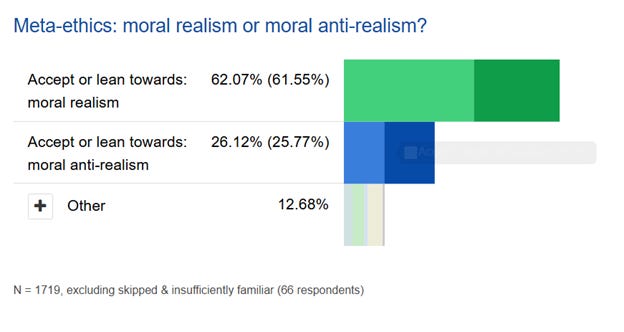
Approximately 62% of philosophers endorse moral realism, 26% reject it, and 13% chose some other response. According to Carini, these results indicate that most philosophers believe that morality is objective. This might be true, but it’s not clear from this data that, technically speaking, it is true. This is because, as Discourse points out, the measures presented here collapse “Accept” and “Lean” into a single aggregate score. If you hover over the darker and lighter bars seen above, you can see the breakdown of each as so:
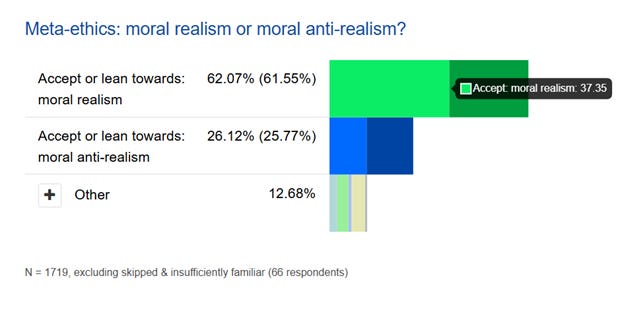
A more precise breakdown that separates Accept and Lean yields these results:
Accept moral realism: 37.35%
Lean towards moral realism: 24.72%
Accept moral antirealism: 11.58%
Lean towards moral antirealism: 14.54%
Other: 12.68% (I won’t bother subdividing this one)
That people lean towards a position does not mean they “believe” the position, so it is not clear that most philosophers “believe in objective morality.” They might, depending on whether, back to the wall, enough of those in the 24.72% of “lean towards moral realism (and perhaps some of those in the “Other” category) would affirm that they “believe” in moral objectivity/moral realism. However, “believe” is close enough to “accept” that this strikes me as a bit of a stretch. It’d be a bit odd if a huge proportion of those who said they “leaned” towards the position instead of choosing “accept” would choose “believe” if given the opportunity. And to lean towards a view is not the same thing as endorsing, believing, or accepting the view, so it may be most appropriate to conclude that it is not, in fact, the case that most philosophers are moral realists, where this is understood to mean “believing” moral realism. On the other hand, when you offer people the choice of “accept” or “lean,” “lean” may just be the softer way of expressing a low level of belief, or belief with less confidence. It’s hard to know. Discourse puts this a bit more firmly than I would, but the point is still a good one:
Merely leaning toward a position is importantly different from accepting it. Someone who merely leans toward moral realism is not, strictly speaking, a moral realist.
So, technically speaking, the claim that most philosophers are moral realists may not be correct. Where I differ from Discourse (but who knows, maybe they’d concede the point) is that I think survey options can push people to choose a response that may have a particular technical meaning (I lean this way, but don’t believe it) but they instead choose it for some other reason (I believe this, but not so strongly as to say “accept” when “lean” is an option). Nonetheless, it’s still true that more philosophers are at least sympathetic towards moral realism than they are towards moral antirealism.
Let’s have a look at what else Carini says:
Most people assume that academic philosophers, the people professionally tasked to think hardest about ethics, tend toward moral relativism: Serious, rigorous, scientifically-minded inquiry dissolves moral objectivity rather than supporting it.
To my knowledge, there is no empirical data on what most people assume about academic philosophers, so I don’t know if it is, in fact, true that most people assume academic philosophers tend towards moral relativism. It wouldn’t surprise me if they did, but this does strike me as rather speculative. If I had to wager, I’d bet that most people don’t have any position at all on what most academic philosophers think about metaethics, since most people don’t have a clue what moral relativism, moral realism, and other candidate positions actually are, or at best have a rudimentary and flawed understanding of these positions and how they relate to each other.
Another puzzling inclusion is the added remark that “Serious, rigorous, scientifically-minded inquiry dissolves moral objectivity rather than supporting it.” Do most people think of philosophers as engaging in scientifically-minded inquiry? I don’t think this, and I don’t know if laypeople generally think of philosophers as taking a “scientific-minded” approach. There’s a good chance they don’t think this, or even think the opposite.
Carini also says:
The people who have thought most carefully about whether morality is objective have mostly concluded that it is.
This remark might give readers the impression that the respondents have all thought about the arguments for and against moral realism carefully. But we have no good evidence this is true, nor any particularly good reasons to believe it’s true. Most of the respondents don’t specialize in metaethics (about ~13% reported specialization in metaethics, so a solid 87% are non-specialists). Academic philosophers increasingly specialize very narrowly. Since a large majority don’t specialize in metaethics, there’s a good chance a majority of the respondents lack a deep understanding of metaethics and haven’t thought about it that carefully. Mileage will vary from one philosopher to another. Just consider: 70% of philosophers are atheists. Should we conclude that they’ve all thought deeply about whether God exists or not, and arrived at this conclusion on the basis of a deep familiarity with philosophy of religion? I wouldn’t bet on it. And it’s not like substantive metaethics training is standard. Sure, you get exposed to it, but I never took or even saw a course in metaethics as an undergraduate or even a graduate student. I am sure they exist, but it’s not clear to me that they’re especially prevalent, much less a standardized part of analytic curriculum. Exposure may emerge obliquely in other courses, such as ethics courses, where professors themselves may not specialize in the topic or present much in the way of focused, specialized training in metaethics in particular. I’m really not sure; it would take another study just to figure out how much exposure philosophers generally have to metaethics and how competent they are.
However, it’s worth noting that the number of moral realists goes up slightly if you focus only on the subset of philosophers who specialize in metaethics to 65.35%. So, among those who presumably have, in fact, thought about the issue most carefully, about two thirds accept or lean towards moral realism. However, the claim that most have “concluded” that it is might give the impression that something like this has occurred:
Those who carefully studied the case for and against moral realism tend to conclude that moral realism is true as a result of this study. In other words, one might have the impression that these results show that studying philosophy causes most people to become moral realists.
To be clear, Carini does not make this claim. I am drawing attention to a possible interpretation or inference one might make on the basis of the claim. And such an interpretation would be highly questionable. First, there is the problem of selection effects. People who become professional philosophers may be disproportionately likely to favor moral realism compared to people who do not become professional philosophers. I discuss the problem of selection effects in detail here. Here’s the short version:
70% of philosophers endorse atheism, while only 19% endorse theism. But if you look at specialists in philosophy of religion, this flips: 70% endorse theism, while only 20% are atheists. Does this mean studying philosophy of religion turns people into theists?
No. This study found that philosophers are more likely to become atheists or agnostics once they begin studying philosophy of religion:
These numbers show that there was an overall shift toward atheism/agnosticism of 3.7% if we compare both directions of belief-revision: the direction of belief-revision was most frequently in the direction of atheism/agnosticism.
People disposed towards theism are more likely to study philosophy of religion, leading to a higher self-selected total proportion of theists among specialists in philosophy of religion. However, more of those who begin these studies become atheists than those who start as atheists become theists. The base rate of theists and atheists could be taken to give the misleading impression that if you study philosophy of religion, you will be convinced by the case for theism to become a theist. But there is no good evidence this is the case; it might even go the other way.
Both philosophers in general and metaethicists in particular tend to favor moral realism. How might we explain this? I suspect the answer may be that people who become philosophers are more disposed towards moral realism than people who choose not to become philosophers. Many more academics specialize in other topics than in philosophy. I’d be willing to bet people in the humanities more generally are more disposed towards moral antirealism, and that the same is true of those in STEM fields. What I mean is that the kinds of people who pursue these other fields may be naturally more disposed towards antirealism than people who study philosophy. If so, philosophy may attract people disproportionately disposed towards moral realism, in which case the 62% majority wouldn’t mean much, and certainly wouldn’t be a good reason to think moral realism is more likely to be true.
But let us suppose, instead, that the base rate of people drawn towards moral realism is so high in the population that most people are naturally inclined towards moral realism. Suppose it is, say, 95% of the population. If this is the case, this is even worse news. It would mean that if philosophers represent this population at the outset of studying philosophy (a starting rate of 95% moral realists), that somehow, as a result of studying philosophy, that rate drops to 62%. This would indicate studying philosophy is much more likely to convert moral realists into moral antirealists than vice versa. This is why a simple majority in favor of realism isn’t that relevant. What’s relevant is whether studying philosophy causes people to become moral realists, and the 2020 PhilPapers survey has no data to support this claim. For what it’s worth: I bet studying analytic philosophy currently does cause people to become moral realists, but I think this is an indictment of the poor state of the field and not an indication moral realism is true.
Carini continues with a discussion of moral realism:
Moral realism wasn’t always the default assumption in academic philosophy. For much of the twentieth century, under the influence of logical positivism, moral claims were widely treated as expressions of attitude or preference rather than genuine truths.
There are a lot of anecdotal accounts suggesting moral antirealism was the dominant view for much of the 20th century, but I believe it was Mike Huemer that made the point that this could be misleading. We don’t have survey data from the 20th century, and it may be that moral realism remained a majority stance but that moral realists kept quiet about their views. Carini helpfully makes a nod towards this possibility:
If any mid-century analytic philosophers were moral realists, they were embarrassed to admit it.
If I had to wager, I’d bet some of this was going on, and that some of it is just spin or narrative from people in the field. Antirealism may have been more prominent in academic publication even if it didn’t command the assent of most philosophers.
Carini goes on to outline a number of realist traditions, before concluding that:
Philosophers working from very different starting points, with very different tools, keep arriving at the same basic conviction: that ethics is a domain of genuine truth, not preference. That convergence is itself evidence worth taking seriously.
I don’t think this is evidence worth taking very seriously. There are many reasons to suspect that the proportion of philosophers who endorse a given view is not, by itself, good evidence for the view. I outline those reasons in this series on what I call the PhilPapers Fallacy. We don’t know the causal impact studying philosophy has on the degree to which philosophers endorse moral realism, we don’t know how strong the selection effects are for peopled disposed to endorse moral realism, we don’t know what sociological or other forces may be driving these changes, and we don’t know by the numbers alone whether philosophers are endorsing moral realism for good reasons.
I suspect a better account of the prevalence of these traditions, and of the increasing popularity of moral realism, is a host of sociological and institutional forces causing an uptick in people disposed towards moral realism doing philosophy, along with bandwagon effects whereby the prominence and success of such people attracts like-minded people and drives away those who hold views to the contrary.
I think the winds of fashion are driving these changes, not advances in the strength and quality of arguments for moral realism. In short, I don’t think new philosophical work is persuading people to become moral realists because the arguments are good; I think people who are disposed towards moral realism are increasingly likely to become and continue working as professional philosophers. Do I have evidence of this? No. But then again, anyone inclined to suggest good arguments are causing the rise in moral realism isn’t exactly furnishing us with data for that claim. And, in any case, there are no good arguments for moral realism.
Lance, thanks for reading my work and engaging! I have to say, this was my first time writing about the academic culture of philosophy itself, and I took the empirical claim as a point from which to launch off into first order philosophical survey. I didn’t consider diving into the details of the empirical claim about philosophers itself in further detail.
I’m intrigued that you have this whole series on the philpapers survey, and the implications we take from it. Looking forward to digging in further.
As far as my sense of what the general population out there thinks, you may be right, but I conceived of myself as thinking of the non-specialists who are interested in philosophy on the Internet, who tend to clump into Niwtzschean atheists and Dostoevskian theists - both thinking that if there is no God, then there is no morality.
Perhaps my essential point was simply this: that most mainstream analytic metaethics does not take this for granted, and that there is reason to break free from that kind of assumption. Looks like you are opposed to moral realism, but I believe there are some good arguments, though it hasn’t been the area I specialized in. I incline toward making the argument in Claire Kirwin’s way: https://elucidations.vercel.app/posts/episode-134/
"People disposed towards theism are more likely to study philosophy of religion, leading to a higher self-selected total proportion of theists among specialists in philosophy of religion."
Could a similar thing be said about people disposed toward anthropogenic climate change? They are more likely to become climate scientists than people who think the Earth's climate will take care of itself; climate change has happened before without human involvement. This leads to a higher self-selected total proportion of proponents of anthropogenic climate change among specialists in climate change?